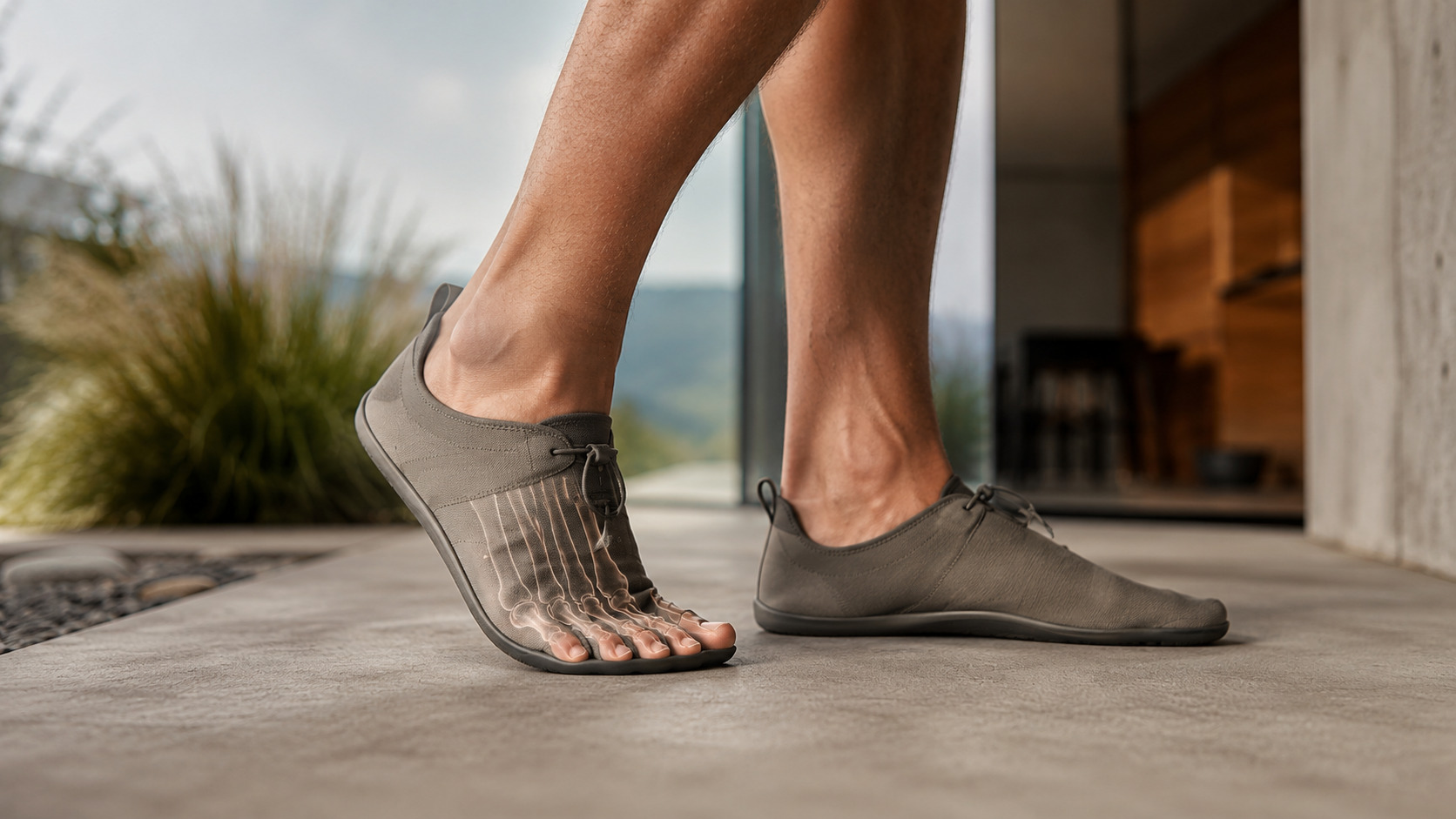
Somewhere in the last two years, barefoot shoes went from a niche running experiment to a mainstream wellness conviction.
They are on fitness influencers. They are in physical therapy waiting rooms. They are showing up in office buildings and hospital corridors and airport terminals worn by people who have never run a race in their lives.
The claims travel fast. Stronger feet. Better posture. Natural movement. A return to how humans were designed to walk before the shoe industry complicated everything.
Some of those claims are real. The research behind them is legitimate. And that is exactly what makes this conversation dangerous for a specific group of people - the ones the barefoot shoe marketing was never actually built for.
If your feet are healthy, structurally sound, and free of any diagnosed condition, this article will give you an honest picture of what barefoot shoes can and cannot do, and what a responsible transition looks like.
If your feet are not healthy - if you manage plantar fasciitis, flat feet, diabetic neuropathy, Achilles tendinitis, or any condition that already asks something of your footwear - this article is written for you specifically. Because the conversation happening loudly online right now is almost entirely about the first group. And most of the people searching the question are in the second.
What Barefoot Shoes Actually Are
Barefoot shoes are defined by four characteristics that separate them from every other category of footwear.
Zero or near-zero heel drop. Traditional running and walking shoes elevate the heel anywhere from 8 to 12 millimeters above the forefoot. Barefoot shoes flatten that completely. Your heel and your toes make contact with the ground at the same level, the way they would if you were standing on bare floor.
Thin, flexible soles. The midsole - the layer that provides cushioning and structure in a conventional shoe - is reduced to a minimum or removed entirely. The goal is ground feel. Every surface variation transmits directly to the foot.
Wide, anatomically shaped toe box. Barefoot shoes follow the natural spread of the foot rather than tapering toward a point. Toes are allowed to splay freely under load the way they would unshod.
No built-in arch support or motion control. This is the characteristic that matters most for people with foot conditions. There is no medial post. No stability structure. No corrective geometry. The shoe does not intervene in how your foot moves. That is the entire design philosophy - the foot is trusted to do the work itself.
That philosophy is internally consistent. It is also a significant ask of a foot that has spent years compensating, adapting, or managing a condition that requires external support to function without pain. Understanding what barefoot shoes remove is the starting point for understanding whether your feet are ready to work without it.
For more on what footwear characteristics actually mean for foot health, see our evaluation methodology.
What the Research Actually Says
The science behind barefoot shoes is not manufactured. It is real, it is peer-reviewed, and it is worth understanding before dismissing the trend or surrendering to it.
Studies on minimalist footwear consistently show measurable increases in intrinsic foot muscle strength after extended periods of barefoot or near-barefoot activity. The small muscles inside the foot - the ones responsible for arch control, toe stability, and dynamic balance - respond to the increased demand that comes from walking without structural support underneath them. Use them more, and they get stronger. That part is not marketing. That is basic physiology.
Proprioception improves too. Proprioception is your foot's ability to sense its position in space and communicate that information to the rest of your body in real time. Thick cushioned midsoles dampen that signal. Thinner soles amplify it. Better ground feel means faster neuromuscular response, which translates to improved balance and more efficient gait mechanics over time. Again - legitimate, documented, reproducible.
Here is what the research does not say. It does not say these benefits appear quickly. The studies showing meaningful foot muscle development measured participants over four to six months of gradual progressive exposure - not four to six weeks of wearing a new shoe to work. It does not say these benefits apply uniformly across all foot types. The populations studied were overwhelmingly healthy adults without pre-existing musculoskeletal conditions. And it does not say that removing support is safe for feet that currently depend on support to manage pain, inflammation, or structural compromise.
The science makes a strong case for barefoot shoes as a long-term investment in foot health for the right candidate. It makes no case at all for using them as a substitute for clinical footwear management when a condition is already present and already being managed by the structure in your shoe.
The Conditions Where Barefoot Shoes Are Actively Risky
For the following conditions, switching to barefoot shoes does not represent a neutral experiment. It represents the removal of the thing that is currently managing your pain. That distinction matters.
Plantar Fasciitis
Plantar fasciitis is an inflammation of the connective tissue that runs along the underside of the foot from heel to forefoot. It is load-sensitive. Every step that places unmanaged tension on that tissue is a step that slows recovery or worsens the condition. A structured shoe with heel cushioning and arch support reduces that tension mechanically with every stride. A barefoot shoe removes that reduction entirely and transfers the load directly to already-inflamed tissue. For active plantar fasciitis, barefoot shoes are not a minimalist alternative. They are a source of continued injury. Learn more about plantar fasciitis and the footwear characteristics that manage it.
Flat Feet and Overpronation
Flat feet collapse the arch inward with every step, creating a chain of mechanical stress that travels up through the ankle, knee, and hip. Stability and motion control shoes interrupt that chain at the foot level using medial post construction and structured midsole geometry. Barefoot shoes have none of that. On a flat foot, the absence of medial support does not free the foot to move naturally - it allows an already compromised structure to collapse further with every step, compounding the downstream effects that make flat feet painful in the first place. Understand what flat feet actually need from a shoe.
Diabetic Neuropathy
Diabetic neuropathy reduces or eliminates the foot's ability to feel pressure, friction, and injury. The feedback loop that tells a healthy foot something is wrong is damaged or absent. Barefoot shoes, with their thin soles and minimal upper structure, increase ground contact intensity and reduce the protective layer between the foot and every surface it contacts. A person with diabetic neuropathy cannot feel a pressure point developing into an ulcer. The shoe is the protection system when the nervous system cannot perform that role. Removing it is not a wellness choice. It is a clinical risk. See what diabetic feet require from footwear.
Achilles Tendinitis
The Achilles tendon connects the calf muscle to the heel bone and is placed under tension with every step. Heel drop - the elevation of the heel above the forefoot - directly reduces the stretch demand on the Achilles during the gait cycle. This is why shoes with a moderate heel drop are a standard conservative management tool for Achilles tendinitis. Zero drop barefoot shoes eliminate that elevation entirely, maximizing Achilles stretch with every single stride. For an already irritated or inflamed tendon, that increase in load is not strengthening. It is provocation. Read more about Achilles tendinitis and heel drop.
Metatarsalgia
Metatarsalgia is pain and inflammation across the ball of the foot, caused by excessive pressure on the metatarsal heads - the five bones that form the front of the foot's weight-bearing platform. Cushioned midsoles distribute that pressure across a wider surface area and reduce peak load at any single point. Barefoot shoes, with their thin flexible soles, do the opposite. Ground forces transmit directly and concentrate exactly where metatarsalgia is already most sensitive. The result is not adaptation. It is aggravation of an already overloaded structure. Understand metatarsalgia and the footwear features that reduce forefoot pressure.
Who Barefoot Shoes Are Actually Good For
Barefoot shoes are not the enemy of foot health. They are a specific tool for a specific foot in a specific situation. That situation exists and it is worth describing honestly.
If you have no active foot condition, no history of plantar fasciitis, no structural diagnosis, no neuropathy, and no chronic pain that your current footwear is managing - barefoot shoes may be one of the better long-term investments you can make in your foot health. The strengthening benefits are real. The proprioceptive gains are real. A foot that learns to support itself under load is a more resilient foot over time. The research supports that outcome for healthy feet that transition correctly.
The word correctly is doing significant work in that sentence. Transition is not a weekend. It is not two weeks of wearing a new shoe and waiting to see what happens. The studies that show genuine benefit measured gradual progressive exposure over months - starting with short duration, low intensity use and building incrementally as the intrinsic foot muscles adapt to their new workload. People who transition too fast do not get the benefits. They get the injuries. And those injuries - calf strain, Achilles overload, stress fractures in the metatarsals - are common enough that they have become a documented pattern in the minimalist footwear literature.
Not sure which category your feet fall into? The MySoleMatch quiz factors in your foot type, any conditions you are managing, your daily activity level, and what you are actually asking your shoes to do - and gives you a recommendation built around your specific situation rather than a trend.
The Transition Problem Nobody Talks About
The barefoot shoe conversation online is almost entirely about the destination. Stronger feet. Natural movement. Freedom from over-engineered footwear. What it rarely covers is what happens between where most people's feet are right now and that destination.
Most barefoot shoe injuries are not caused by the shoes being wrong. They are caused by the timeline being wrong. A foot that has spent years in structured, cushioned, supportive footwear has adapted to that environment. The intrinsic muscles have a reduced workload. The Achilles and calf complex have shortened to accommodate heel elevation. The plantar fascia has learned to operate with external arch support underneath it. Removing all of that at once - on day one of a new shoe - does not liberate those structures. It shocks them. Calf strain is the most common early injury. Achilles tendinitis is the most common reason people abandon the transition entirely. Metatarsal stress fractures are the most serious outcome and they happen more often than the marketing suggests.
The people who benefit from barefoot shoes are almost always the people who treated the transition as a training program rather than a shoe swap. Eight to twelve weeks minimum. Starting with an hour a day. Building weekly. Keeping their previous footwear in rotation throughout. If that timeline feels unrealistic for your life - for the shifts you work, the floors you stand on, the steps you log before noon - that is useful information about whether this is the right tool for your feet right now.
The MySoleMatch Bottom Line
Barefoot shoes are better for some feet. They are worse for others. That is not a hedge. It is the most useful thing this article can tell you.
The trend is real. The research behind it is legitimate. And neither of those things tells you anything about your feet specifically - what they are managing, what they need, and what happens when you remove the structure that is currently keeping your day functional.
The question was never whether barefoot shoes are better. The question is whether they are better for you. And that answer lives in your foot type, your conditions, your daily demands, and your willingness to treat a transition as the serious physical adjustment it actually is - not a purchase decision.
If you have a diagnosed condition, the answer is almost certainly not yet. Possibly not ever, depending on the condition. Get the condition managed first. Build the foot strength that barefoot shoes require before asking your feet to generate it from scratch under load.
If your feet are healthy and the idea genuinely interests you, do it right. Slow transition. Parallel footwear. Patience measured in months not days.
If you are not sure where your feet land - and most people are not - that is exactly the problem MySoleMatch was built to solve. Not to sell you a shoe. To help you understand your foot first so the shoe decision makes itself.