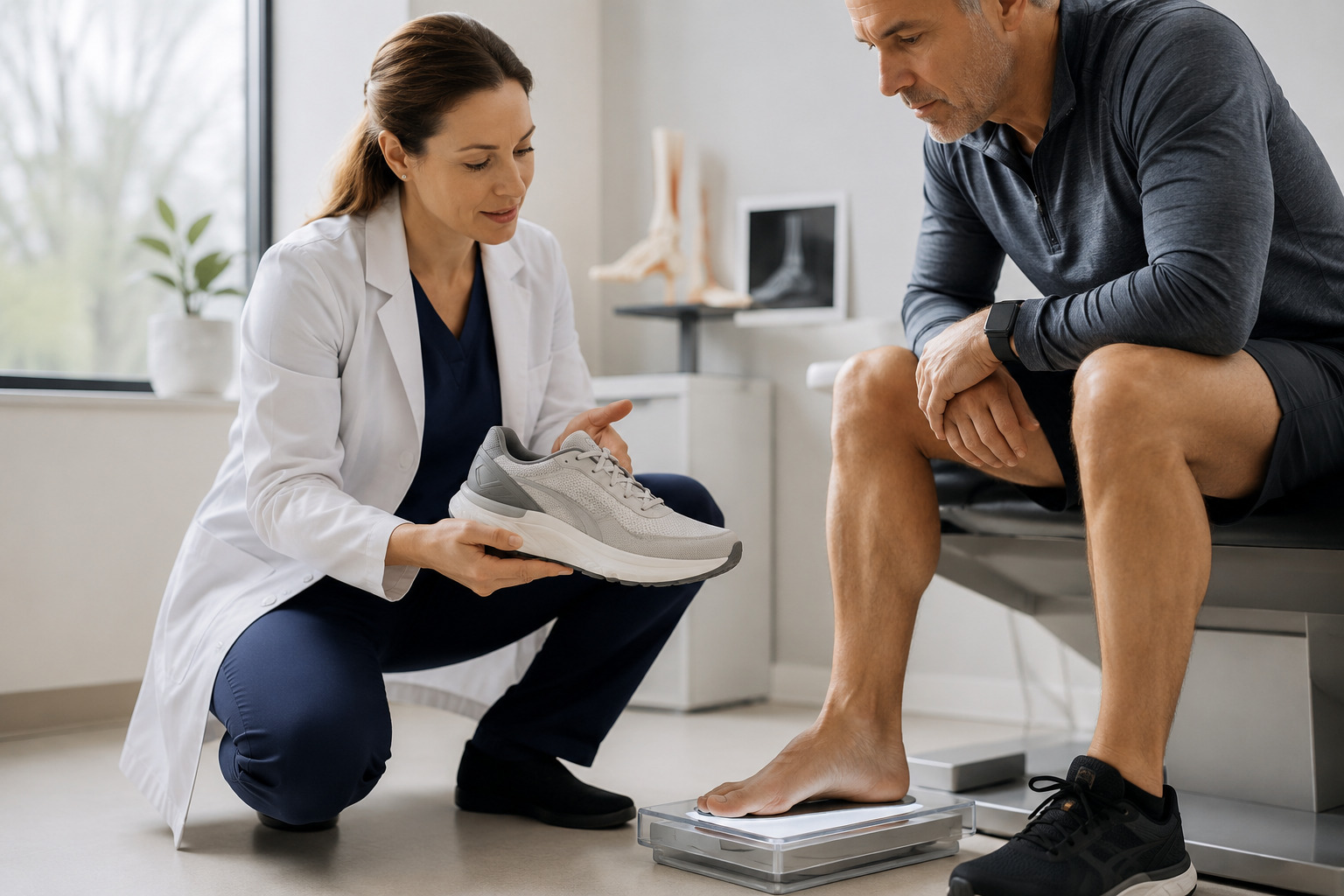
Here is how most people with a diagnosed foot condition buy shoes. They search the condition name plus the words best shoes. They find a ranked list. They buy the top result, or the one with the most reviews, or the one a friend mentioned. The shoe arrives. The pain continues. They conclude that footwear cannot help their condition.
That conclusion is wrong. But the shopping process that led to it was also wrong, in a specific way that is worth understanding before you spend another dollar.
Ranked lists of best shoes for a condition are built around popularity, affiliate revenue, and search volume. They are not built around the mechanical requirements of your foot. A shoe that appears on every plantar fasciitis list may be an excellent shoe for someone whose plantar fasciitis is driven by arch collapse and inadequate support. It may be the wrong shoe entirely for someone whose plantar fasciitis is driven by heel fat pad atrophy and insufficient cushioning. The condition name is the same. The mechanical requirement is different. The shoe that addresses one may actively fail the other.
Choosing a shoe for a diagnosed foot condition is not a search task. It is a decision process. And it starts not with brand names but with understanding what your condition is actually demanding from the structure of the shoe.
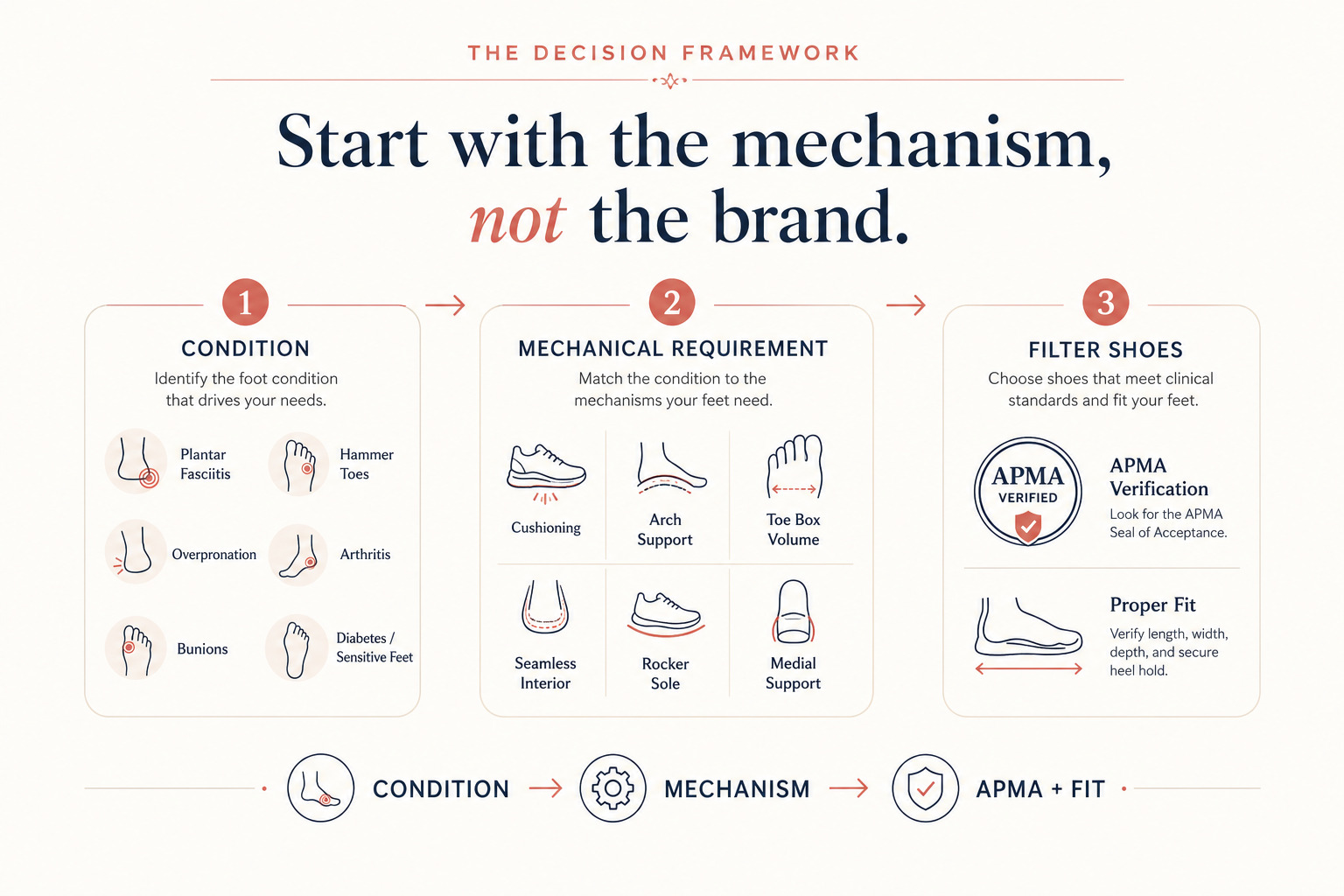
Start with the mechanism, not the brand.
Every foot condition creates a specific mechanical demand on the shoe. Identifying that demand first: cushioning, support geometry, toe box volume, internal seamlessness, is what makes the difference between a shoe that resolves symptoms and one that does not.
The Framework in One Sentence
Identify what your condition requires mechanically from a shoe, then find shoes that meet those requirements, then filter for APMA verification and fit. In that order. Not the reverse.
What follows is that framework applied to the six conditions that account for the overwhelming majority of condition-specific footwear questions. Each section covers what the condition demands, what disqualifies a shoe regardless of its reputation, and where to go for deeper guidance. Read only the section that applies to you.
Plantar Fasciitis
The plantar fascia is a thick band of connective tissue running from the heel to the ball of the foot. When it becomes inflamed from repetitive strain or excessive load, the characteristic result is sharp heel pain on the first steps of the morning, easing after a few minutes of walking, then returning after prolonged standing or activity.
What plantar fasciitis requires from a shoe is two things working together: heel cushioning that absorbs impact before it reaches the already-irritated insertion point, and arch support that reduces the tensile load on the fascia with every step. A shoe with maximum cushioning but no arch support transfers load reduction entirely to the heel. A shoe with firm arch support but inadequate heel cushioning addresses the load but not the impact. Both fall short. The condition requires both simultaneously.
A rocker sole geometry, where the sole curves upward at the toe and heel rather than lying flat, further reduces peak plantar fascia tension during push-off by allowing the foot to roll through the gait cycle without requiring full toe extension. This is why rocker-sole shoes appear consistently in podiatric plantar fasciitis management protocols.
What disqualifies a shoe: Zero drop construction, flat unsupported insoles, and any shoe that requires a break-in period before comfort improves. A correct shoe for plantar fasciitis is comfortable from the first wear. See APMA-verified plantar fasciitis recommendations.
Bunions
A bunion is a progressive angular deformity at the first metatarsophalangeal joint, where the big toe drifts toward the second toe and a bony prominence develops on the medial side of the forefoot. Footwear does not cause bunions in isolation, but it is the most significant environmental factor in how fast an existing bunion progresses and how much pain it produces day to day.
What bunions require from a shoe is forefoot volume, not just width. The distinction matters. A wide shoe provides more forefoot circumference but may still have a tapered toe box that pushes the big toe laterally and loads the joint. What the bunion joint needs is a shoe with a wide toe box that allows the toes to sit in their natural spread without the upper exerting any lateral pressure on the first metatarsophalangeal joint. The upper material at the bunion site should be soft and yielding, not structured or rigid, so that any contact with the prominence is cushioned rather than compressive.
A last built with a straight or anatomical shape rather than a tapered shape is the construction feature that determines whether the toe box actually delivers the volume the bunion needs. Brand width designations are a starting point. Last shape is the deciding factor.
What disqualifies a shoe: Pointed or tapered toe boxes, structured uppers with rigid material at the forefoot, and any shoe where the widest point of the upper does not align with the widest point of the foot. See APMA-verified bunion recommendations.
Flat Feet
Flat feet, clinically described as pes planus, describes an arch that collapses inward with each step rather than maintaining the structural curve that distributes load across the foot. The collapse is not limited to the arch. It creates a chain of compensatory mechanics that affects the ankle, knee, hip, and lower back. Footwear for flat feet addresses the mechanical root, not just the local symptom.
What flat feet require is medial post construction, a denser foam or structural component on the inner side of the midsole that resists inward collapse during the loading phase of the gait cycle. Stability shoes provide a moderate medial post. Motion control shoes provide a firmer, more aggressive one. The correct category depends on the degree of pronation and the body weight that the shoe must manage. A lightweight person with mild flat feet may find a stability shoe sufficient. A heavier person with significant arch collapse typically requires motion control construction to achieve the same mechanical correction.
A structured heel counter, the firm cup at the back of the shoe that controls rearfoot position, is equally important. Without it, the heel everts, or rolls inward, during stance phase regardless of the medial post, undermining the entire corrective intent of the shoe.
What disqualifies a shoe: Neutral cushioning construction with no medial support, flexible midsoles that compress inward under load, and zero drop shoes that maximize ground contact force without any mechanical correction. See APMA-verified flat feet recommendations.
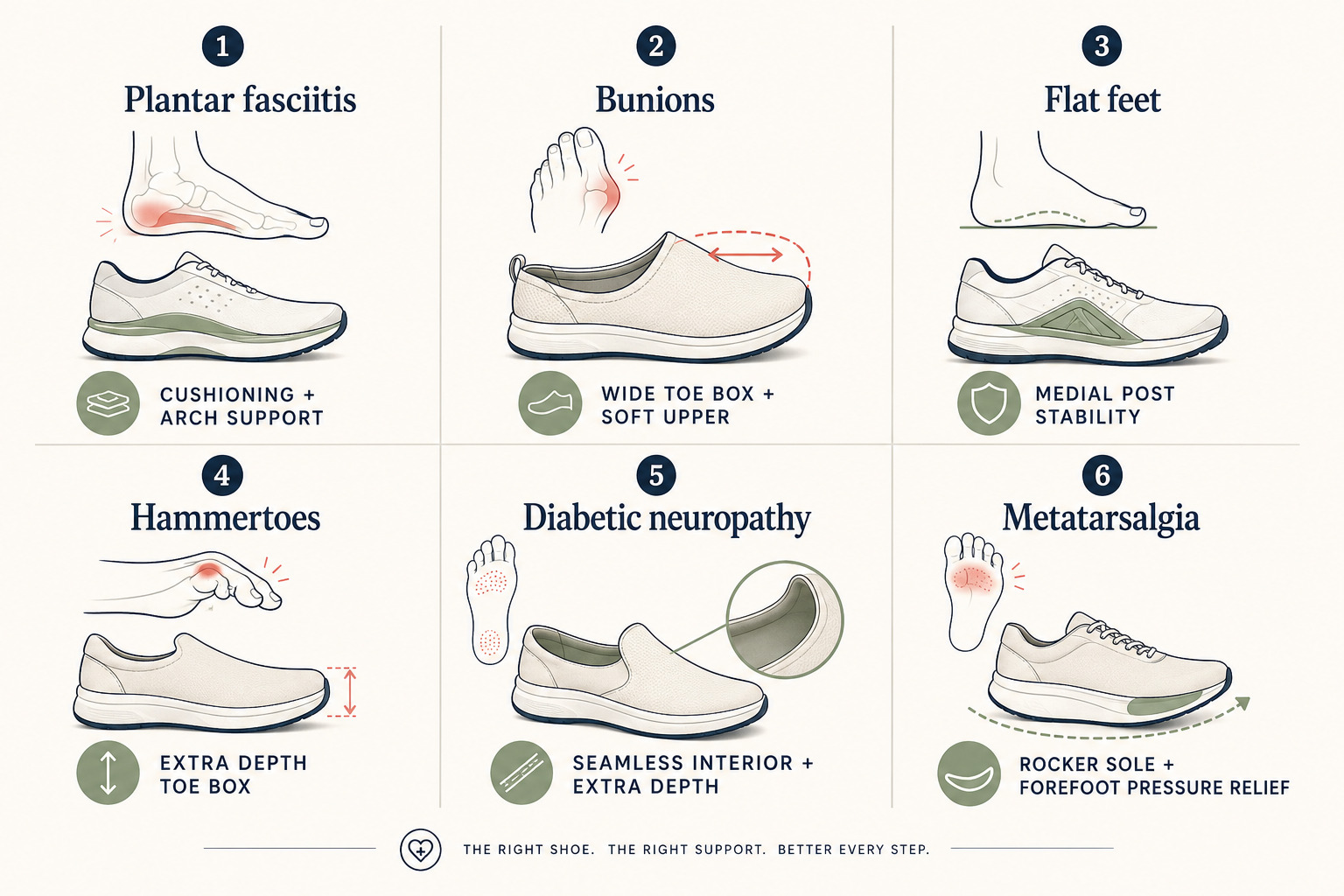
Six conditions. Six different mechanical requirements.
Each condition makes a specific demand on shoe construction. Plantar fasciitis needs cushioning and arch support together. Bunions need toe box volume and soft uppers. Flat feet need medial post construction. Hammertoes need vertical depth. Diabetic neuropathy needs seamless interiors. Metatarsalgia needs forefoot pressure redistribution.
Hammertoes
A hammertoe is a contracture deformity of the lesser toes in which the proximal interphalangeal joint bends downward, causing the toe to sit in a curved or claw-like position rather than lying flat. The contracted joint sits higher than normal inside the shoe and contacts the ceiling of the toe box with every step. This produces the corns, calluses, and dorsal toe pain that define the condition's daily burden.
What hammertoes require from a shoe is vertical depth at the toe box, not just width. Extra-depth construction provides additional vertical clearance inside the shoe above the toe bed, allowing the contracted joint to sit without contact against the upper. A shoe that is wide enough but not deep enough still produces the dorsal pressure that causes irritation. Both dimensions must be correct simultaneously.
Upper material at the toe box matters as well. A mesh or soft knit upper yields when the contracted toe presses against it, reducing friction and pressure. A structured leather or synthetic upper does not yield, and any contact point becomes a chronic irritation source regardless of the depth of the box.
What disqualifies a shoe: Standard-depth toe boxes regardless of width, rigid structured uppers at the forefoot, and shoes with any toe box taper that reduces vertical clearance at the toe tips. See APMA-verified hammertoe recommendations.
Diabetic Neuropathy
Diabetic peripheral neuropathy is not a comfort issue. It is a protective sensation issue. The nerves that would normally signal pain, pressure, friction, or heat from an ill-fitting shoe are damaged or non-functional. A shoe that creates a pressure point on a neuropathic foot may be worn for an entire shift without producing any pain signal while that pressure point progresses toward tissue breakdown and ulceration.
What diabetic neuropathy requires from a shoe crosses into therapeutic footwear territory. The interior must be seamless or nearly seamless, eliminating any stitching or structural seam that can create a focal pressure point against skin that cannot feel it. Extra depth is essential, providing clearance for any foot deformity present and space for a custom orthotic if required. The insole must be removable. The upper must be soft and accommodating rather than structured. Cushioning must be sufficient to absorb ground reaction forces that neuropathic tissue cannot signal as excessive until damage has already occurred.
For people with diabetes, width is not a preference. It is a clinical specification. Any shoe that creates lateral forefoot compression on a neuropathic foot is creating pressure injury risk that the wearer cannot detect.
What disqualifies a shoe: Any shoe with interior seams at pressure points, standard-depth construction, rigid uppers, or any fit that creates forefoot compression. For people with active neuropathy, footwear should be assessed by a podiatrist rather than self-selected from a retail environment. See APMA-verified diabetic neuropathy recommendations.
Metatarsalgia
Metatarsalgia describes pain and inflammation concentrated at the metatarsal heads, the rounded ends of the five long foot bones that form the ball of the foot. It is not a single condition but a symptom pattern with multiple possible drivers: forefoot fat pad thinning, high arch mechanics that concentrate load on the metatarsal heads, inflammatory arthritis, or adjacent conditions like Morton's neuroma or hammertoes that alter load distribution across the forefoot.
What metatarsalgia requires from a shoe is forefoot pressure redistribution. A rocker sole geometry is the most effective construction feature for this purpose. By curving the sole upward through the forefoot, the rocker sole shifts the peak pressure point behind the metatarsal heads rather than directly on them, reducing the load on the tissue that is already inflamed. Maximum forefoot cushioning addresses the symptom. The rocker sole addresses the mechanism.
A wide toe box reduces lateral compression on the metatarsal heads and allows the forefoot to spread naturally during push-off rather than being constrained laterally. Metatarsal padding, either built into the insole or added as a supplement, can further redistribute pressure by providing a raised surface just behind the metatarsal heads that takes load before it reaches them.
What disqualifies a shoe: Flat, unsupported insoles with no rocker geometry, narrow toe boxes that compress the metatarsal heads laterally, and thin-soled shoes that provide no forefoot cushioning barrier between the metatarsal heads and the ground. See APMA-verified metatarsalgia recommendations.
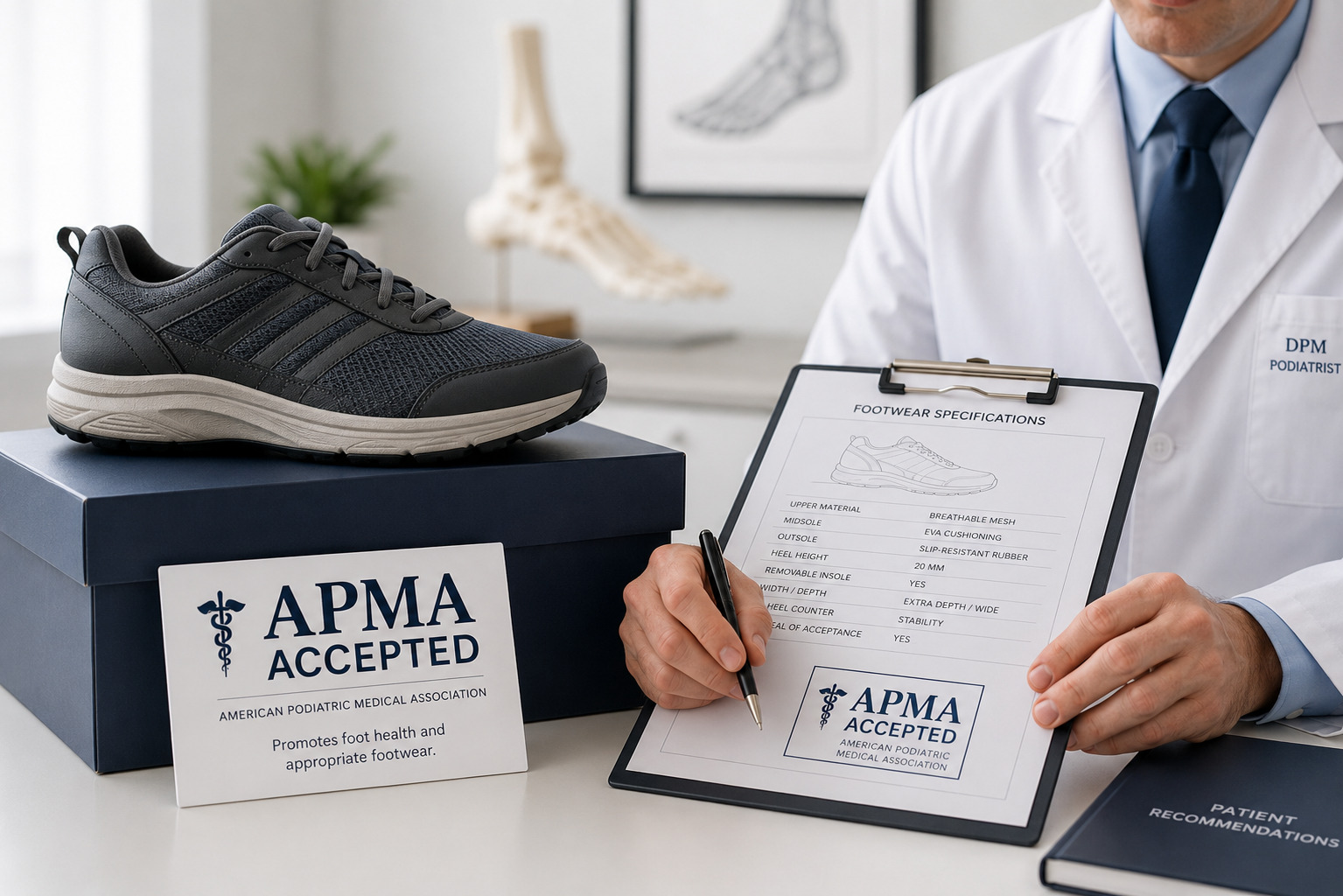
Verification over reputation.
The APMA Seal of Acceptance indicates a shoe has been reviewed by a committee of licensed podiatrists and found to promote good foot health. It is the most reliable third-party signal available in retail footwear. MySoleMatch features only APMA-verified shoes in its condition-specific recommendations.
The Decision Protocol Applied
With the mechanical requirements of your condition clear, the decision process becomes a filter rather than a search. Start with shoes that carry the APMA Seal of Acceptance, which verifies that the shoe has been reviewed by licensed podiatrists for foot health promotion. Within that set, match the specific construction features your condition requires. Then confirm width, depth, and fit before committing.
Two additional rules apply across all conditions. First, try shoes later in the day. Feet swell measurably through the course of a day under load, and a shoe that fits correctly in the morning may create forefoot compression by afternoon in someone who stands for a full shift. Second, never accept discomfort as a break-in expectation. A shoe that is correctly matched to your condition's mechanical requirements should feel immediately supportive and comfortable. Pain on first wear is not something that resolves with time. It is a signal that the mechanical match is wrong.
If you have been unable to find a shoe that resolves your condition's symptoms after applying this framework, the next step is a podiatrist assessment rather than another round of shoe shopping. A board-certified podiatric physician can identify whether a custom orthotic, a prescription therapeutic shoe, or a structural issue requiring intervention is the correct next step. The MySoleMatch podiatrist finder covers thirty-one cities with verified practicing podiatrists for anyone ready to move from footwear optimization to clinical assessment.
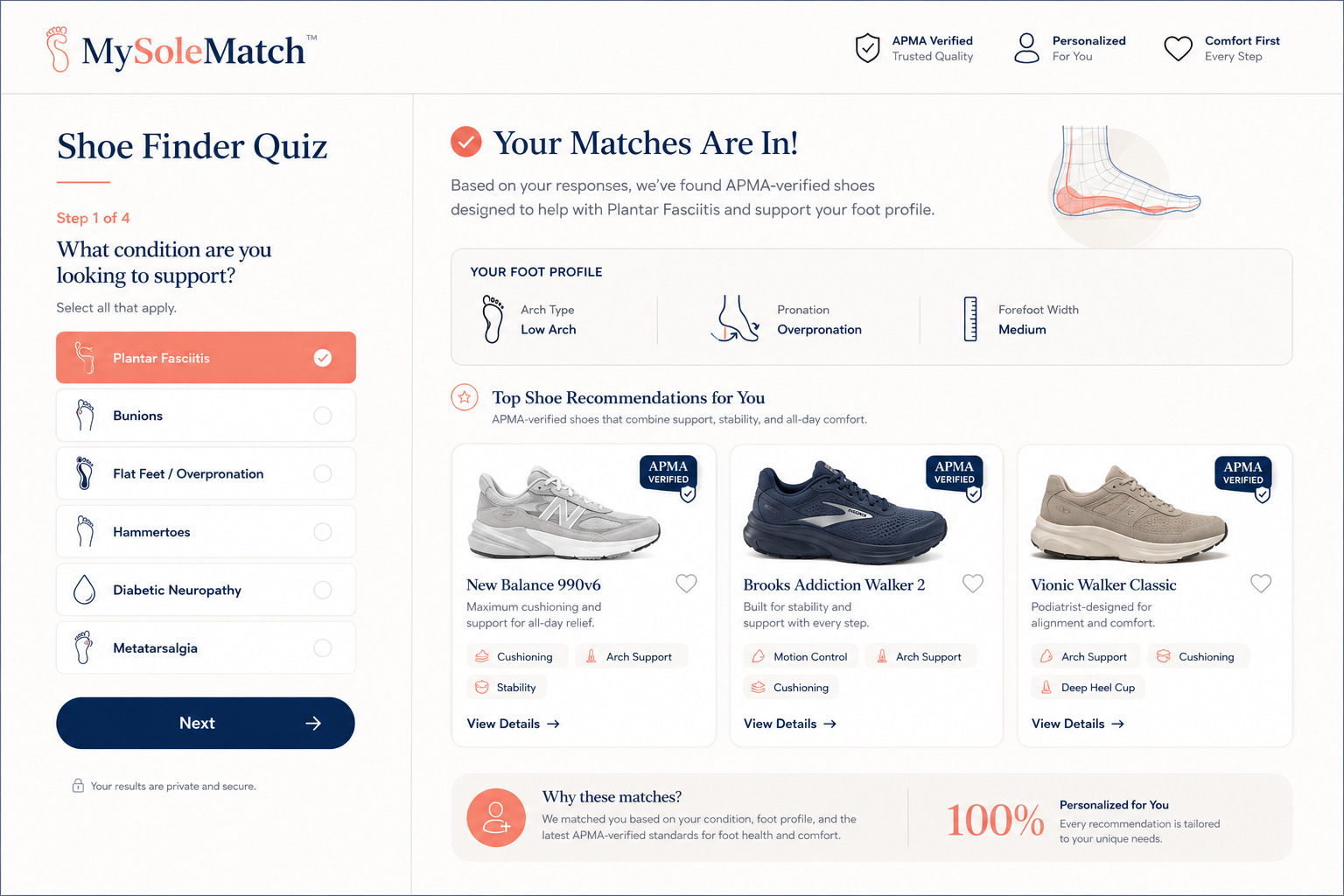
Your condition. Your foot profile. Your recommendation.
The MySoleMatch shoe finder quiz routes to condition-specific, APMA-verified recommendations based on your foot profile and diagnosed condition. No ranked lists. No brand bias. Recommendations built on the same mechanical framework this article describes.
The shoe that resolves a foot condition is not the most popular one. It is the one that addresses the specific mechanical demand your condition places on footwear. That is a narrower and more answerable question than any search result will give you. And it is the question this platform was built to help you answer.
The shoe finder quiz applies this framework to your specific foot profile and routes you to APMA-verified recommendations matched to your condition. Start there.