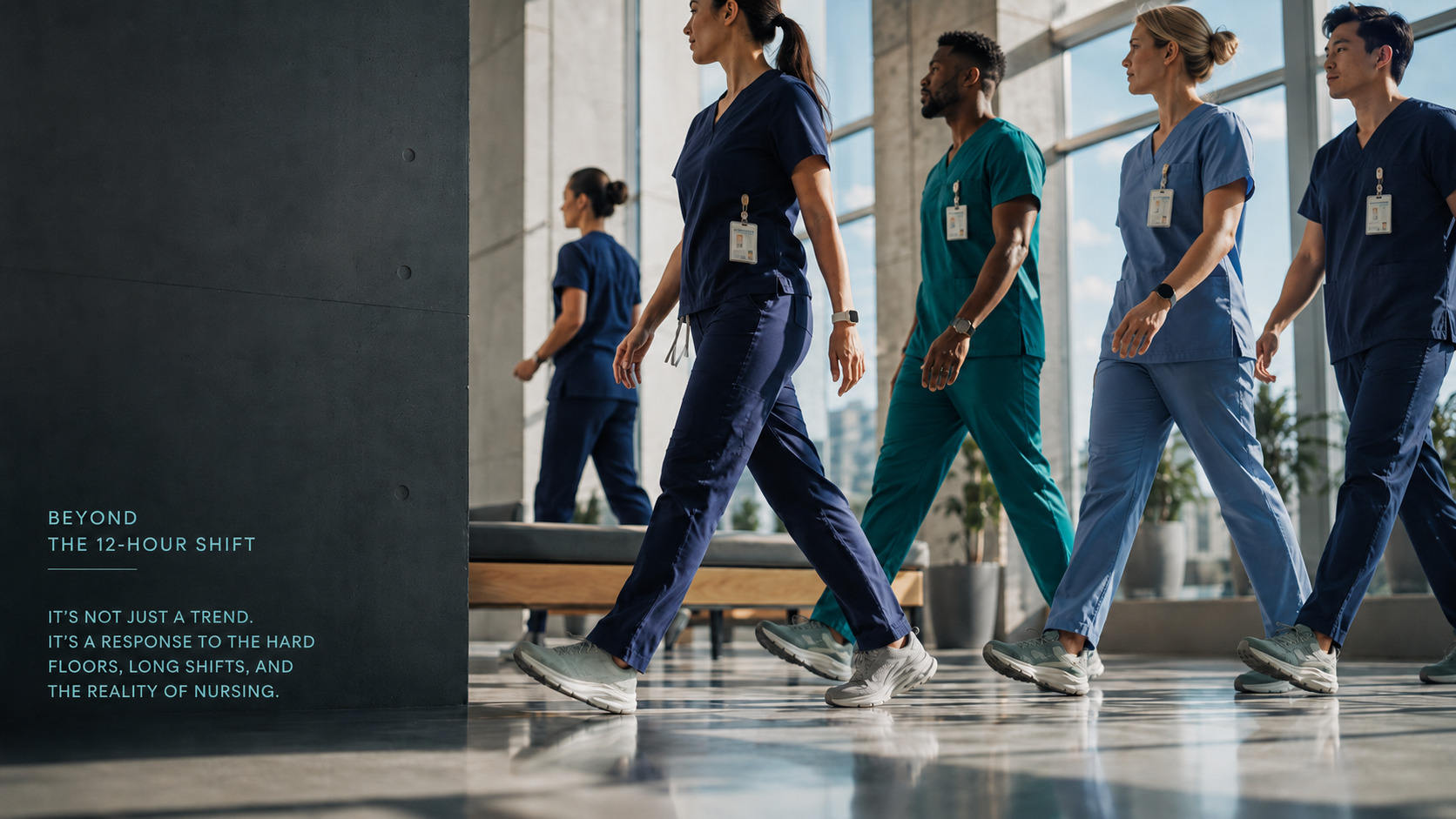
Walk into any hospital and you will notice it.
Not right away. It takes a shift or two before the pattern registers. But once you see it you cannot unsee it.
The shoes.
Look down at the feet moving through any busy hospital unit - emergency, medical-surgical, ICU, step-down - and a disproportionate number of them are wearing the same brand. Thick soles. Curved profile. Lightweight despite their size. Often in a color that has no business being on a hospital floor but somehow always is.
HOKA.
Nobody sent a memo. There was no hospital-wide shoe policy. No brand ambassador walked the unit handing out samples. Nurses found this shoe the same way nurses find most things that actually work - one colleague showed up wearing them, looked noticeably more comfortable at hour eleven than everyone else, and the questions started.
What are those?
Where did you get them?
Do they actually help?
That is how HOKA spread through hospitals across the country. Not through advertising. Not through a healthcare marketing campaign. Through the most trusted distribution network in medicine - nurses talking to other nurses.
The question worth asking is not whether HOKAs are popular with nurses. Walk any unit and that answer is obvious. The question worth asking is why. Why did so many nurses, independently, across different hospitals, different specialties, different body types and foot conditions, arrive at the same shoe?
The answer is not as simple as cushioning.

The Shoe That Spread Without a Marketing Budget
HOKA did not market to nurses. Nurses found HOKA the way they find everything that works - one colleague, one shift, one conversation at a time. What started as a trail running shoe built in the French Alps became the default footwear of hospital units across the country through word of mouth alone.
Most people do not think of nursing as a physical job.
They think of it as a skilled job. A demanding job. An emotionally exhausting job. All of that is true. What gets left out of that description is what nursing does to the body from the floor up.
A nurse working a 12-hour day shift walks an average of 4 to 5 miles before the shift ends. Not in one walk. Not on a track or a trail or a surface designed for walking. In short bursts - room to room, station to patient, supply closet to bedside - on the hardest floors in modern construction. A landmark workflow study tracking 767 nurses across 15 states confirmed the number. Nearly 5 miles per shift. Roughly 85 minutes of walking packed into a 12-hour window that already has no room for breaks.
By the end of a typical work week, a nurse has walked the equivalent of a half marathon. Not for fitness. For work.
The physical cost of that load is well documented. Research shows that between 44 and 55 percent of hospital nurses report foot and ankle pain - making it the most prevalent musculoskeletal complaint of the preceding seven days and the third most prevalent overall after lower back and neck problems. Nearly two thirds of nurses working in United States hospitals report ankle or foot pain. Almost one in four say it interferes directly with their ability to do their job.
These are not runners logging too many miles on worn-out shoes. These are healthcare professionals whose occupational demands happen to exceed what most footwear was designed to handle.
That distinction matters. A runner chooses to run. A nurse has no equivalent choice. The miles accumulate whether the feet are ready for them or not. The shift does not end early because the plantar fascia is irritated. The patient does not wait because the heel is aching.
The foot pain is not incidental to nursing. It is a predictable outcome of the job description.
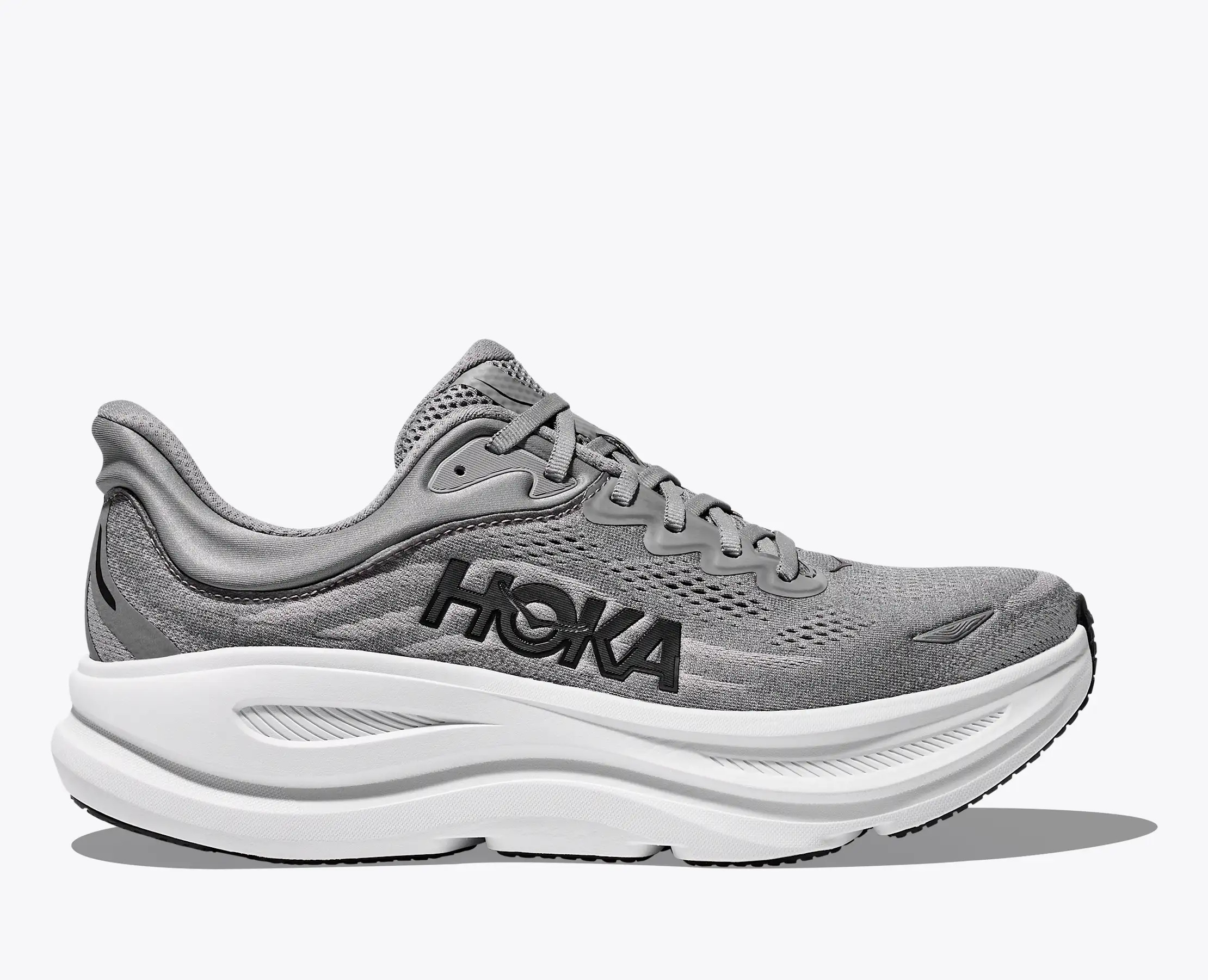
The Shoe That Started the Conversation
The Bondi 9 is the model most nurses encounter first - maximum cushioning, late-stage MetaRocker, and enough shock absorption to make the difference between finishing a shift functional and finishing it in pain. It is the shoe that started the conversation about HOKA in hospitals. It is not the shoe that works for every nurse, but it is the shoe that most nurses find when they first ask their colleagues for recommendations.
Talk to any podiatrist about occupational foot pain and they will eventually ask the same question.
What kind of floor are you standing on.
It sounds like a minor detail. It is not. The surface beneath the foot determines how much force travels upward through the ankle, knee, hip, and lower back with every step. Soft surfaces absorb impact. Hard surfaces return it. And few surfaces in modern construction are harder than the floors of a hospital.
Polished vinyl over poured concrete. That is what most hospital floors are. The vinyl exists for infection control and easy cleaning. The concrete exists because hospitals are large, heavy buildings that need structural permanence. Neither material was chosen with the feet of the people walking on it twelve hours a day in mind. The result is a surface that returns nearly all of the force of every footfall directly back into the body.
Consider what that means over the course of a shift. A nurse takes roughly 8,000 to 12,000 steps during a 12-hour day. Each step on a hard floor generates an impact force that the foot, ankle, and lower leg must absorb and dissipate. On softer surfaces - grass, rubberized track, even asphalt - the ground absorbs some of that energy. On polished concrete it does not. Every step is fully accounted for by the body.
Multiply that by three or four shifts per week. Multiply that by a career.
This is why nurses are not simply looking for comfortable shoes. Comfort is a consumer concern. What nurses are managing is cumulative mechanical load on a body that gets no recovery time between repetitions because the repetitions never stop. The shoe they need is not the shoe a casual walker needs or even the shoe a recreational runner needs. It is something closer to what a construction worker standing on a concrete slab for twelve hours needs - maximum shock absorption, efficient energy transfer, and a design that reduces the muscular work required to propel the body forward step after step after step.
Most footwear was not built for that specific combination of demands.
HOKA, accidentally, was.
HOKA was not designed for nurses.
It was designed for two French trail runners who wanted to go faster downhill.
Nicolas Mermoud and Jean-Luc Diard founded HOKA in 2009 in Annecy, France, working from a simple frustration - the shoes available for mountain trail running absorbed too little impact on long descents and fatigued the legs too quickly. Their solution was radical for the time. While the rest of the running world was moving toward minimalist shoes - thin soles, low stack heights, close to the ground - HOKA went in the opposite direction entirely. Thick midsoles. Oversized cushioning. A curved sole profile that rolled the foot forward rather than letting it land flat.
The running community was skeptical. The shoes looked strange. They worked anyway.
What Mermoud and Diard did not know in 2009 was that the problem they were solving for trail runners was structurally identical to the problem nurses were living with every shift. Long duration. Hard repetitive impact. Muscular fatigue accumulating over hours. The need to keep moving efficiently when the body is already tired.
The design feature that explains most of the HOKA appeal for nurses is called MetaRocker. It is not a cushioning technology. It is a geometry - a curved sole profile that is higher at the heel and toe and lower in the midfoot, creating a rocking motion that guides the foot through each stride rather than requiring the foot's own muscles to generate that forward momentum independently.
On a trail, that geometry helps a runner move efficiently downhill without overloading the quads and calves. On a hospital floor, that same geometry reduces the muscular effort required to take the next step at hour ten of a twelve-hour shift. Clinical biomechanical research measuring rocker-bottom footwear against conventional shoes has demonstrated a 15 percent reduction in calf and Achilles strain - a finding that has influenced the broader adoption of rocker geometry in occupational footwear. For a nurse who has already taken 9,000 steps before midnight, 15 percent less muscular demand per step is not a small number.
Then there is the cushioning. HOKA's maximalist midsole - the feature that made the shoes look absurd to conventional running wisdom in 2009 - provides a level of shock absorption that most footwear built for healthcare environments never approached. The thick foam stack intercepts impact energy before it travels up the kinetic chain. Less force reaching the ankle. Less force reaching the knee. Less force reaching the lower back that is already under strain from twelve hours of patient care.
And despite all of that foam, HOKA shoes are remarkably lightweight. That matters more than it sounds. A heavy shoe becomes noticeably heavier at hour eleven. A shoe that weighs 8 to 9 ounces stays manageable across a full shift in a way that a dense leather clog or a heavily structured stability shoe never quite does.
The combination of those three things - MetaRocker geometry reducing muscular effort, maximalist cushioning absorbing floor impact, and a lightweight build that does not compound fatigue - is not a coincidence of good marketing. It is an accidental but precise answer to what hospital floors do to human feet over the course of a working life.
HOKA solved a trail running problem. Nurses found the solution first.
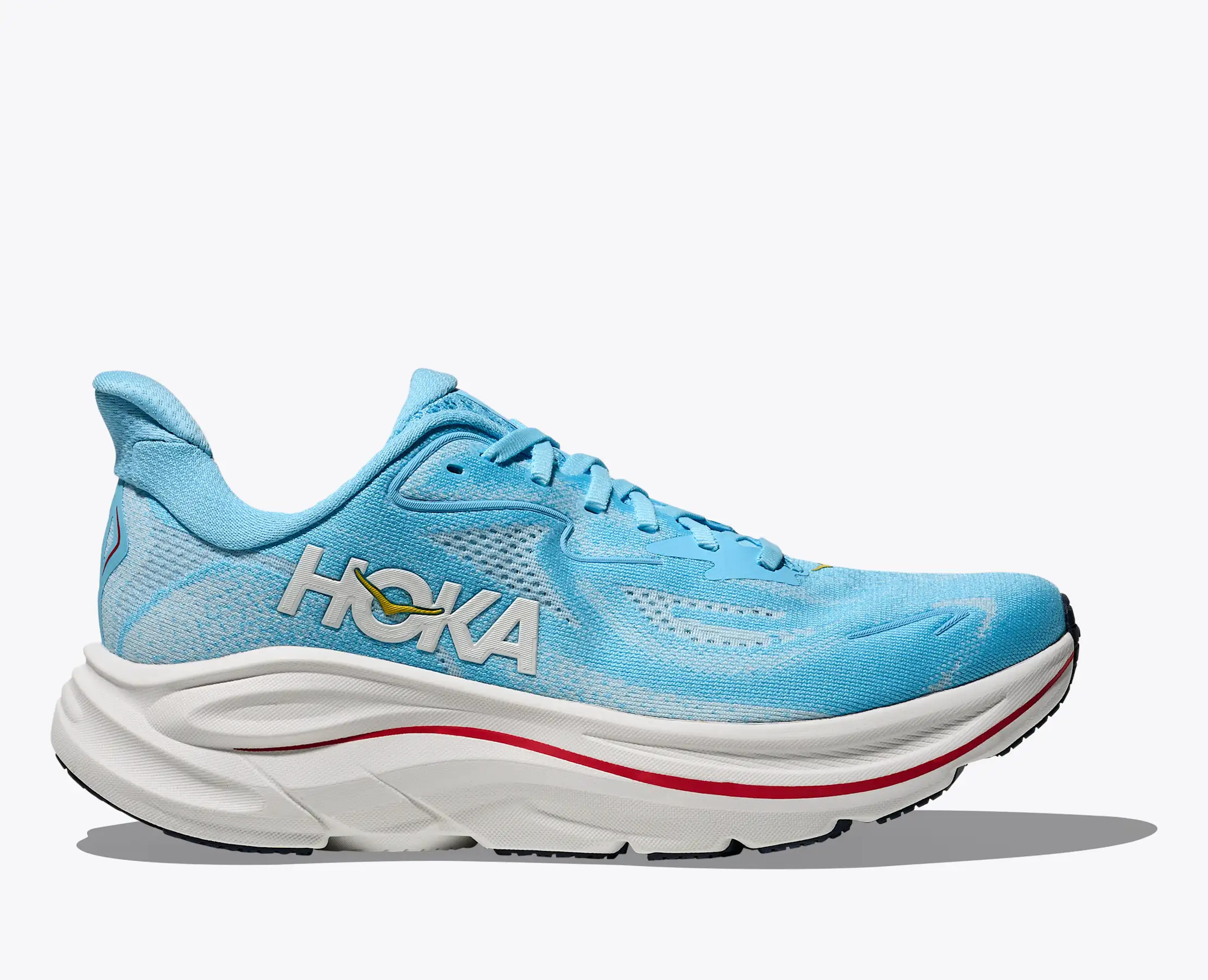
HOKA Clifton 10: The Everyday Shift Shoe
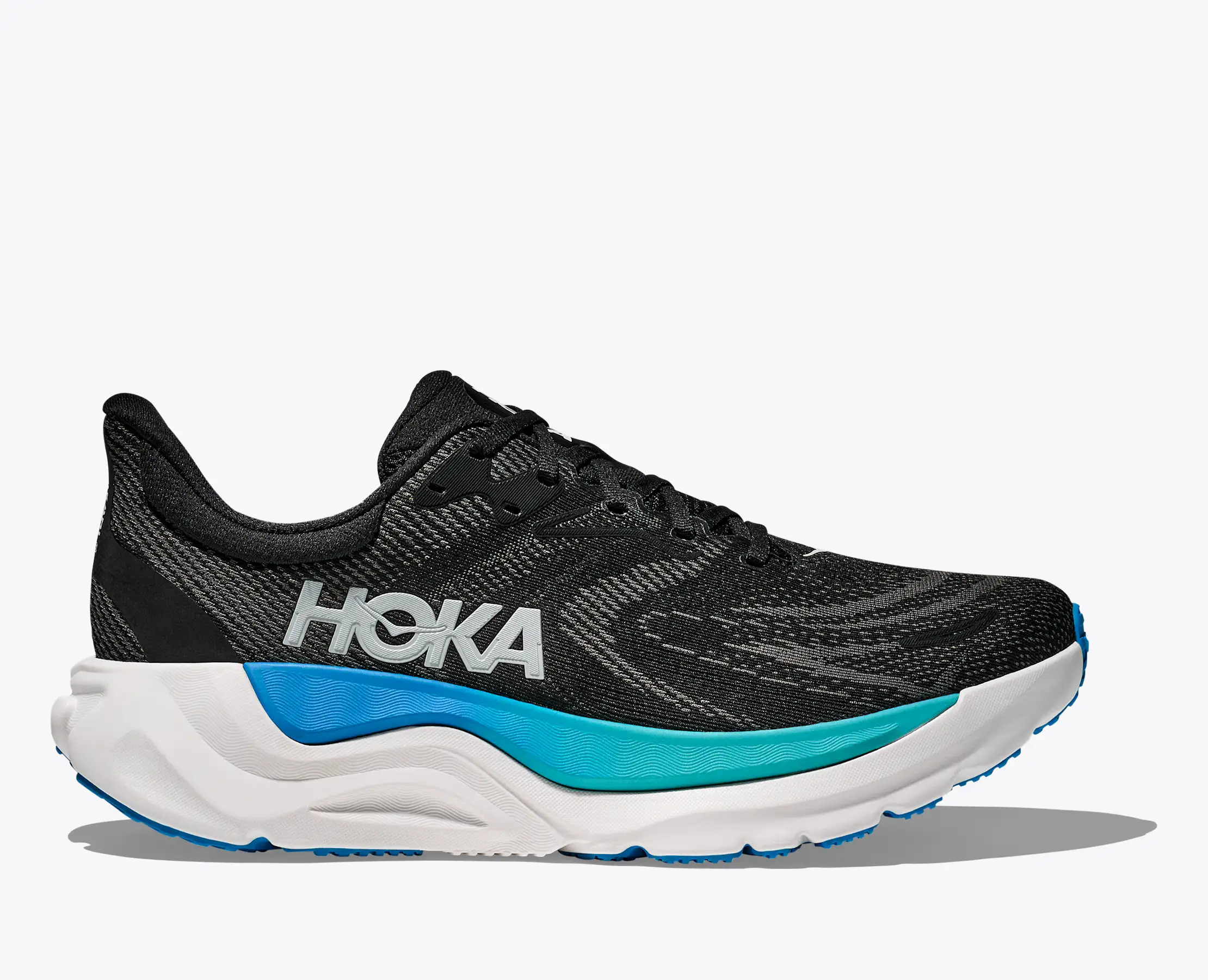
HOKA Arahi 8: For Nurses Who Overpronate
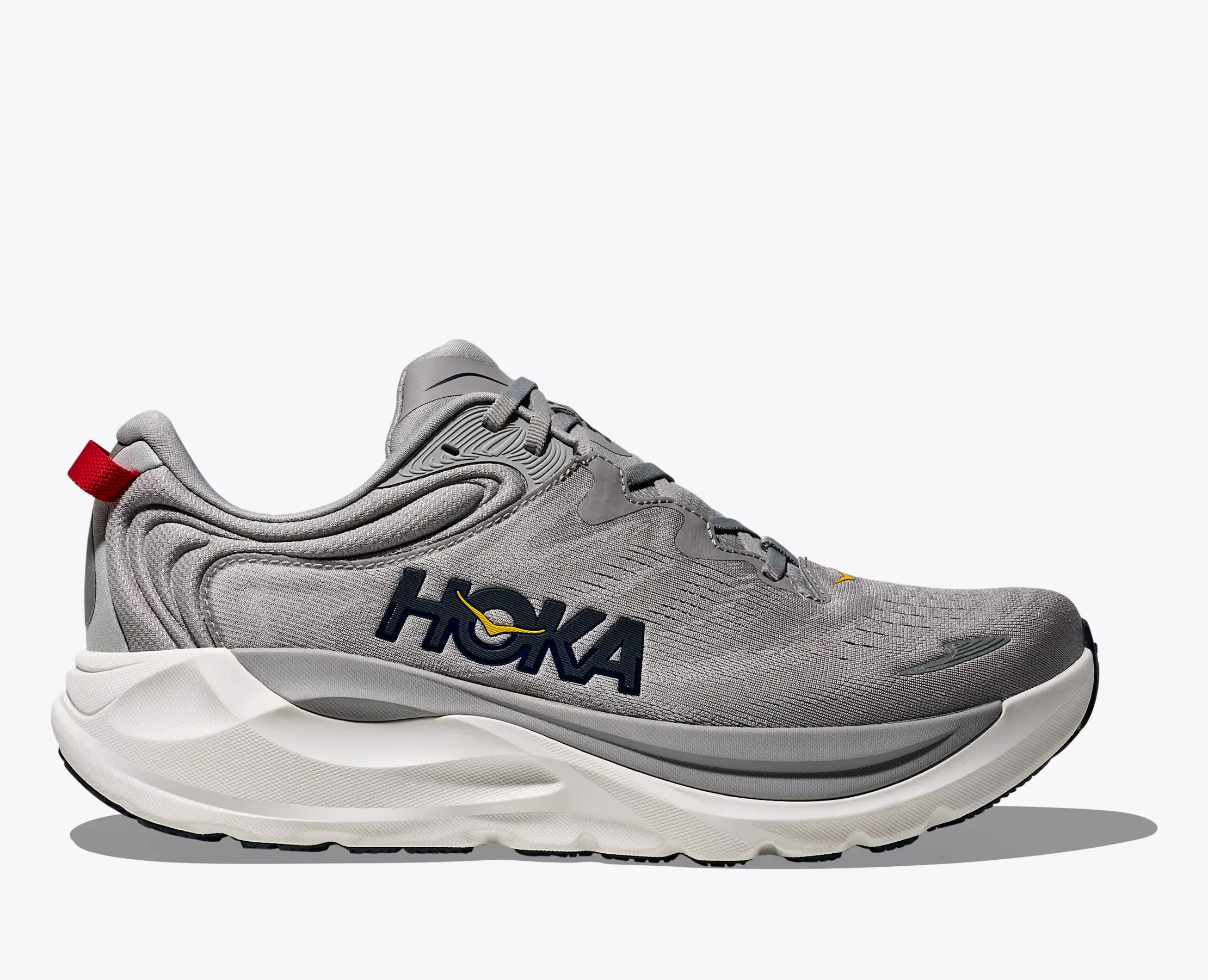
HOKA Gaviota 6: Maximum Stability for Demanding Units
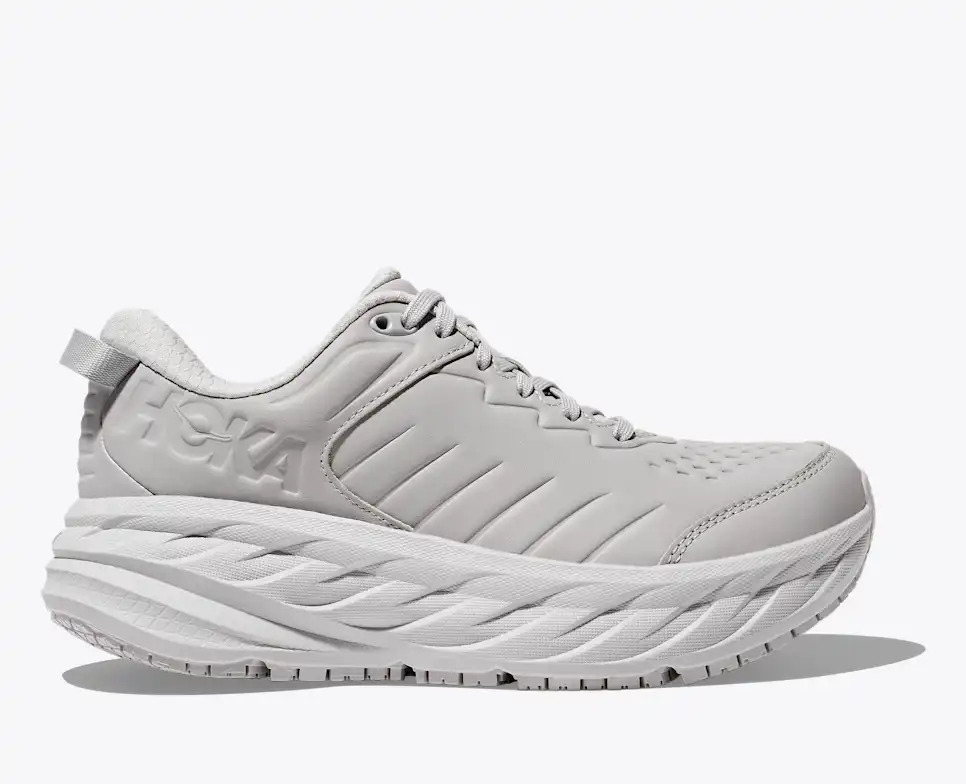
HOKA Bondi SR: The One Made for Healthcare Floors
Here is what does not get said in most articles about HOKAs for nurses.
Cushioning is passive. It absorbs what the foot brings to it. It does not correct how the foot moves, does not address the mechanics that cause pain in the first place, and does not substitute for a shoe that actually fits the specific foot wearing it.
A nurse with high arches experiences HOKA's thick midsole differently than a nurse with flat feet. A nurse with significant overpronation - whose foot rolls inward with each step, compounding over thousands of repetitions per shift - may find that a neutral HOKA cushions the impact while doing nothing to address the biomechanical pattern creating the damage. A nurse with plantar fasciitis may find relief in the heel cushioning but struggle with the rocker geometry if the curve is placed in a way that increases forefoot loading rather than reducing it.
This is not a criticism of HOKA. It is a description of how footwear actually works.
No single shoe solves every foot problem for every person. The reason HOKAs work so well for so many nurses is precisely because the design addresses several of the most common challenges of hospital work simultaneously - impact, fatigue, forward propulsion efficiency. But several is not all. And popular is not the same as compatible.
HOKA knows this. The brand makes more than a dozen distinct models with meaningfully different geometries, stack heights, stability features, and intended use cases. The Bondi and the Clifton are both HOKAs. They feel and function differently underfoot. A nurse who tried the Clifton and found it slightly firm might have a different experience in the Bondi. A nurse who needs medial support for overpronation has options in the Arahi and the Gaviota that a neutral Bondi does not provide. A nurse with a wider forefoot or bunions needs a different fit consideration entirely. A nurse who wants versatility across shift and off-shift activity without committing to maximum cushioning will find the Kawana 3 sits in exactly that space.
The word of mouth mechanism that spread HOKAs through hospitals is powerful and genuine. It is also imprecise. When a colleague says these changed my life you are hearing one person's experience with one foot type in one HOKA model on one unit's floors after one set of previous shoes. That experience is real. It may not be yours.
The most honest thing that can be said about HOKAs and nurses is this: the brand's design philosophy happens to address the right problems for a significant portion of the nursing workforce. That is why the convergence happened. That is why the shoe spread without a marketing budget aimed at healthcare. But the convergence is a starting point for the conversation about footwear, not the end of it.
The end of it is a shoe that matches this specific nurse's feet, this specific nurse's foot conditions, this specific nurse's shift demands, and this specific nurse's history with pain.
That is a different question than which brand is most popular on the unit.
The question nurses actually need answered is not which shoe is most popular on the unit.
It is which shoe is right for this shift, this floor, this foot, and this body. That requires knowing a few things that most shoe shopping - online or in store - never asks about.
How long is the shift and what kind of unit.
A nurse working a 12-hour day shift on a busy medical-surgical floor has different needs than a nurse working an 8-hour night shift in an ICU. The med-surg nurse is covering more distance, moving faster, and encountering more varied demands on the foot throughout the shift. The ICU nurse may be taking fewer steps overall but spending longer periods standing in one position, which creates a different kind of fatigue and a different kind of loading on the plantar fascia and heel structures. Shift length and unit type matter more than most shoe guides acknowledge.
What the foot is actually doing.
Overpronation - the inward rolling of the foot with each step - is one of the most common biomechanical patterns among nurses reporting foot and ankle pain. A neutral cushioning shoe, however well padded, does not address overpronation. It cushions the impact of a stride that is still mechanically inefficient. A nurse with significant overpronation needs a stability feature - whether that is a medial post, a firmer foam on the inner side of the midsole, or a geometry that guides the foot rather than simply absorbing its impact. HOKA makes stability models specifically for this. Most nurses who converge on the brand through word of mouth end up in neutral models because those are what colleagues recommend most often. That match is not always correct.
What conditions are already present.
Plantar fasciitis, flat feet, high arches, bunions, metatarsalgia, heel spurs - each of these changes what a shoe needs to do and where it needs to do it. A nurse managing plantar fasciitis needs specific heel cushioning and a rocker geometry that reduces the stretch load on the plantar fascia during toe-off. A nurse with bunions needs a wider toe box that does not compress the first metatarsophalangeal joint over thousands of steps per shift. A nurse with high arches needs cushioning distributed differently than a nurse with flat feet. These are not minor variables. They are the difference between a shoe that helps and a shoe that accelerates an existing problem.
Slip resistance.
The CDC identifies spilled contaminants as one of the leading causes of slip and fall incidents in healthcare environments. OSHA strongly advises healthcare workers to wear shoes with rubber outsoles patterned for grip. Not all HOKA models are equally slip resistant and the brand is not specifically engineered for healthcare floor conditions the way dedicated occupational footwear sometimes is. A nurse choosing a HOKA for shift work should verify the outsole characteristics of the specific model rather than assuming the brand's reputation covers this requirement. The HOKA Bondi SR is the model specifically engineered for clinical floor conditions.
Orthotic compatibility.
Many nurses managing chronic foot conditions use custom or over-the-counter orthotics as part of their treatment plan. HOKA's removable footbeds make most models orthotic compatible - but the thick midsole stack means that adding an orthotic on top of HOKA's existing geometry changes the fit and feel of the shoe in ways that require some adjustment. A nurse transitioning from a different shoe platform to HOKA while using orthotics should allow time to adapt rather than expecting immediate comfort.
What the shift does to the shoe over time.
Hospital environments are demanding on materials. Frequent cleaning, exposure to contaminants, and the sheer volume of steps accelerate the wear cycle of any shoe. HOKA's foam midsoles, like all foam midsoles, compress and lose their cushioning properties over time - typically after 300 to 500 miles of use. For a nurse walking 4 to 5 miles per shift across three or four shifts per week, that means a midsole that was performing optimally in month one may be significantly less effective by month four or five even if the upper looks fine. The shoe that helped in January may not be helping in June. Replacing footwear on a schedule rather than waiting for visible wear is one of the most effective and least followed pieces of footwear advice in occupational health.
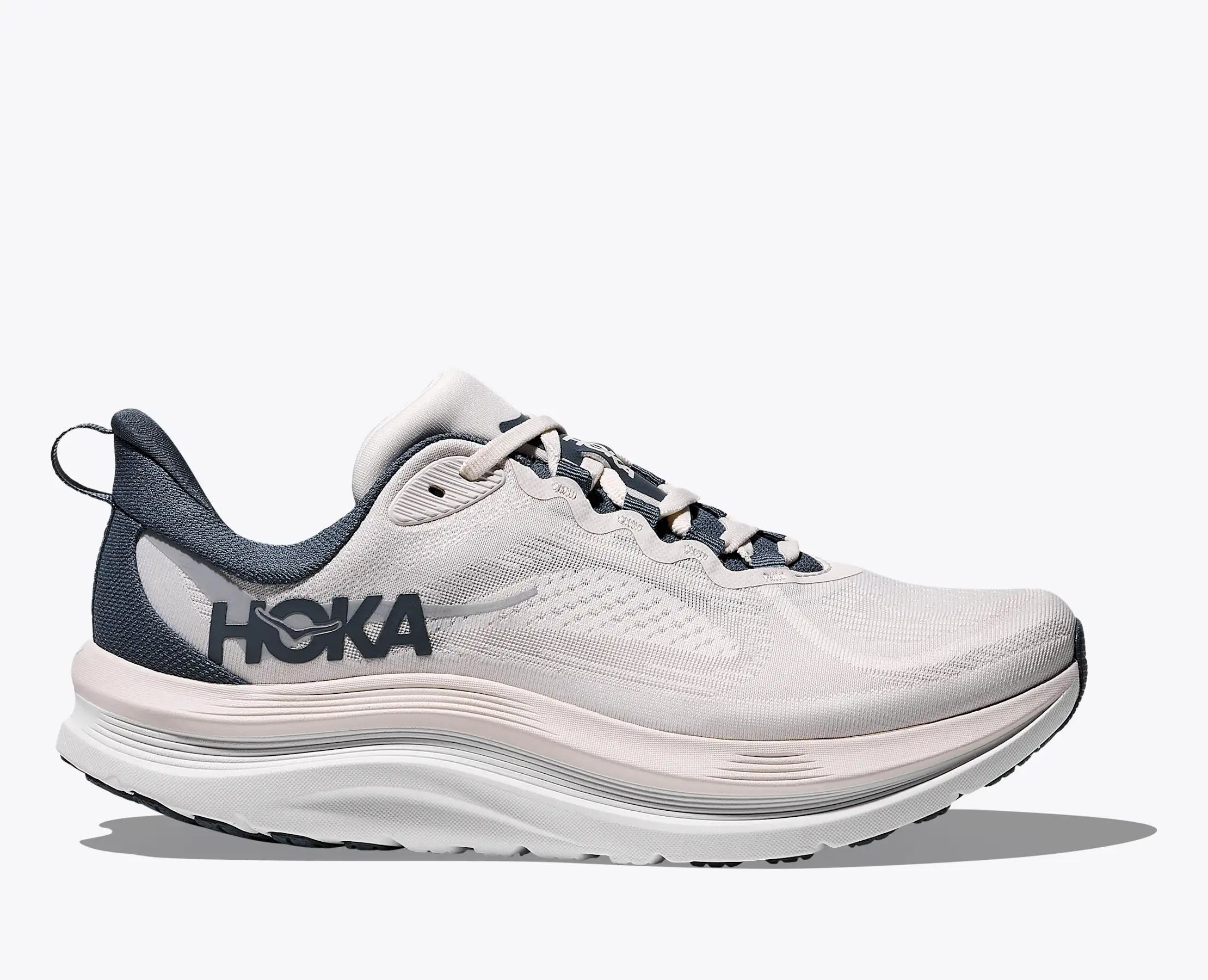
HOKA Kawana 3: The Middle Ground Most Nurses Never Consider
Not every nurse needs maximum cushioning. Not every nurse needs maximum stability. The Kawana 3 sits in the space between - responsive enough for nurses who also run, cushioned enough for a full shift, and lighter than the Bondi without sacrificing the MetaRocker geometry that makes HOKA work for healthcare floors.
HOKAs did not spread through hospitals because of a marketing campaign.
They spread because nurses are among the most rigorous product testers in the world and they did not know it. When a shoe fails a nurse it fails publicly, repeatedly, and expensively - in pain that shows up at hour eight of a twelve-hour shift and does not leave when the shift ends. When a shoe works it works in conditions that would expose any weakness in the design. Thousands of steps on concrete floors under physical and cognitive load with no scheduled recovery time.
HOKA passed that test for enough nurses that the word spread. That is a genuine signal worth taking seriously.
But a signal is not a prescription. The convergence of so many nurses on one brand tells us something important about what that brand gets right - the geometry, the cushioning philosophy, the weight-to-protection ratio. It does not tell us that every nurse who walks into a HOKA store and buys the most popular model will solve their specific foot problem. It does not tell us that the colleague who swears by the Bondi has the same foot mechanics, the same conditions, and the same history of pain as the nurse asking the question.
What it tells us is where to start looking.
The nurses who end up in HOKAs and stay there are usually the ones whose foot profile happens to match what the shoe does well - moderate to high cushioning needs, neutral to mild stability requirements, no significant conditions that require specific corrective features beyond what HOKA's standard geometry provides. For that profile, which is genuinely common, HOKAs are an excellent answer.
For every other nurse the answer is more specific. It begins with understanding the foot, the conditions it carries, the shift it is asked to survive, and the floor it is asked to survive it on. Then it works backward to the shoe.
That is a harder conversation than asking which brand everyone else is wearing. It is also the only conversation that reliably ends with feet that do not hurt.
If you are not sure where that specific search begins, the MySoleMatch shoe finder was built to bridge exactly that gap - matching your foot type, shift length, and existing conditions to the right footwear before you spend a dime. Because the right shoe is not the most popular one on the unit. It is the one built for the miles you actually walk.