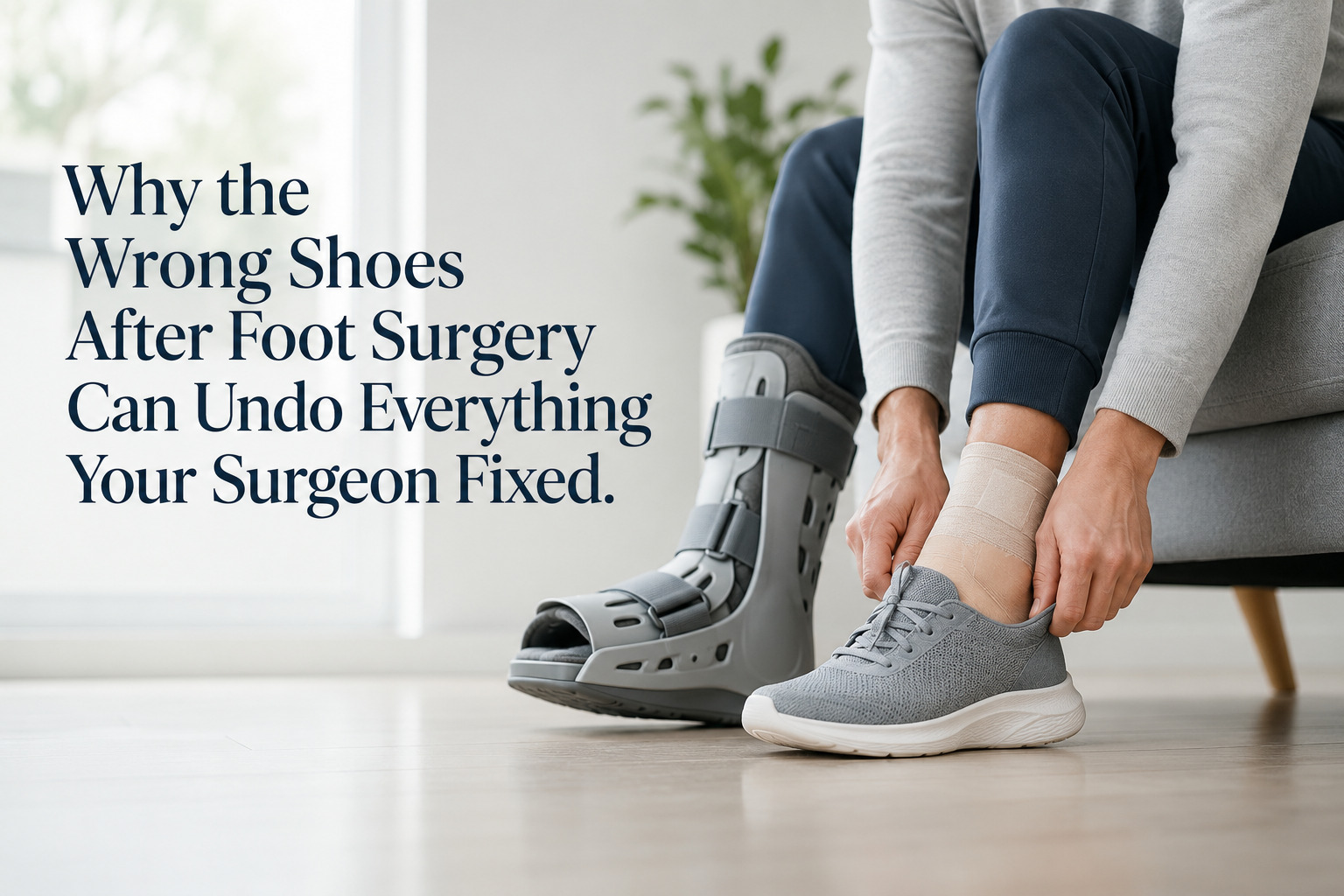
The surgery worked. The foot did not stay fixed.
It is one of the most common conversations in podiatric surgery follow-up appointments. The procedure went well. The imaging looked clean at six weeks. The patient was cleared to transition out of the surgical shoe. And then, somewhere between month three and month eighteen, the pain came back. The deformity started returning. The correction that took forty-five minutes in an operating room began slowly reversing itself over months of daily wear.
The surgeon did not make a mistake. The hardware held. The bone healed. What failed was what happened after the patient left the building. Specifically, what they put on their feet.
This is not a rare edge case. According to a 2020 study published in the Journal of Foot and Ankle Research, bunion recurrence rates after surgery range from 10 to 25 percent depending on the procedure type. One in four patients, in the worst-case category, undergoes a procedure only to have the deformity return. Board-certified podiatric surgeons cite returning to narrow or pointed-toe footwear within two years of surgery as one of the most significant and consistently documented drivers of that recurrence.
The surgery fixed the structure. The shoe undid the fix.
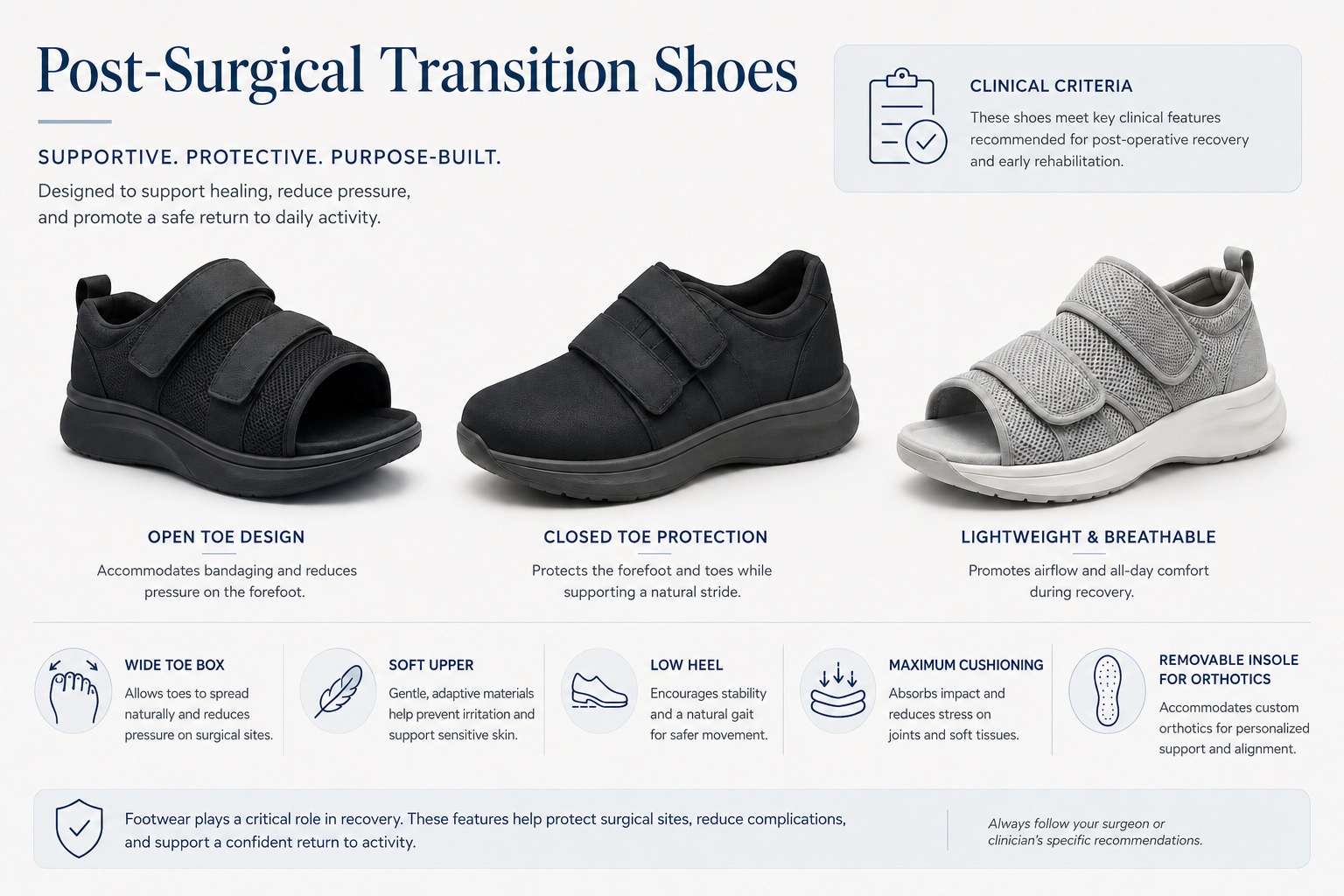
The Transition Shoe Is a Clinical Decision, Not a Style Choice
The first shoe worn after the surgical boot comes off determines whether the correction the surgeon achieved holds or begins to reverse. Wide toe box, soft upper, low heel, maximum cushioning. These criteria select the shoe.
The numbers make this worth paying attention to.
Foot surgery in the United States happens at a scale most people do not appreciate until they or someone they know is scheduled for it. An estimated 330,000 bunionectomies are performed annually in the US, making bunion correction one of the most commonly performed foot procedures in the country. Hammertoe surgery accounts for approximately 700,000 surgical repairs per year, according to Treace Medical Concepts' 2023 market disclosure. Plantar fascia release, Morton's neuroma excision, and metatarsal surgeries add hundreds of thousands more procedures annually.
Medicare data confirms that podiatrists perform 77 percent of all bunionectomies and 83 percent of all hammertoe surgeries performed in the United States. These are the physicians most familiar with what happens to surgical corrections when patients return to footwear that reintroduces the mechanical forces the surgery corrected.
At a 10 percent recurrence rate, 33,000 bunion corrections fail every year. At 25 percent, the number approaches 80,000. The patients in that range face revision surgery. A procedure that is materially more complex than the original because it involves altered anatomy, scar tissue, compromised bone stock, and in some cases hardware from the first operation. Revision bunion surgery recurrence rates run higher still.
The footwear a patient chooses during and after recovery is not a minor lifestyle consideration. It is a clinical variable with documented consequences.
The most important thing most patients are never told about bone healing.
Board-certified podiatric surgeon Dr. Tom Biernacki, DPM, who performs Lapiplasty and Austin bunionectomy procedures at Balance Foot and Ankle in Michigan, describes the phenomenon consistently in his clinical documentation: bone healing lags behind pain resolution by four to six weeks.
Read that again, because it is the fact that explains most post-surgical footwear mistakes.
The foot feels healed four to six weeks before it actually is. The incision closes. The swelling reduces noticeably. The pain that made daily life difficult during the first weeks of recovery becomes manageable, then mild, then largely absent. Everything the patient can feel tells them they are ready to resume normal life, including normal shoes.
But the bone has not finished consolidating. The osteotomy site, which is the precise cut made to reposition the metatarsal, is still knitting together at the cellular level. The structural correction achieved in the operating room is held in place by hardware and healing tissue that has not yet reached full mechanical strength. The foot looks healed from the outside. From the inside, it remains vulnerable.
Patients who transition back to regular footwear at six weeks because the incision looks good, without X-ray confirmation of bone consolidation from their surgeon, are bearing full body weight on a repair that is not ready for it. Dr. Biernacki's clinical documentation notes that these patients "often experience swelling setbacks, pain recurrence, and even hardware irritation that would not have occurred with two to four more weeks in supportive transition footwear."
The patient made a reasonable decision based on how they felt. The biology did not care how they felt.
What a narrow toe box actually does to a bunion correction.
A bunion, hallux valgus, forms when the first metatarsal shifts medially and the big toe drifts toward the second toe. The forces driving that shift are a combination of genetics, gait mechanics, and external compression from footwear. Surgery corrects the bony position. It does not eliminate the forces that created it.
A narrow or pointed-toe shoe applies lateral compressive force to the forefoot with every step. Before surgery, that force was one of the contributors to the original deformity. After surgery, it encounters a corrected metatarsal that is still being held in its new position by healing tissue and hardware. The corrected alignment requires mechanical stability during healing. Stability that depends on the surrounding tissue maintaining the position the surgeon created.
Narrow footwear recreates the compressive environment that the surgery was performed to escape. Not dramatically. Not immediately. Over months of daily wear, each step applying a small lateral force to a healing correction, the tissue accommodates. The metatarsal shifts. The hallux angle increases. The patient returns to their surgeon with imaging that shows a familiar deformity beginning to re-establish itself.
High heels compound the problem. Elevated heel height shifts body weight forward onto the forefoot, increasing the load at the first metatarsophalangeal joint. The exact joint that was surgically corrected. Clinical documentation from multiple podiatric surgery practices identifies high heels and narrow shoes as the two footwear factors most consistently associated with post-bunionectomy recurrence.
The surgical correction did not fail. The footwear environment progressively reversed it.
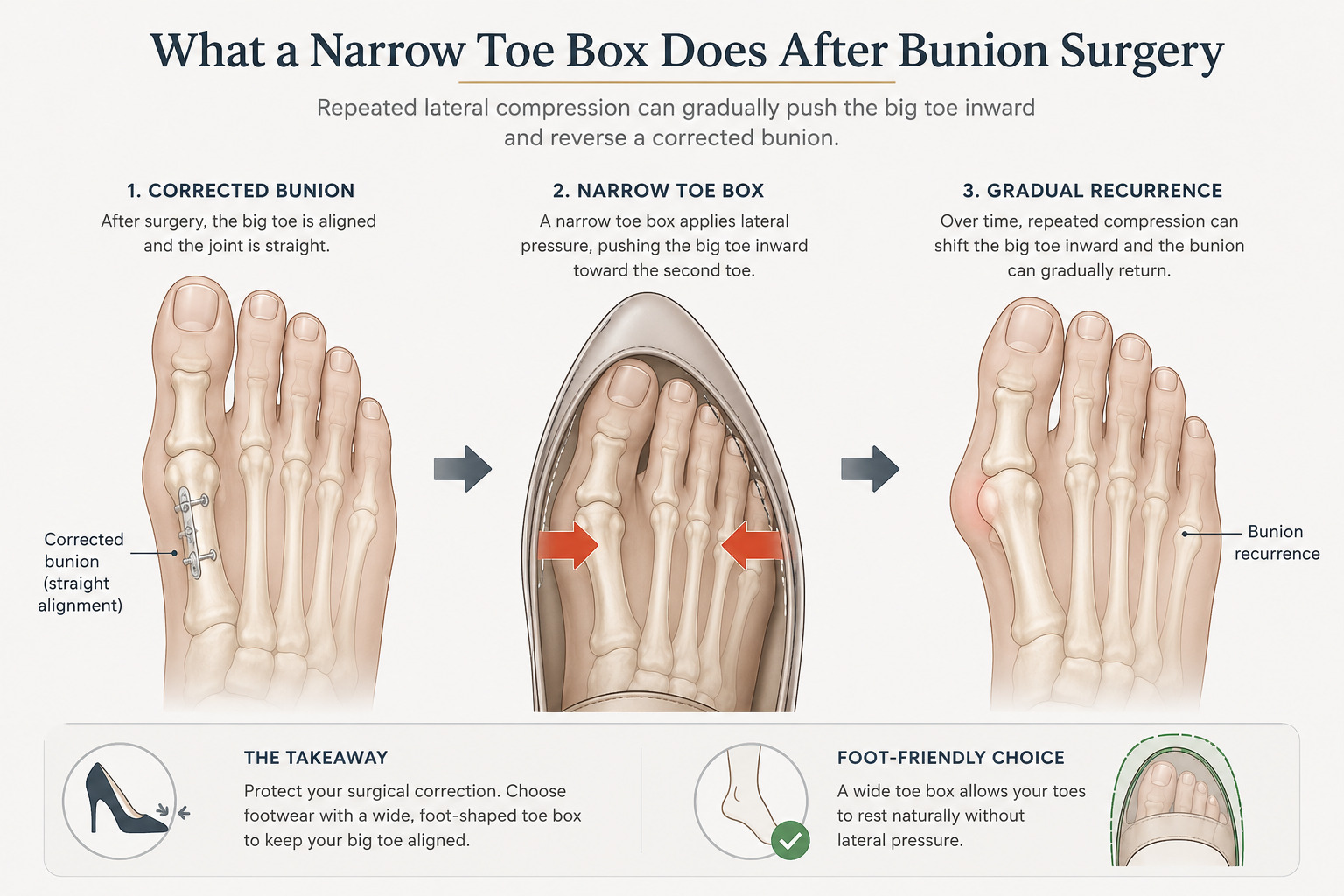
What a Narrow Toe Box Does After Bunion Surgery
Every step in a narrow shoe applies lateral compressive force to the corrected metatarsal. Before surgery that force drove the deformity. After surgery it encounters a correction still held by healing tissue. Over months the tissue accommodates. The deformity begins to return.
Hammertoe correction has the same vulnerability, and most patients do not know it.
Hammertoe surgery straightens a toe that has been bent at the middle joint by an imbalance in the tendons and ligaments. The correction involves releasing or transferring tendons, sometimes removing a section of bone, and placing a pin or screw to hold the toe in its corrected position while healing occurs.
The corrected toe is held straight during healing. What happens after the hardware is removed or after the temporary pin is taken out at six to eight weeks, is entirely dependent on the mechanical environment the toe enters.
A shoe with a low or shallow toe box applies downward pressure to the corrected toe with every step. The tendons and ligaments that were balanced by surgery are still remodeling. The joint that was straightened is still adapting. In a shoe with adequate toe box depth, the toe heals in its corrected position and the soft tissue remodels around that position. In a shoe that applies compressive force from above, the toe accommodates to the pressure. The deformity that required surgery begins to redevelop.
Extra-depth shoes with generous toe box volume are not a preference for post-hammertoe patients. They are a clinical requirement. Orthofeet's extra-depth designs and New Balance's 928v3 are frequently cited by podiatric surgeons specifically because the additional interior volume maintains the corrected toe position without applying mechanical pressure to healing tissue.
The transition window is where most mistakes happen - and most of them are entirely understandable.
The post-surgical footwear timeline is phase-dependent. During the first four to eight weeks, the surgical shoe or CAM boot provided by the surgeon is non-negotiable. It is not uncomfortable out of medical indifference. It is engineered to maintain the specific mechanical environment the procedure requires during bone consolidation.
The transition phase - weeks six to twelve for most procedures - is where patients make the decisions that determine whether the surgery holds long-term. The surgical shoe comes off. The foot looks dramatically better than it did before surgery. Life is pressing on the patient from every direction - work, family, the normal frictions of daily existence that did not pause for the recovery period.
And the shoes in the closet are right there.
Dr. Biernacki's clinical documentation identifies this moment with precision: "The single biggest mistake patients make is returning to normal shoe gear too early. The foot looks fine, the pain has decreased, and the temptation to ditch the boot is overwhelming - but bone healing lags behind pain resolution by four to six weeks."
The temptation is understandable. The clinical consequence of acting on it is not theoretical. It is measurable, documented, and expressed in recurrence rates that run between 10 and 25 percent depending on procedure type.
The transition shoe - the first shoe worn after the surgical boot - needs to satisfy specific clinical criteria. A wide or extra-wide toe box that does not contact healing incision sites. A soft, flexible upper that does not create pressure over healing joints. A low heel of one inch or less. Maximum cushioning to absorb the impact that healing tissue is not yet equipped to handle. A removable insole to accommodate custom orthotics if prescribed.
These are not features that describe fashionable shoes. They describe the HOKA Bondi 9, the New Balance 928v3, the Brooks Ghost in extra-wide, and the Orthofeet Edgewater. The same shoes podiatrists recommend because the clinical profile of post-surgical feet matches the clinical profile those shoes were designed to serve.
The hardest conversation in post-surgical podiatric care is about permanence.
Surgery corrects a structural problem. It does not change the foot type, the gait mechanics, or the biomechanical tendencies that contributed to the condition requiring surgery in the first place. A patient with first ray hypermobility, excessive motion of the first metatarsal, will still have first ray hypermobility after bunionectomy. A patient whose hammertoes developed from years in narrow-toed shoes still has the foot structure that made them susceptible.
The footwear changes required after foot surgery are not a temporary accommodation to recovery. They are a permanent recalibration of what belongs on the feet. The shoes that contributed to or accelerated the condition requiring surgery: narrow toe boxes, elevated heels, thin soles, rigid uppers, cannot return to the rotation without recreating the mechanical environment that produced the original problem.
This is the conversation many patients are not fully prepared for when they schedule surgery. They understand there will be recovery time. They understand there will be limitations during healing. What they sometimes do not understand until the follow-up appointment is that the footwear changes are not a phase of recovery. They are the rest of their footwear life.
The good news, and it is genuinely good news, is that the shoes meeting the post-surgical clinical criteria are not medical devices. They are well-designed, widely available shoes that many patients find more comfortable than anything they wore before surgery. The HOKA Bondi 9 does not look like a post-surgical accommodation. The New Balance 928v3 does not announce itself as orthopedic footwear. Brooks in extra-wide is a running shoe used by athletes.
The permanent footwear change is not a sacrifice. For most patients who make it, it is the discovery that comfortable feet were available the whole time.
What the research actually supports doing.
The clinical literature and the practical guidance from board-certified podiatric surgeons converge on a consistent set of principles. They are not complicated. They are just rarely communicated with the specificity that makes them actionable.
Do not transition out of the surgical shoe without imaging confirmation from your surgeon. How the foot feels is not the relevant data point. X-ray confirmation of bone consolidation is. The surgeon who performed the procedure is the only person with the information needed to make that call accurately.
When the transition shoe is selected, prioritize the features the healing foot requires over the features the pre-surgical foot preferred. A wide toe box that does not contact incision sites. A soft upper. A low heel. Maximum cushioning. A removable insole for orthotics if prescribed. These criteria select the shoe, not brand loyalty or aesthetics.
Treat the permanent footwear changes as protection for the investment the surgery represented. A bunionectomy costs thousands of dollars, weeks of recovery, and significant disruption to daily life. Returning to the shoes that contributed to the original bunion treats that investment as disposable.
Post-surgical swelling persists for three to nine months in most patients. This is normal. It means the shoe appropriate at six weeks of recovery may not be the shoe appropriate at six months, which may not be the shoe appropriate at twelve months. Foot volume changes throughout recovery. The footwear should accommodate those changes rather than resist them.
Finally, custom orthotics prescribed by a podiatrist after foot surgery address the biomechanical factors that contributed to the original condition with a precision that off-the-shelf footwear cannot replicate. For patients with first ray hypermobility, significant overpronation, or other structural factors that drove the original deformity, orthotics are not optional accessories. They are part of the mechanism by which the surgical correction is maintained long-term.
The surgeon's job ends in the operating room.
What happens after is the patient's responsibility - and it is a responsibility that the research suggests many patients are not fully equipped to exercise because they have not been given the information that makes exercising it possible.
The recurrence rates are not inevitable. A 10 to 25 percent bunion recurrence rate is not a fixed feature of the surgery. It is a rate measured across patients who received variable levels of post-surgical footwear guidance, who had variable access to appropriate transition footwear, and who returned to variable home environments with variable shoe closets waiting for them.
The patients at the lower end of that recurrence range did something different from the patients at the upper end. Some of the difference is procedure selection. Some is biomechanics. Some is genetics. And some: a measurable, documented, clinically significant some, is what they put on their feet when the surgical shoe came off.
That part is within the patient's control. It was always within the patient's control. The question is whether the patient has the information to exercise that control effectively.
You do now.
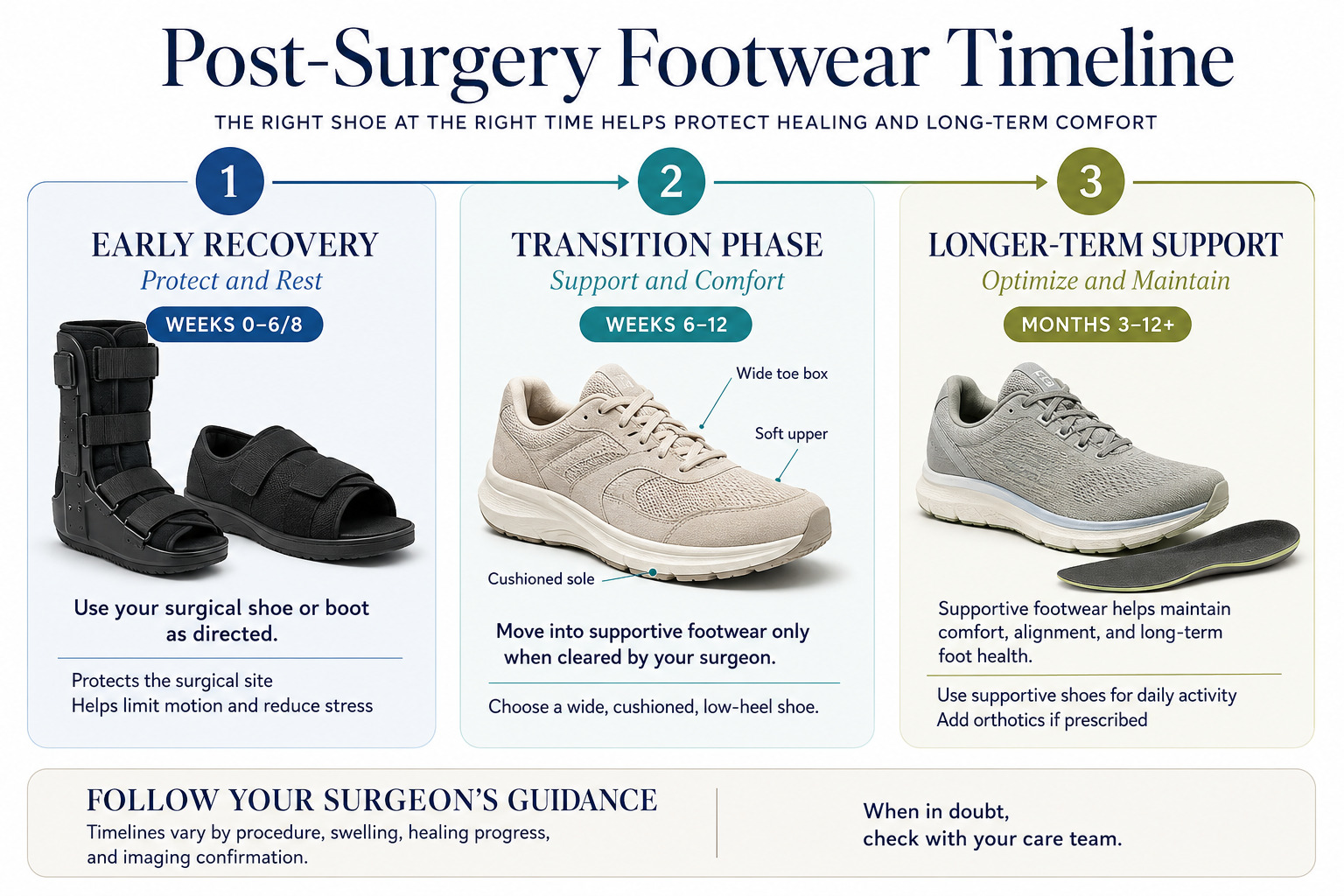
The Shoes That Meet the Post-Surgical Clinical Criteria
Wide toe box, soft upper, low heel, maximum cushioning, removable insole for orthotics. These are not style preferences. They are the features that determine whether a surgical correction holds long-term. The HOKA Bondi 9, New Balance 928v3, and Orthofeet Edgewater meet all five criteria.
Sources and clinical references.
The following sources informed this article. All clinical claims are traceable to peer-reviewed research, board-certified clinical documentation, or verified institutional data.
- Journal of Foot and Ankle Research, 2020 - bunion recurrence rates 5 to 25 percent by procedure type
- Weil Foot and Ankle Institute - 330,000 bunionectomies performed annually in the United States
- Treace Medical Concepts SEC market disclosure, 2023 - 700,000 hammertoe surgical repairs per year in the United States
- Medicare data via American Podiatric Medical Association - podiatrists perform 77 percent of bunionectomies and 83 percent of hammertoe surgeries in the United States
- Dr. Tom Biernacki, DPM, FACFAS - Board-Certified Podiatric Surgeon, Balance Foot and Ankle, Michigan - clinical documentation on post-surgical footwear transition and bone healing lag
- American College of Foot and Ankle Surgeons - post-operative protocol guidelines for bunionectomy and hammertoe correction
- InformedHealth.org, Institute for Quality and Efficiency in Health Care, updated October 2024 - bunion surgery outcomes and recovery
If you are currently recovering from foot surgery and need guidance on the right transition shoe for your specific procedure, our post-surgery footwear guide covers phase-specific recommendations for bunionectomy, hammertoe correction, Morton's neuroma excision, and plantar fascia release. If you are ready to find a shoe that fits the clinical criteria your healing foot requires, our guided shoe finder can match you to the right option in under two minutes. And if you need a podiatrist for post-surgical follow-up, our podiatrist finder covers major cities across the United States.