
You did not cut corners. You researched the options, read the reviews, and spent more than you wanted to on a pair of shoes that came consistently recommended for people who spend their days on their feet. You wore them in gradually. You replaced your old pair before they were completely destroyed.
And by 2pm, your feet still ache. By the end of the shift, you are counting down the minutes until you can sit down. By the time you get home, you are limping in a way you would rather not admit to.
This is one of the most common experiences among nurses, teachers, retail workers, restaurant staff, and anyone else whose job keeps them upright for eight or more hours a day. And the frustrating truth is that the shoe is rarely the only variable. What happens to your feet over the course of a long shift involves a set of physiological processes that no shoe, however well designed, can fully prevent on its own.
Understanding what those processes are is the first step toward knowing what footwear can realistically do, what it cannot, and where the other variables in the equation actually live.
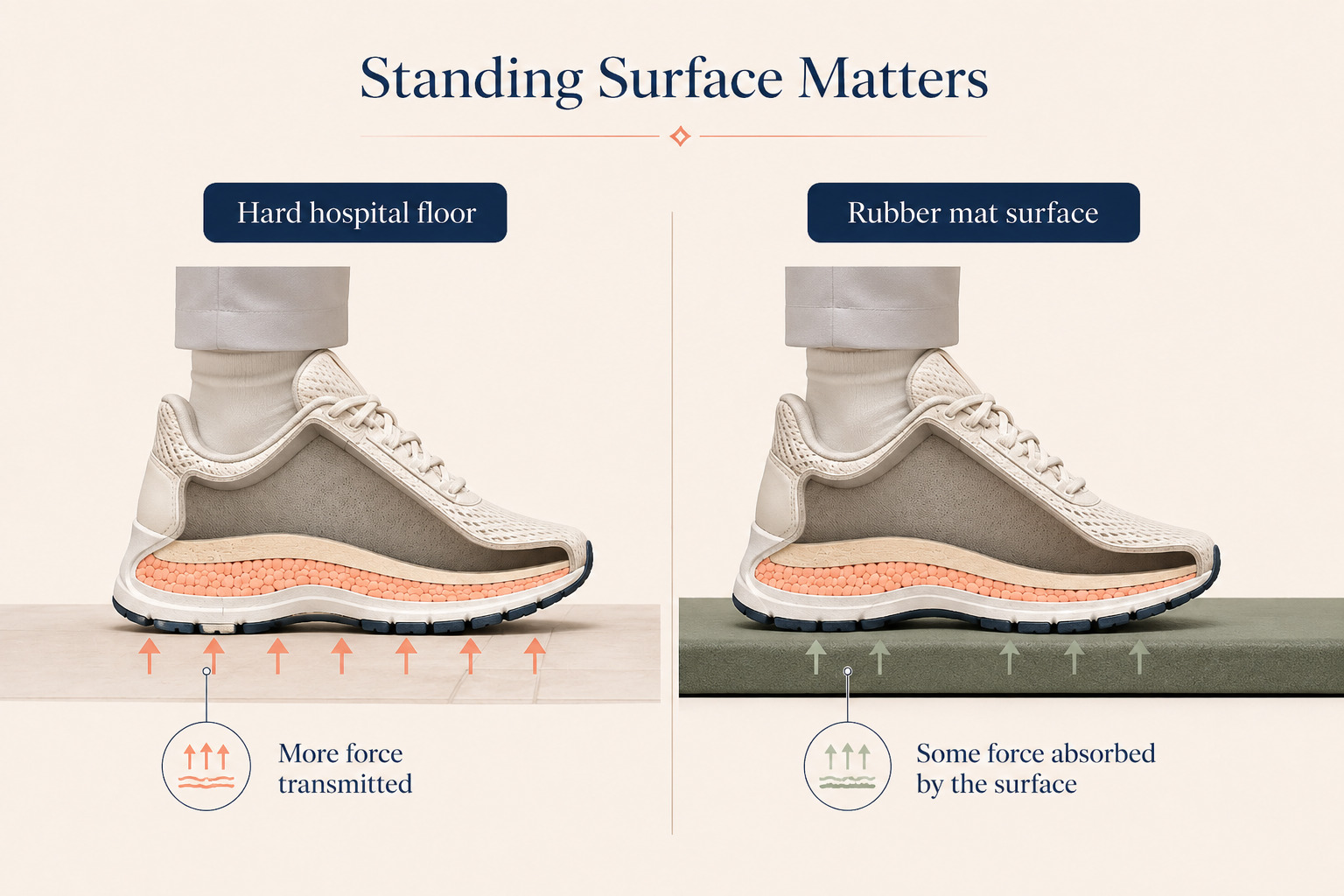
The shoe is one variable. The shift is another.
Eight hours of standing on hard surfaces creates physiological changes in the foot that accumulate faster than most people realize. The right shoe manages those changes. It does not eliminate them.
What Actually Happens to Your Feet During a Long Shift
Standing is not a passive activity. Every minute you are upright, the muscles in your feet, calves, and lower legs are contracting continuously to maintain balance and support your body weight. Unlike walking, which allows those muscles to contract and relax in a rhythmic cycle, sustained standing creates continuous muscle tension with no recovery period built in. Over several hours, this produces the deep aching fatigue that is distinct from the sharp pain of an acute injury and distinct from the morning pain of a chronic condition. It is the accumulated cost of sustained load on tissue that was not designed for uninterrupted static demand.
Simultaneously, gravity is working against your circulatory system. Blood returning from the lower extremities must travel upward against gravity, a process that depends heavily on calf muscle contractions to pump venous blood back toward the heart. When you are standing still, that calf pump is largely inactive. Peer-reviewed research published in PMC documents that prolonged standing causes insufficient calf muscle pumping, venous stasis, and increased venous pressure in the lower legs, leading to fluid leaking from capillaries into surrounding tissue. The result is the swelling, heaviness, and throbbing that builds through the day and peaks by late afternoon. Clinical research has found that clinically relevant levels of lower extremity symptoms can develop after as little as forty minutes of prolonged static standing.
The foot itself also changes dimensionally across a shift. Feet swell with fluid accumulation, particularly around the ankle and forefoot. A shoe that fit well at 7am may be genuinely too narrow or too shallow by 3pm, creating compression across the metatarsal heads and toes that was not present at the start of the day. This is not a fitting error that can always be anticipated at purchase.
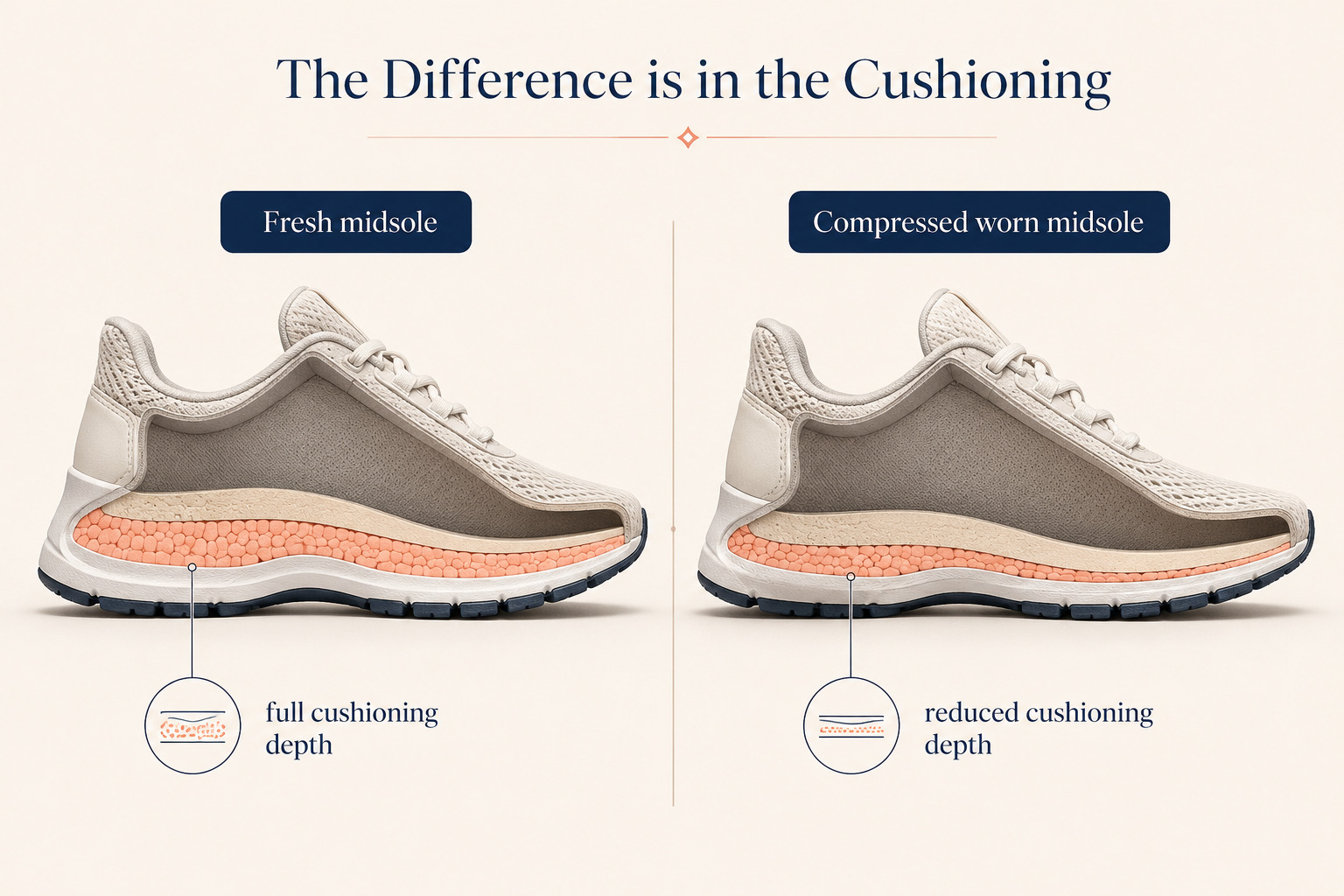
The cushioning you bought is not the cushioning you have
EVA foam midsoles compress permanently under load. Research documents meaningful loss of shock absorption between 300 and 500 miles of use, often well before the shoe shows visible wear. For people standing eight or more hours daily, that threshold arrives faster than most expect.
The Shoe Problem Nobody Mentions
Here is something the reviews rarely tell you. The cushioning in the shoe you bought when it was new is not the cushioning you have six months into daily wear. Every footstep compresses the midsole foam, and over time that foam loses the resilience to return to its original shape. The shoe looks fine. The outsole shows normal wear. But the midsole has quietly lost the ability to absorb impact the way it did on day one.
Peer-reviewed research published in PMC found that midsole cushioning degradation in EVA foam, the most common midsole material across all price points, occurs after anywhere between 480 and 640 kilometers of use. For someone standing and walking on hard floors for eight hours daily, that threshold arrives significantly faster than for a casual walker. Clinical data from podiatric sources suggests that for healthcare workers wearing the same pair every shift, replacement every six to eight months is appropriate before cushioning loss begins contributing to foot pain, even when the shoe appears externally intact.
This matters because a significant number of people experiencing mid-shift foot pain are not wearing the wrong shoe. They are wearing the right shoe past its functional lifespan. The solution is not a different shoe. It is a newer version of the same shoe.
Why the Right Shoe Is Necessary But Not Sufficient
A well-designed shoe for prolonged standing does three things. It absorbs the ground reaction force that would otherwise travel directly through the foot and into the ankle, knee, and hip. It provides enough arch support to prevent the plantar fascia from bearing an excessive share of body weight over the course of a shift. And it maintains enough forefoot volume to accommodate the swelling that accumulates through the day without compressing the metatarsal heads.
What it cannot do is prevent the venous pooling and fluid accumulation that result from hours of upright static posture. That is a physiological process driven by gravity and the circulatory demands of prolonged standing, and it occurs regardless of shoe quality. It also cannot compensate for a foot condition, structural issue, or gait pattern that places abnormal load on a specific structure with every step. A shoe that distributes load well across a normal gait pattern may still allow excessive strain on a plantar fascia that has already been compromised, or on metatarsal heads that are receiving more than their designed share of force due to a first ray that is not functioning correctly.
A peer-reviewed study published in the Journal of Foot and Ankle Research in 2025 identified footwear as an important but not standalone contributor to occupational foot pain, with biomechanical factors, surface hardness, and individual foot structure all playing independent roles that footwear alone cannot fully offset.
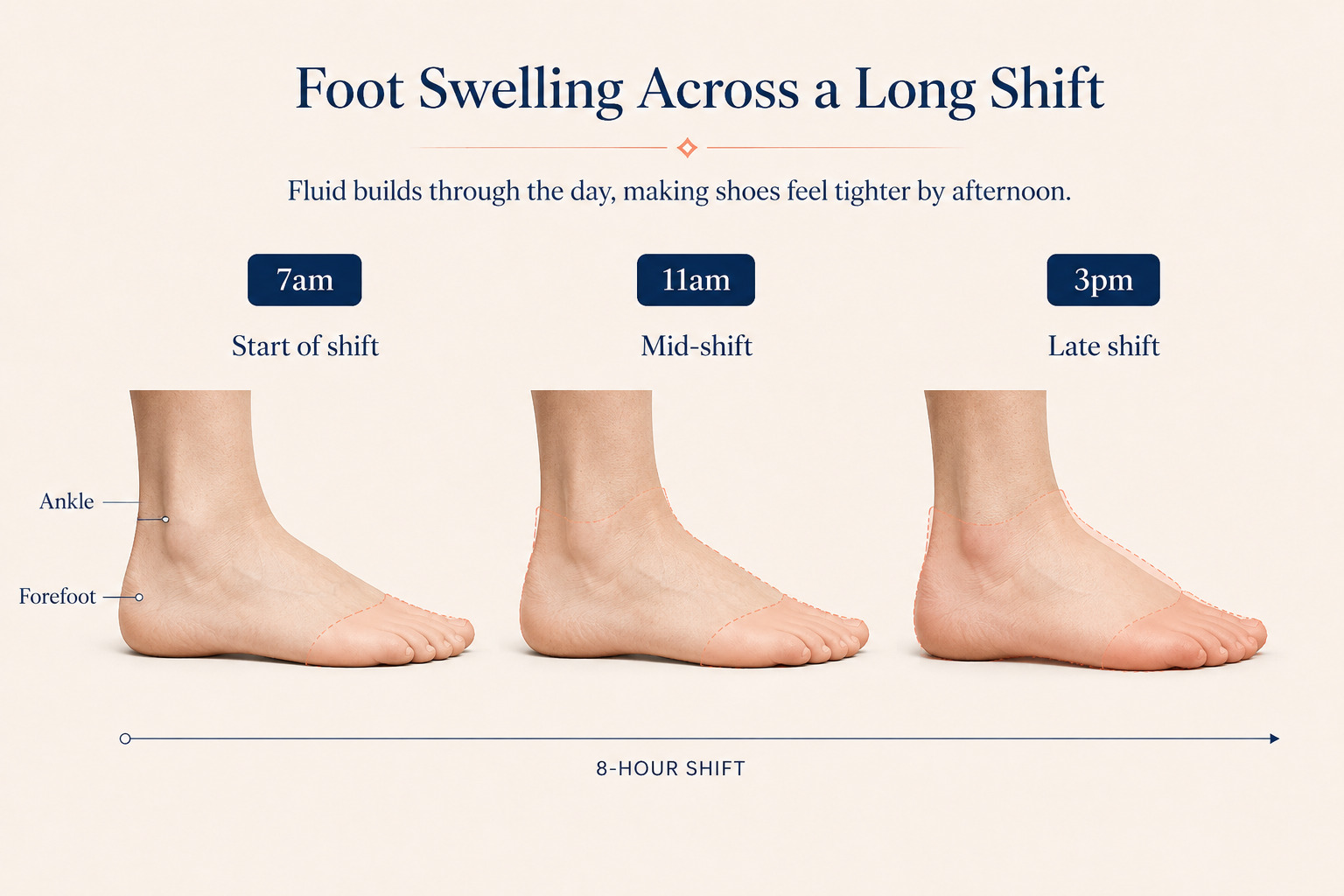
Your foot at 7am is not your foot at 3pm
Feet swell measurably across a long shift as venous pooling and fluid accumulation increase in the lower extremities. A shoe fitted in the morning may be meaningfully tighter by mid-afternoon, creating compression that was not present at the start of the day.
What Else Is in the Equation
Surface hardness is one of the most consistently underestimated variables. Concrete, tile, and hardwood floors offer no give under load. Every step on these surfaces transfers ground reaction force directly through the foot with no absorption from below. The shoe midsole is the only buffer between the foot and that surface. On a softer surface such as rubber matting, the surface itself absorbs a portion of that force, reducing the demand on the midsole. This is why standing on a commercial kitchen rubber mat feels meaningfully different from standing on a hospital corridor tile floor, even in identical shoes.
Static posture versus dynamic posture matters as well. Research shows that walking, even intermittently, activates the calf muscle pump and significantly reduces venous pooling compared to sustained static standing. People whose jobs allow them to move between tasks accumulate fatigue more slowly than those who stand in a fixed position for long periods. Where movement is not possible, brief weight shifts and deliberate calf raises have documented benefit for reducing lower extremity symptoms during prolonged standing.
Shoe rotation is a practical intervention that most people do not consider. Wearing the same pair every shift prevents the midsole foam from fully recovering between uses. EVA foam requires between thirty-six and forty-eight hours to re-expand after compression load, according to materials research. Rotating between two pairs extends the effective lifespan of both and ensures that the midsole is closer to its functional capacity at the start of each shift rather than carrying the residual compression from the previous day.
When the Pain Is Telling You Something the Shoe Cannot Fix
Mid-shift foot pain that is diffuse, builds gradually, and resolves with rest is consistent with the accumulated fatigue of prolonged standing that all the variables above contribute to. Footwear optimization, surface management, movement breaks, and shoe rotation address this pattern directly.
Pain that is sharp and localized, that concentrates at the heel or arch, that is present from the first steps of the morning before any standing has occurred, or that is accompanied by swelling in one foot but not the other, points toward something structural that footwear modification alone will not resolve. Plantar fasciitis, metatarsalgia, posterior tibial tendon dysfunction, and stress fractures of the metatarsals all present in people who stand occupationally, and each requires identification before the right footwear solution can be matched to the actual problem.
Swelling that is unilateral, that comes on suddenly, or that is accompanied by warmth, redness, or pain in the calf warrants prompt medical evaluation to rule out deep vein thrombosis, which can occur in people with prolonged standing occupations and presents with symptoms that overlap with ordinary shift fatigue.
The MySoleMatch podiatrist finder covers thirty-one cities with verified practicing podiatrists. If foot pain has been present for more than four weeks, has not responded to shoe changes, or is affecting how you walk and recover between shifts, a clinical examination is the appropriate next step.
What to Actually Look for in a Shoe for Long Shifts
Given everything above, the shoe for prolonged standing needs to do more than be comfortable in the store. It needs to maintain adequate cushioning across a full shift and across months of daily use, provide enough forefoot volume to accommodate mid-shift swelling without compressing the toes, and offer arch support that reduces plantar fascia strain during sustained loading.
Rocker sole geometry adds meaningful value for people whose pain centers in the forefoot. The pivot point in a rocker sole completes heel-to-toe transition without requiring full toe dorsiflexion, reducing the peak pressure on the metatarsal heads during push-off with every step across an eight-hour shift. For someone taking six thousand to ten thousand steps per shift, the cumulative reduction in forefoot load is clinically significant.
A removable footbed that accepts a metatarsal pad or custom orthotic gives the shoe a second line of pressure management beyond what the midsole provides. This matters particularly for people who have a structural factor, such as a long second metatarsal or a high arch, that creates uneven load distribution the shoe itself cannot fully address.
The standing all day guide and the nurses guide cover the specific APMA-verified shoes that meet these criteria across multiple brands and price points. The shoe finder quiz routes to condition-specific recommendations if the pain has a more specific character than general shift fatigue.
The Shoe Is One Variable in a Multi-Variable Problem
Foot pain after a long shift in good shoes is not evidence that the shoes failed. It is evidence that prolonged standing on hard surfaces is a physiologically demanding activity that accumulates across hours in ways a single piece of footwear cannot fully absorb.
The right approach is to optimize every variable that is within your control. Footwear that fits correctly and has not exceeded its functional lifespan. Rotation between pairs. Surface management where possible. Movement breaks that activate the calf pump. And honest attention to whether the pain has a specific character that points toward a structural condition requiring clinical identification.
Most people doing demanding standing work will experience some degree of end-of-shift fatigue regardless of shoe quality. The goal is to manage it to a level that does not accumulate across days and weeks into something more persistent and more limiting.