
The footwear industry has spent decades normalizing pain in new shoes. The break-in period is treated as an accepted part of shoe ownership, a temporary phase of discomfort that resolves as the shoe conforms to the foot. Salespeople mention it. Return policies are built around it. And millions of people push through pain in new shoes every year, assuming the discomfort is expected and temporary.
Podiatric guidance says something different. A shoe that is correctly matched to a foot in terms of length, width, depth, and construction should be comfortable from the first wear. Not after a week. Not after fifty miles. From the first time it is on the foot. Pain in a new shoe is information, and reading that information correctly is the difference between a foot that adapts to a well-fitted shoe and a foot that sustains progressive damage from a shoe it was never compatible with.
The question is not whether new shoes can cause some sensation. They can. The question is what kind of sensation is normal mechanical adjustment, what kind is a warning signal that requires attention, and what kind means the shoe is wrong and should be returned before more damage occurs. These three categories are clinically distinct. Most people have never been taught to tell them apart.
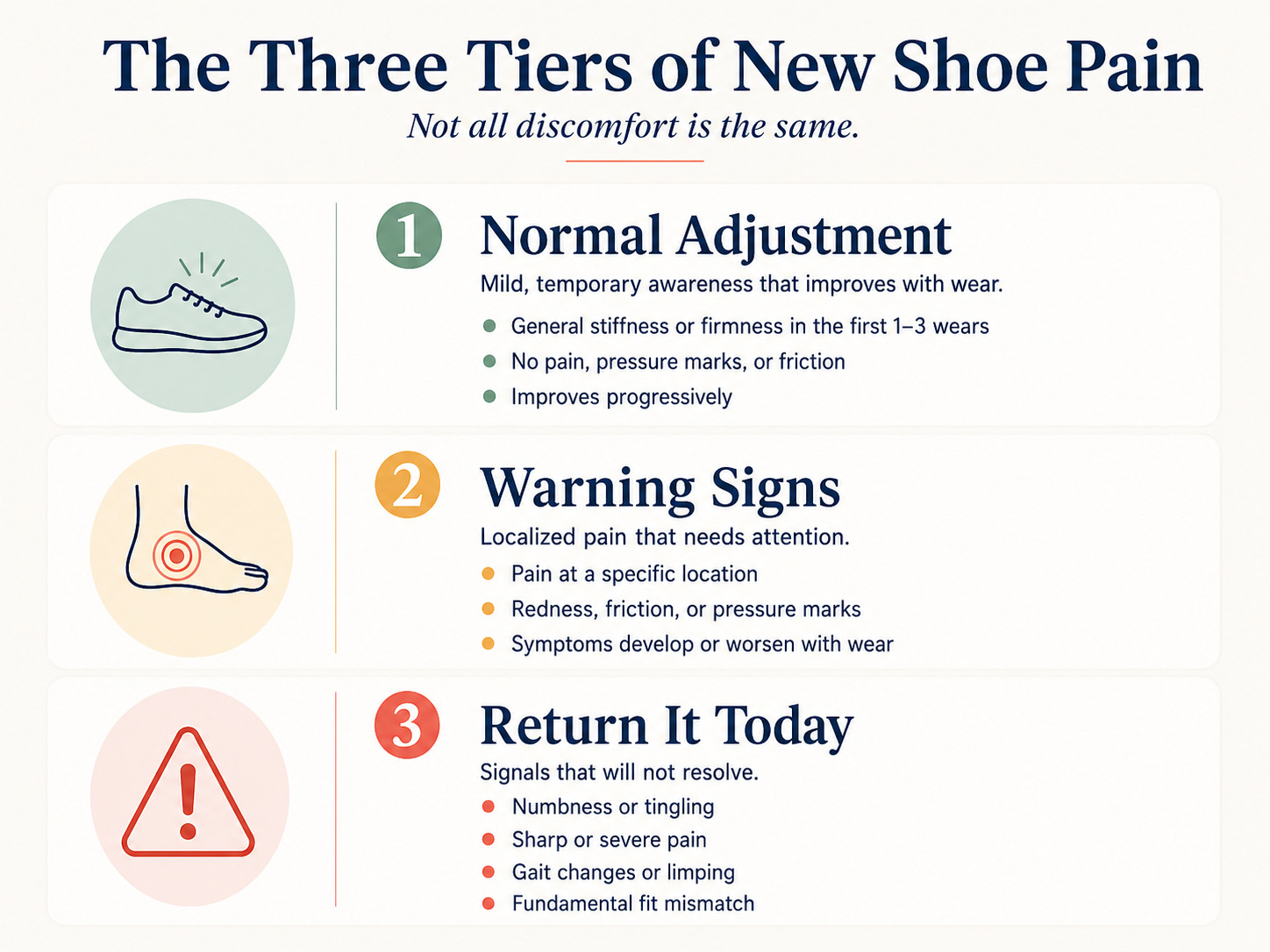
Not all new shoe discomfort is equal.
Normal adjustment, warning signs, and return-immediately signals are three distinct categories. The difference between them is not intensity alone but location, timing, and whether the sensation resolves or progresses with continued wear.
What Is Normal: Mild Adjustment Sensation
Mild stiffness in a new shoe during the first few wears is a legitimate mechanical reality. The midsole foam in a new shoe has not yet compressed to accommodate the specific pressure distribution of your foot. The upper materials have not yet flexed to the precise bend points of your foot's movement pattern. A sensation of slight firmness or awareness of the shoe during the first one to three wears, in the absence of pain, pressure marks, or friction, falls within the range of normal adjustment.
The distinction that matters is whether the sensation is generalized awareness or localized discomfort. Awareness that a shoe feels new is not pain. It does not worsen through the wear session. It does not create redness, friction, or pressure marks when the shoe comes off. It does not occur at a specific point on the foot that corresponds to a structural feature of the shoe. It is simply the foot registering an unfamiliar environment.
Normal adjustment also resolves progressively. If mild stiffness is present in the first wear and noticeably reduced by the third wear without any localized discomfort developing, that is the trajectory of a shoe that fits correctly and is completing a genuine break-in arc.
What Is a Warning Sign: Localized Pain That Needs Attention
Localized pain in a new shoe is a different category entirely. When discomfort occurs at a specific anatomical point rather than as a general sensation, the shoe is communicating a mechanical mismatch at that location. The location of the pain is the diagnosis.
Pressure at the back of the heel that produces redness or a blister within the first few wears indicates the heel counter is too wide for your heel, allowing slip and friction with every step, or too rigid and narrow, creating direct pressure on the heel bone. Neither resolves with continued wear. The heel counter does not soften. The heel does not narrow.
Pressure or numbness across the forefoot after thirty to sixty minutes of wear indicates forefoot width is insufficient for your metatarsal spread under load. This is particularly relevant because feet swell measurably through a day of standing and walking. A shoe that feels acceptable in width when first put on in the morning may create genuine forefoot compression by midday. If forefoot pressure develops within a single wear session, the shoe is the wrong width.
Arch pain or heel pain that begins during the first wear and is more than mild awareness indicates a mismatch between the shoe's support geometry and your foot's structural needs. A shoe with insufficient arch support for a foot that requires it will begin loading the plantar fascia incorrectly from the first step. This does not improve with continued wear. The arch height in a shoe is fixed construction, not something that adjusts to the foot over time.
Warning sign pain warrants a pause before the shoe is worn again. Assess whether the pain corresponds to a fit issue that can be addressed with a different insole, a heel cup insert, or lacing adjustment. If the underlying construction cannot be corrected with a modification, the shoe is a candidate for return.
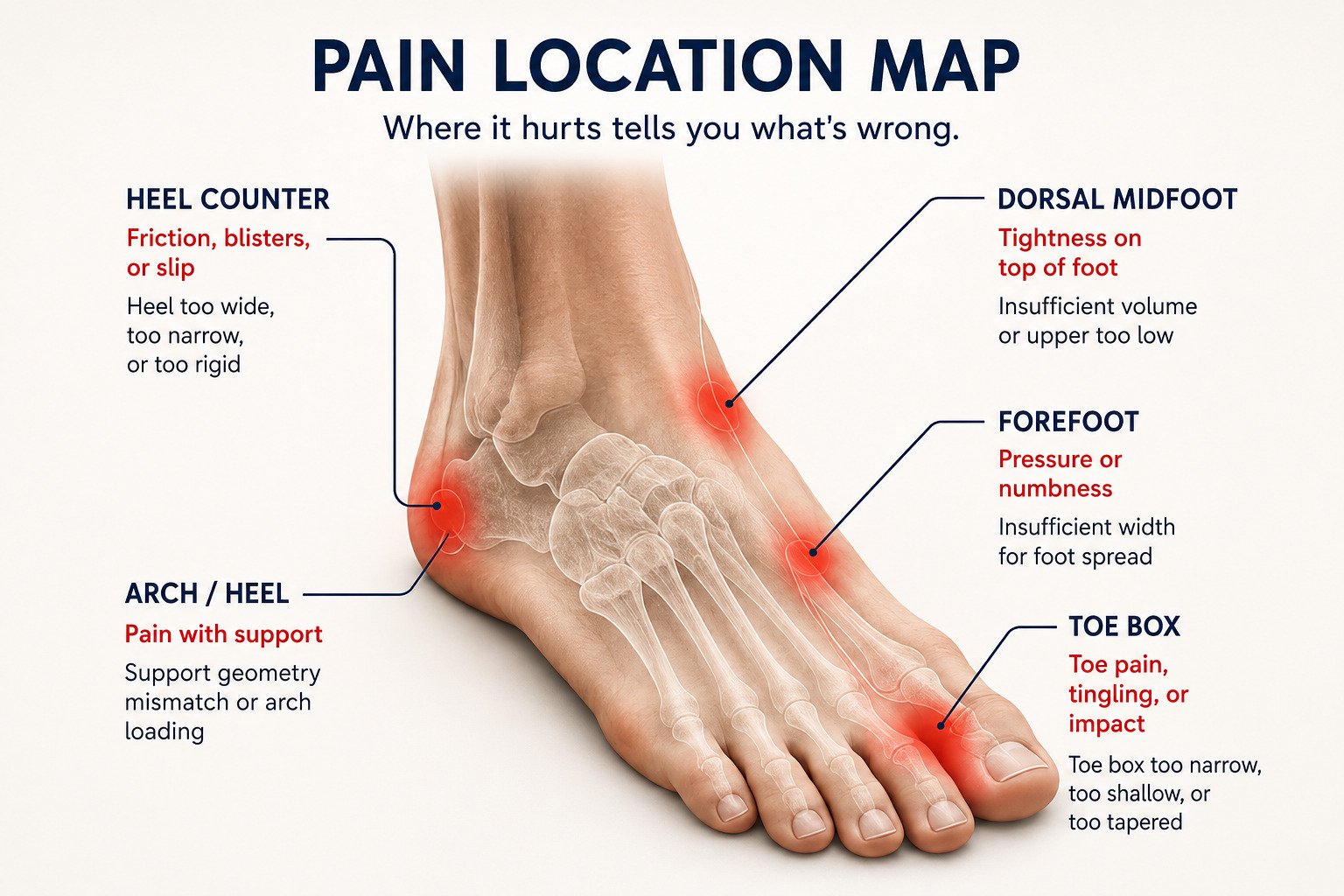
Location identifies the mismatch.
Pain at the heel indicates a heel counter fit problem. Forefoot pressure or numbness indicates width insufficiency. Arch or heel pain from the first wear indicates a support geometry mismatch. Dorsal midfoot tightness indicates insufficient volume. Each location points to a specific construction variable, not a break-in issue.
What Means Return It Today: Signals That Will Not Resolve
Some pain signals in a new shoe are not warning signs. They are immediate disqualifiers. These are sensations that arise from fundamental dimensional mismatches between the shoe's construction and your foot's shape. No amount of wear, no insole swap, and no lacing modification will correct them because the mismatch exists in the fixed geometry of the shoe itself.
Numbness or tingling in the toes during the first wear indicates the toe box is compressing the forefoot enough to affect nerve function. This is forefoot compression significant enough to create neurological symptoms. Continued wear of a shoe producing this signal risks progressive nerve irritation and in people with existing forefoot conditions can accelerate Morton's neuroma development or worsen existing interdigital nerve compression. Return the shoe.
Pain at the first metatarsophalangeal joint, the bunion joint, during the first wear indicates the upper is creating lateral pressure on the joint from the first step. In a foot with an existing bunion, this pressure directly drives the inflammatory cycle that produces pain and accelerates angular progression. The upper material will not soften enough to eliminate that contact point. Return the shoe.
Heel pain that is sharp rather than mild on the first wear, particularly if it matches the morning heel pain pattern characteristic of plantar fasciitis, indicates the shoe's arch support geometry is actively loading the plantar fascia incorrectly. A shoe that triggers plantar fasciitis pain on the first wear is the wrong mechanical match for that condition. Return the shoe.
Any pain that is severe enough to alter your gait during the first wear is an immediate return signal. A shoe that causes limping is not breaking in. It is causing harm.
How the Threshold Shifts for Specific Conditions
The three tiers above apply to neurologically intact feet with no active foot conditions. For certain populations the tolerance threshold is lower and the stakes are higher.
For people with plantar fasciitis, any heel or arch pain in a new shoe beyond the mildest awareness is a warning sign, not normal adjustment. The plantar fascia is already operating under chronic tensile load. A shoe that adds to that load from the first wear will not improve. It will sustain or worsen the inflammatory cycle that is already present.
For people with bunions, any sensation at the bunion prominence during the first wear is a return signal, not a warning sign. There is no break-in phase for a bunion joint. Contact is contact. Pressure on an inflamed joint does not reduce with continued exposure.
For people with diabetic neuropathy, the entire framework shifts. Reduced or absent protective sensation means the normal pain signals that identify warning signs and return signals may not be present at all. The absence of pain in a new shoe does not confirm the shoe fits correctly. It may mean the foot cannot feel that it does not. For people with active neuropathy, new shoes should be assessed by a podiatrist before extended wear, and the foot should be inspected after every new shoe session for redness, pressure marks, or skin changes that would otherwise be felt as discomfort.
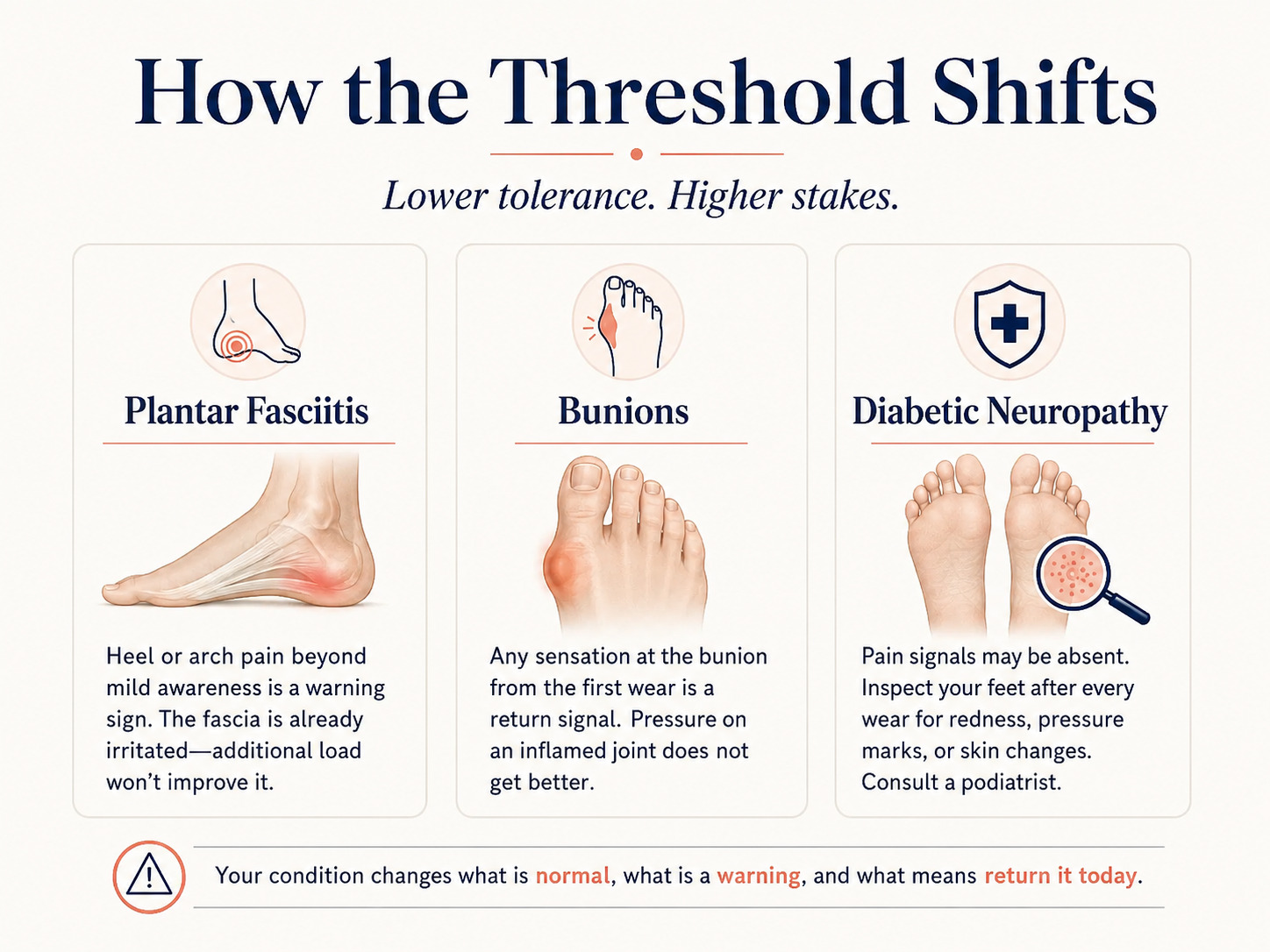
Lower tolerance. Higher stakes.
For plantar fasciitis, bunions, and diabetic neuropathy, the three-tier framework compresses. What counts as normal adjustment for a healthy foot is a warning sign or immediate return signal for these populations. Your condition changes what the shoe is telling you.
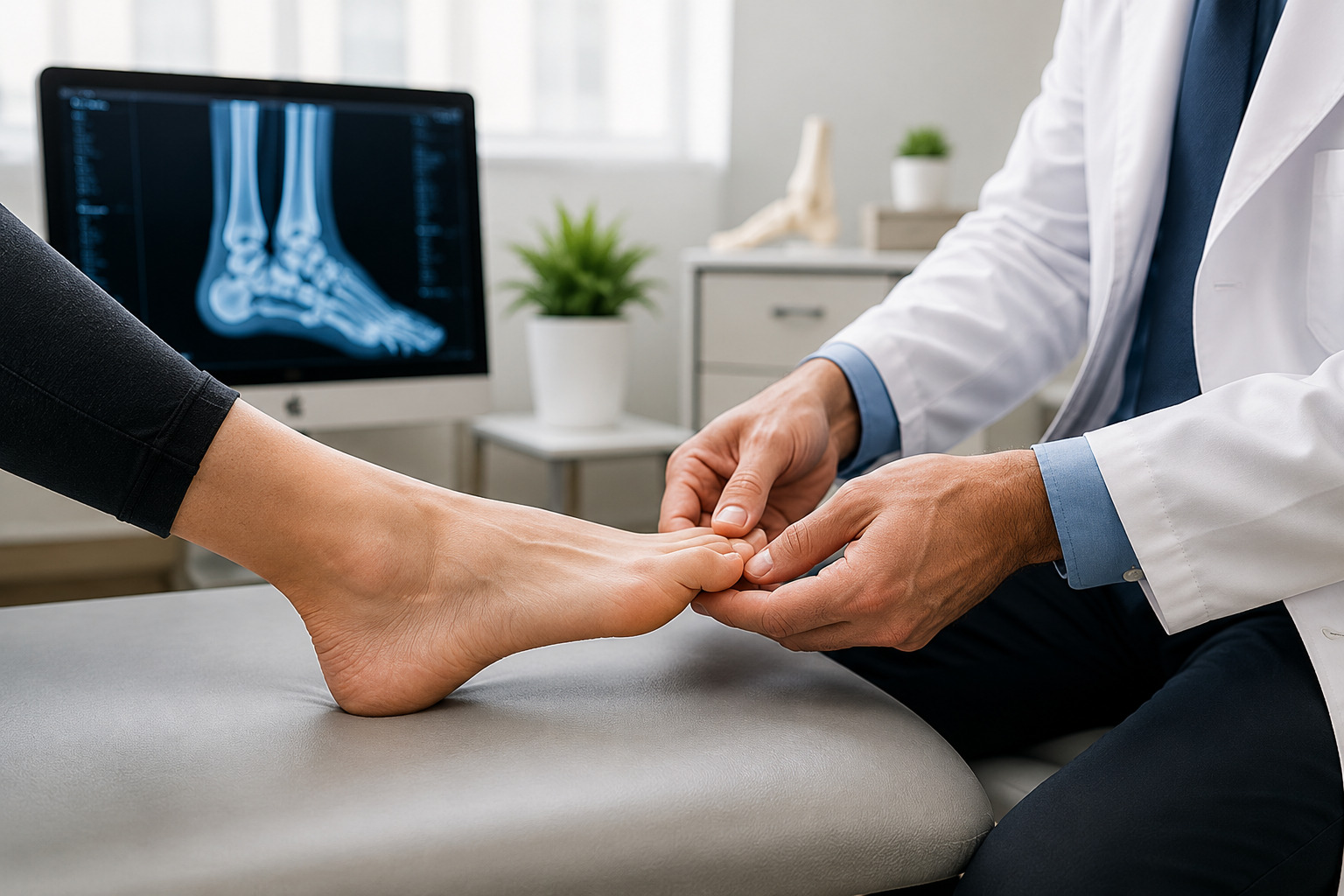
When Footwear Is No Longer the Answer.
Persistent foot pain across multiple correctly fitted shoes is not a footwear problem. It is a clinical signal. A board-certified podiatric physician can identify whether a structural issue, a custom orthotic requirement, or a condition requiring intervention is the correct next step.
When the Shoe Is Not the Problem
If you have returned multiple shoes for pain signals, selected replacements based on clinical criteria rather than popularity, and still find that new shoes produce discomfort beyond mild adjustment sensation, the shoe may not be the variable. Persistent foot pain across multiple correctly fitted shoes is a clinical signal, not a consumer problem.
A board-certified podiatric physician can assess whether a structural issue such as a stress fracture, tendon pathology, or progressive deformity is driving pain that footwear alone cannot resolve. A custom orthotic prescription changes the internal geometry of any shoe to match the specific dimensional needs of your foot in a way that off-the-shelf insoles cannot replicate. These are clinical interventions that sit outside the scope of footwear selection and require professional assessment to access.
The MySoleMatch podiatrist finder covers thirty-one cities with verified practicing podiatrists for anyone whose pain signals have moved beyond what a shoe change can address. The shoe finder quiz routes to condition-matched, APMA-verified shoes for anyone still in the selection process. Both are the correct next step depending on where you are in that process.
A new shoe should not require tolerance. It should require only the judgment to read what it is telling you.