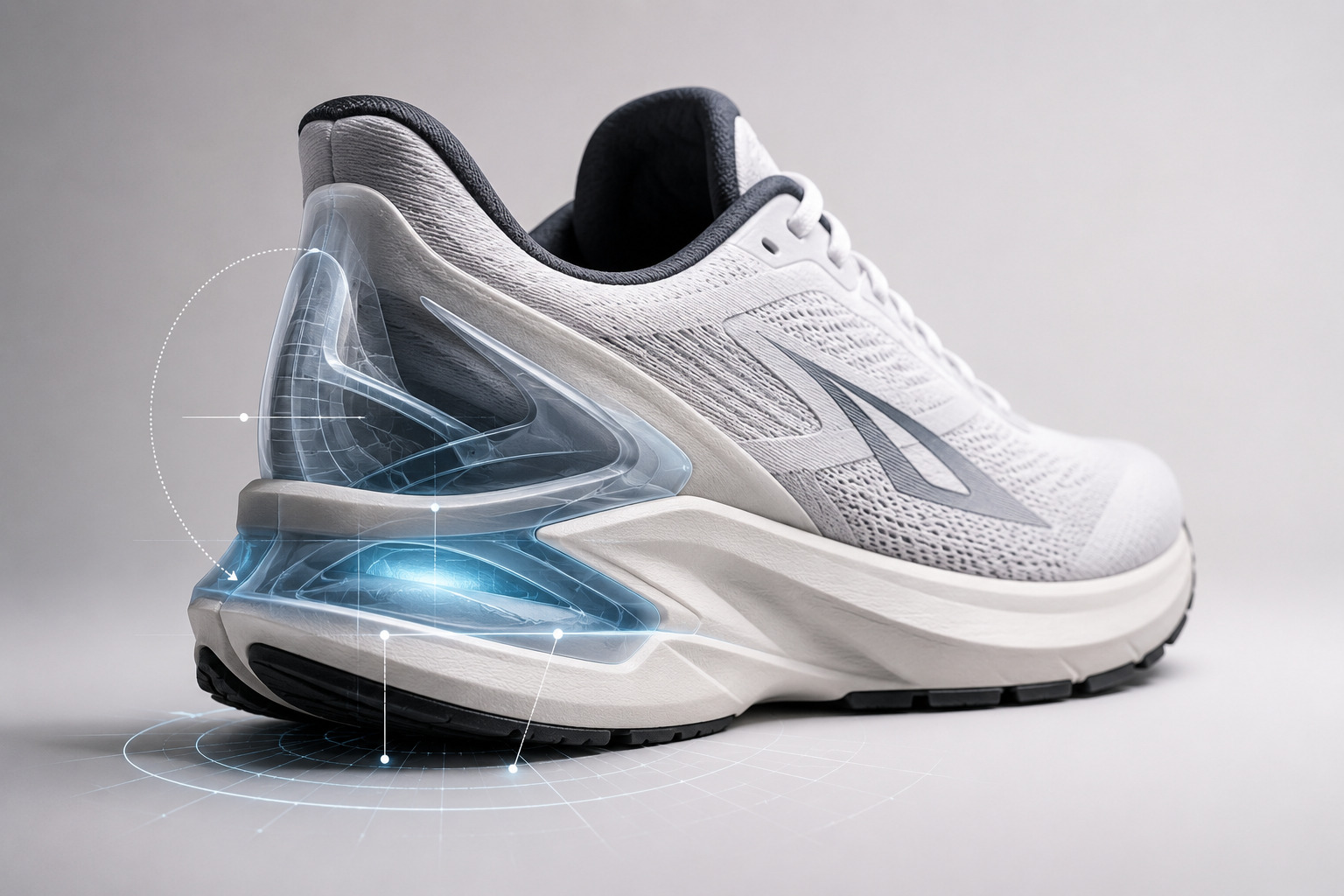
Ask most people what makes a shoe good for ankle support and the answer comes quickly: a high collar. The higher the shoe rises above the ankle joint, the more support it provides. This assumption is so widely held that it shapes purchasing decisions for athletes, people recovering from ankle sprains, hikers choosing between boot heights, and anyone who has been told by a coach or parent to wear high-tops to protect their ankles.
The research does not support it. At least not in the way most people assume. And the features that actually determine how well a shoe supports the ankle are almost never what gets discussed at the point of sale. Understanding what ankle support in footwear really means and where it actually comes from, is more useful than any collar height rule of thumb.
Why ankle support in footwear matters
Ankle sprains are among the most common musculoskeletal injuries encountered in primary care, emergency departments, and orthopedic clinics, according to NIH StatPearls. A 2025 epidemiology study published on PubMed using National Electronic Injury Surveillance System data found that an estimated 7.4 million ankle sprains presented to US emergency departments between 2010 and 2024.
What makes this more than a simple acute injury problem is what happens afterward. NIH StatPearls reports that up to 40% of ankle sprains go on to develop chronic symptoms, and approximately 20% of individuals who sustain an acute sprain develop chronic ankle instability. A condition where the ankle continues to give way, feel unreliable, and remain vulnerable to re-injury long after the original sprain has healed. A systematic review published in the Journal of Foot and Ankle Research found the prevalence of chronic ankle instability at 25% across study populations, rising to 46% among those with a prior history of ankle sprains.
For this population, which is substantial, footwear choice is not casual. The right shoe can meaningfully reduce the mechanical conditions that lead to re-injury. The wrong shoe can replicate them with every step. And the most common framework people use to make that choice, being collar height, turns out to be one of the least reliable guides available.
What the research actually says about high-top shoes
The assumption that high-top shoes prevent ankle sprains has been studied extensively since the 1980s, and the findings are more nuanced than the popular belief suggests.
On the biomechanical side, there is supporting evidence. A PubMed review of footwear and ankle sprain prevention found that studies support the use of high-top shoes for their ability to limit extreme ranges of motion, provide additional proprioceptive input, and decrease external joint stress. A 2014 PMC study found that high-top shoes were more effective than low-top shoes in reducing the amount and rate of ankle inversion during landing on a tilted surface. The kind of sudden, extreme motion that causes a lateral ankle sprain.
But clinical outcomes, actual injury rates in real populations over real time, tell a different story. The Medical University of South Carolina summarizes the evidence clearly: a 2019 systematic review and meta-analysis found no superiority of either high-top or low-top shoes in preventing ankle sprains. Multiple earlier studies reached the same conclusion, including a prospective randomized trial in collegiate basketball players that found no significant difference in ankle sprain rates between high-top and low-top footwear.
More concerning is what some research suggests about the mechanism. A PMC study found that wearing high-top shoes can induce delayed pre-activation timing and decreased amplitude of the evertor muscles. the muscles on the outside of the lower leg that actively stabilize the ankle during movement. In other words, the collar may be doing some of the stabilization work that the muscles would otherwise perform, and over time that may reduce the functional strength of the very system the ankle depends on most.
MUSC's conclusion from the body of evidence is direct: ankle sprain prevention is determined more by proper warm-up, ankle and core strengthening, and balance exercises than by collar height. The shoe matters - but collar height is not where the protection primarily comes from.
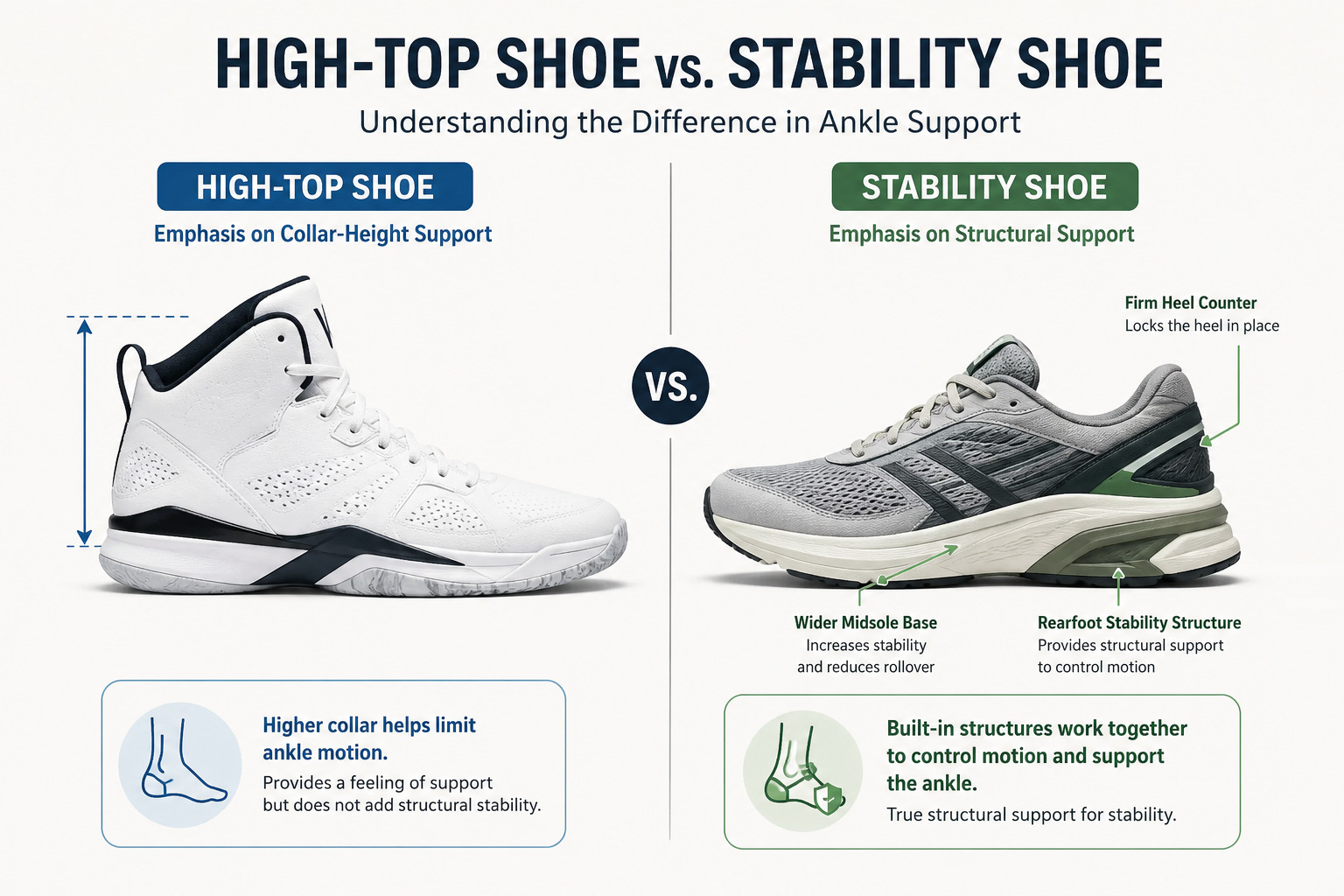
Collar height is one variable. Structural integrity is the more important one.
A high collar limits extreme range of motion at the ankle joint. A firm heel counter, wide midsole base, and secure fit lockdown provide rearfoot stability through the entire gait cycle. Not just at extreme ranges. These are different mechanisms addressing different aspects of ankle support.
What actually provides ankle support in a shoe
Ankle support in footwear comes from a combination of structural features working together. Collar height is one of them and for specific situations, like static stability when an external force is applied, it does provide measurable benefit. But it is not the primary or most reliable source of support for most of the situations where ankle stability matters during normal movement.
The heel counter
The heel counter is the stiff cup at the back of the shoe that surrounds the calcaneus, which is the heel bone. A firm, well-constructed heel counter locks the rearfoot in a neutral position, prevents the heel from tilting inward or outward under load, and provides the structural anchor from which the rest of the shoe's support system operates. For ankle stability, the heel counter is arguably the single most important feature in the shoe and it has nothing to do with collar height. A low-top shoe with a firm heel counter provides more meaningful rearfoot stability than a high-top shoe with a soft, collapsible one.
Testing the heel counter is straightforward. Squeeze the back of the shoe between your fingers. A heel counter that provides genuine support resists compression firmly. One that collapses easily between your fingers will do the same under the load of your body weight in motion.
The midsole base width
A wider midsole base increases the lateral stability platform of the shoe. The surface area over which the foot's weight is distributed. A narrow midsole base, common in racing and minimalist shoes, reduces that platform and increases the mechanical advantage of any inversion force applied to the ankle. For someone with chronic ankle instability or a history of lateral ankle sprains, a shoe with a broader midsole base reduces the lever arm of that inversion moment with every footstrike. This is structural protection that operates continuously through normal gait and not just at extreme ranges of motion.
Medial post and rearfoot stability structure
For people whose ankle instability has a pronation component, where the arch collapses inward and the ankle rolls medially rather than laterally, a medial post or guide rail system in the midsole addresses the root mechanical cause directly. Overpronation places abnormal stress on the medial ankle structures and the posterior tibial tendon. A stability shoe with a medial post controls that inward collapse, reducing the cumulative load on those structures over thousands of steps. This is a different mechanism from lateral ankle sprain prevention, but it is equally relevant to ankle health for a large portion of the population.
Fit lockdown and upper security
A foot that moves inside the shoe: sliding laterally, lifting at the heel, or shifting forward during deceleration, cannot benefit from the shoe's structural support features. Fit security is the prerequisite for all of them. A snug, secure fit through the midfoot and heel, with a lacing system that holds the foot in consistent contact with the shoe's support geometry, is a fundamental component of ankle support that no amount of structural engineering can compensate for when it is absent.
Outsole geometry and surface traction
Ankle sprains frequently occur when the foot encounters an uneven surface. Like a curb edge, a trail root, a court surface under a pivot. An outsole that provides reliable traction on the surfaces where the shoe will actually be worn reduces the frequency of the unexpected foot plant events that initiate inversion. This is particularly relevant for trail running and hiking, where outsole lugs and compound rubber formulations are doing meaningful ankle-protective work that collar height alone cannot replicate.
When collar height actually does matter
This is not an argument that collar height is irrelevant. It is an argument that it is one variable in a more complex system, and that prioritizing it over the structural features described above produces worse footwear decisions for most people.
There are specific contexts where collar height provides genuine additional benefit. For static stability. When a person is standing still and an external force is applied to the ankle, biomechanical research does support the protective effect of a higher collar. For activities involving very high rates of inversion loading, such as certain court sports and trail running on technical terrain, the collar may provide a meaningful last line of defense at extreme ranges of motion beyond what the structural features of the midsole and outsole address.
For people with severe chronic ankle instability, a combination approach often makes clinical sense. Like a shoe with strong heel counter and midsole stability plus a higher collar, used alongside ankle bracing during high-risk activities and a dedicated proprioception and strengthening program. MUSC's review notes that external supports such as ankle bracing are effective at reducing re-injury risk, particularly when combined with preventive exercise programs. The shoe is one layer of a multi-layer management strategy, not the whole strategy.
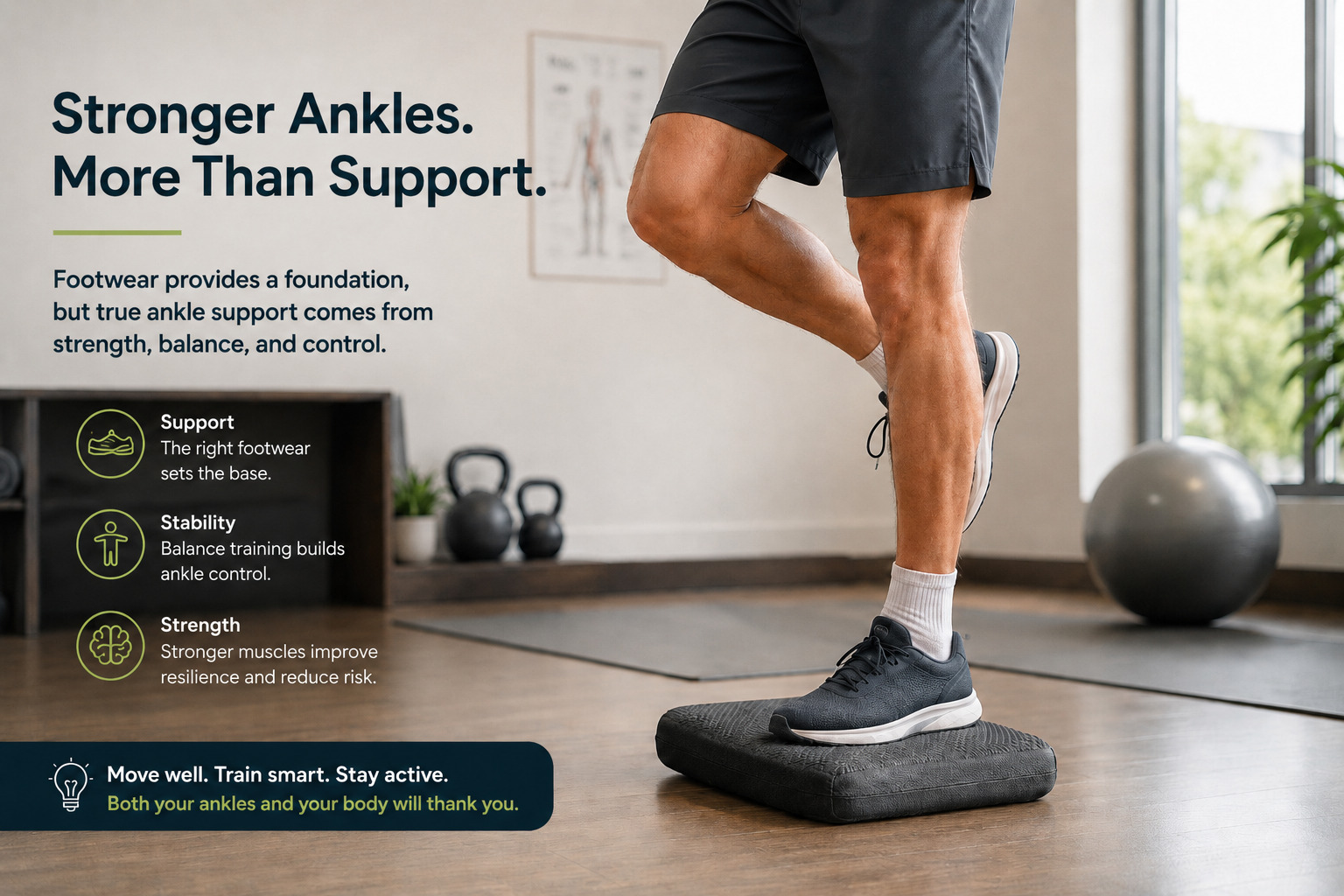
Footwear is one layer. Proprioceptive training is another.
The research consistently shows that ankle strengthening, balance training, and neuromuscular conditioning reduce re-injury risk more reliably than collar height alone. For chronic ankle instability, the shoe supports the program. It does not replace it.
What this means by condition
History of lateral ankle sprains without chronic instability
For someone who has sprained an ankle once or twice but does not have ongoing instability, the footwear priority is a shoe with a firm heel counter, secure fit, and appropriate outsole traction for their primary activity. Collar height is a secondary consideration. Proprioceptive training to restore neuromuscular function after the sprain is more protective than any shoe feature.
Chronic ankle instability
For someone with confirmed chronic ankle instability: recurrent giving way, persistent sense of unreliability in the ankle, ongoing episodes of re-sprain, the footwear picture changes. A stability shoe with a firm heel counter, broad midsole base, and secure upper fit is the baseline. Ankle bracing during high-risk activities adds a protective layer. A dedicated rehabilitation program addressing proprioception, peroneal muscle strength, and single-leg stability is the most evidence-supported long-term intervention. The MySoleMatch ankle instability guide covers the full footwear requirements for this condition.
Overpronation with medial ankle involvement
For ankle instability that presents medially, where the arch collapses and the ankle rolls inward, a stability shoe with a medial post or guide rail system is the primary requirement. This is a different mechanical problem from lateral instability and requires a different structural solution. High collar height addresses neither. A medial post addresses the root cause directly. See the softness versus stability article for the full explanation of how medial posts and modern stability systems work.
Hiking and trail activities
For hiking, the collar height question is more genuinely relevant than in most other contexts. Trail surfaces are unpredictable, loads are often carried, and the frequency of unexpected foot plant events is higher. Here, a mid or high boot with a firm heel counter, broad outsole base, and reliable lug traction provides a genuinely more protective combination than a trail shoe alone. The collar is doing real work in this context, but it is still working alongside the heel counter and outsole, not instead of them.
The practical takeaway
When evaluating a shoe for ankle support, the questions worth asking are not primarily about collar height. They are about the heel counter. Does it resist compression firmly or collapse easily? The midsole base. Is it wide enough to reduce the inversion lever arm? The fit lockdown. Does the heel stay firmly seated and does the midfoot feel secure under load? The outsole. Does it match the surfaces and activities involved?
Collar height matters in specific contexts and should not be dismissed entirely. But it is one variable in a system where heel counter integrity, midsole stability, fit security, and outsole traction are doing more of the protective work more consistently across a wider range of everyday situations.
The broader lesson is one that applies throughout footwear for foot conditions: single features rarely tell the whole story. A shoe labeled ankle support because it has a high collar may provide less functional ankle protection than a well-structured low-top stability shoe. The label describes one feature. The question is whether the full structural profile of the shoe matches the specific mechanical demands of the foot and the activity.
If you have a history of ankle sprains, chronic instability, or ankle pain with a specific activity pattern, the MySoleMatch quiz maps your condition to the structural requirements that matter. Including rearfoot stability category, heel counter integrity, midsole base, and activity context. And if your ankle instability is significant or recurring, a podiatrist or sports medicine physician can evaluate the ligamentous integrity of the joint and determine whether footwear alone is sufficient or whether bracing, orthotics, or rehabilitation should be part of the picture. The MySoleMatch podiatrist finder can help locate a specialist in your area.