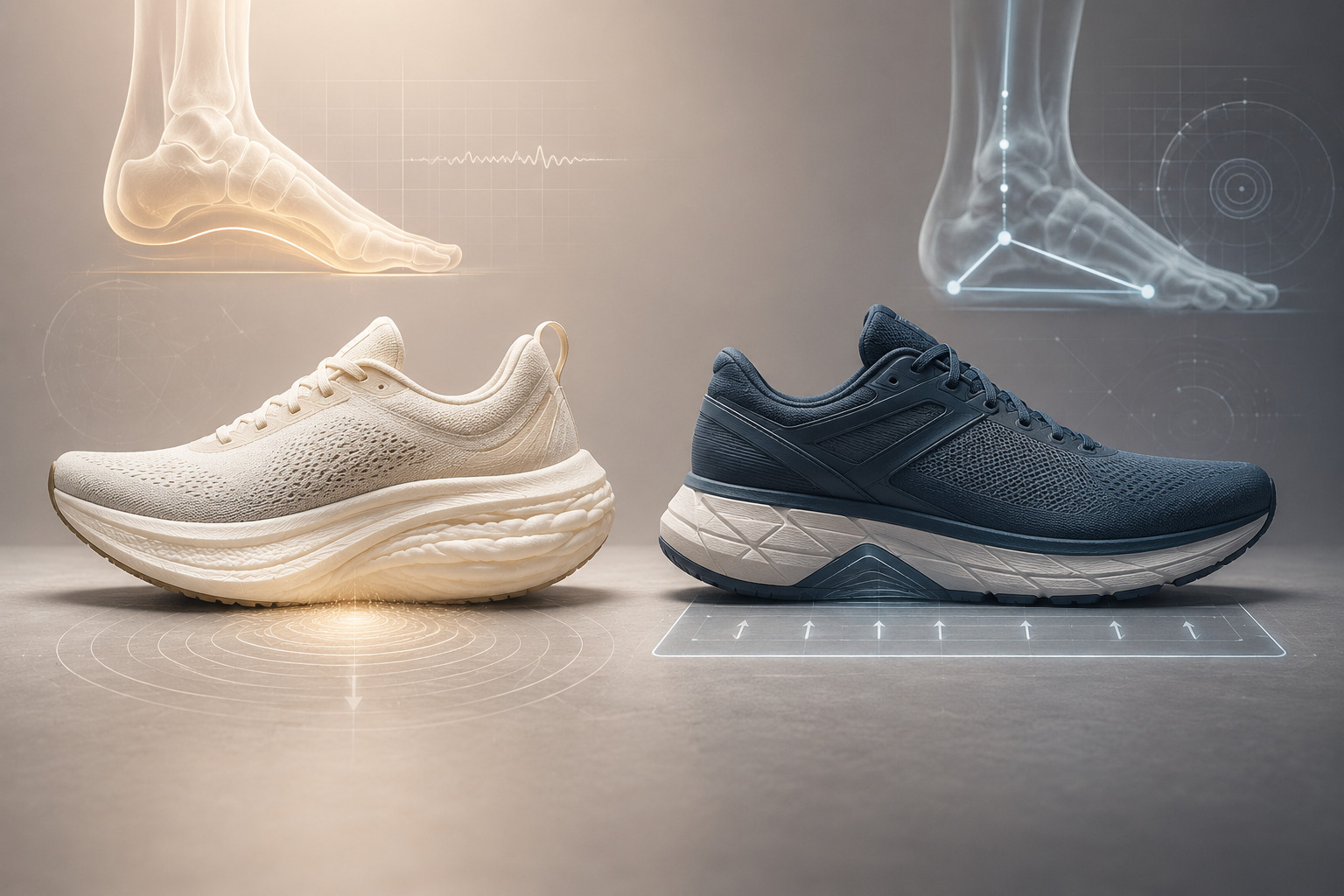
When feet hurt, the instinct is immediate and almost universal. Find something softer. More padding. More cushion. Something that absorbs the impact rather than transmitting it upward through the heel and arch and ankle. It is a reasonable instinct. It is also one of the most reliable ways to make certain foot conditions significantly worse.
Softness and stability are not the same property. They are not even closely related. A shoe can be maximally soft and provide almost no meaningful support. A shoe can feel firm underfoot and be one of the best-performing options for chronic foot pain. The confusion between these two properties is not a minor misunderstanding. It shapes which shoes people buy, how long they wear them, and why so many people spend real money on highly cushioned footwear and still end up in the same pain they started with.
What softness actually is in a shoe
Softness in a shoe refers to the compressibility of the midsole foam. When you press your thumb into the midsole and it gives easily, that is softness. When you step in and feel immediate plush underfoot, that is softness. It is a tactile property, which is a measure of how much resistance the material offers under load.
Soft foams absorb impact by compressing. That compression does reduce peak pressure at the point of contact, which is why cushioning has real value for certain presentations. Like heel fat pad atrophy, metatarsalgia, stress fractures, and anyone whose primary problem is impact load concentration. For those conditions, softness is clinically relevant.
But softness has a mechanical cost. A foam that compresses easily under your heel also compresses unevenly under your arch. It compresses more on the inside edge of the foot than the outside if you overpronate. It compresses more at the heel than the forefoot if you heel-strike heavily. The softer the foam, the more it conforms to whatever the foot is already doing, including the dysfunctional movement patterns that caused the problem in the first place.
What stability actually is in a shoe
Stability in a shoe refers to its resistance to deformation under asymmetric load. It is the shoe's ability to maintain its structural geometry when the foot applies uneven force - which is what happens during every footstrike for someone who overpronates, supinates, or has a structural leg length difference.
Stability features include a medial post. A denser foam wedge on the inner edge of the midsole that resists inward collapse. A firm heel counter that locks the calcaneus in a neutral position. A broader midsole base that reduces the lever arm of pronation. A rigid shank through the midfoot that prevents torsional flex at the arch. None of these features feel soft. Most of them feel firm, structured, and occasionally stiff when you first pick the shoe up.
It is worth noting that modern stability shoes have moved beyond traditional dual-density foam alone. Brooks GuideRails, for example, use a wider midsole base and targeted sidewall geometry to guide the foot rather than blocking motion with a hard medial post. ASICS FluidSupport in the Kayano 33 takes a similar approach, with an adaptive structure that responds to the foot's movement pattern rather than rigidly correcting it. The mechanism has evolved, but the goal is identical: control motion, reduce cumulative tissue strain, guide the foot through a more efficient path with every step. If you want the full breakdown of how FluidSupport works, that article covers it in detail.
What they do is control motion. They guide the foot through a more mechanically efficient path with each step. They reduce the cumulative strain on the plantar fascia, the posterior tibial tendon, the Achilles, and the medial knee that builds up over thousands of steps in a shoe that simply moves wherever the foot takes it.
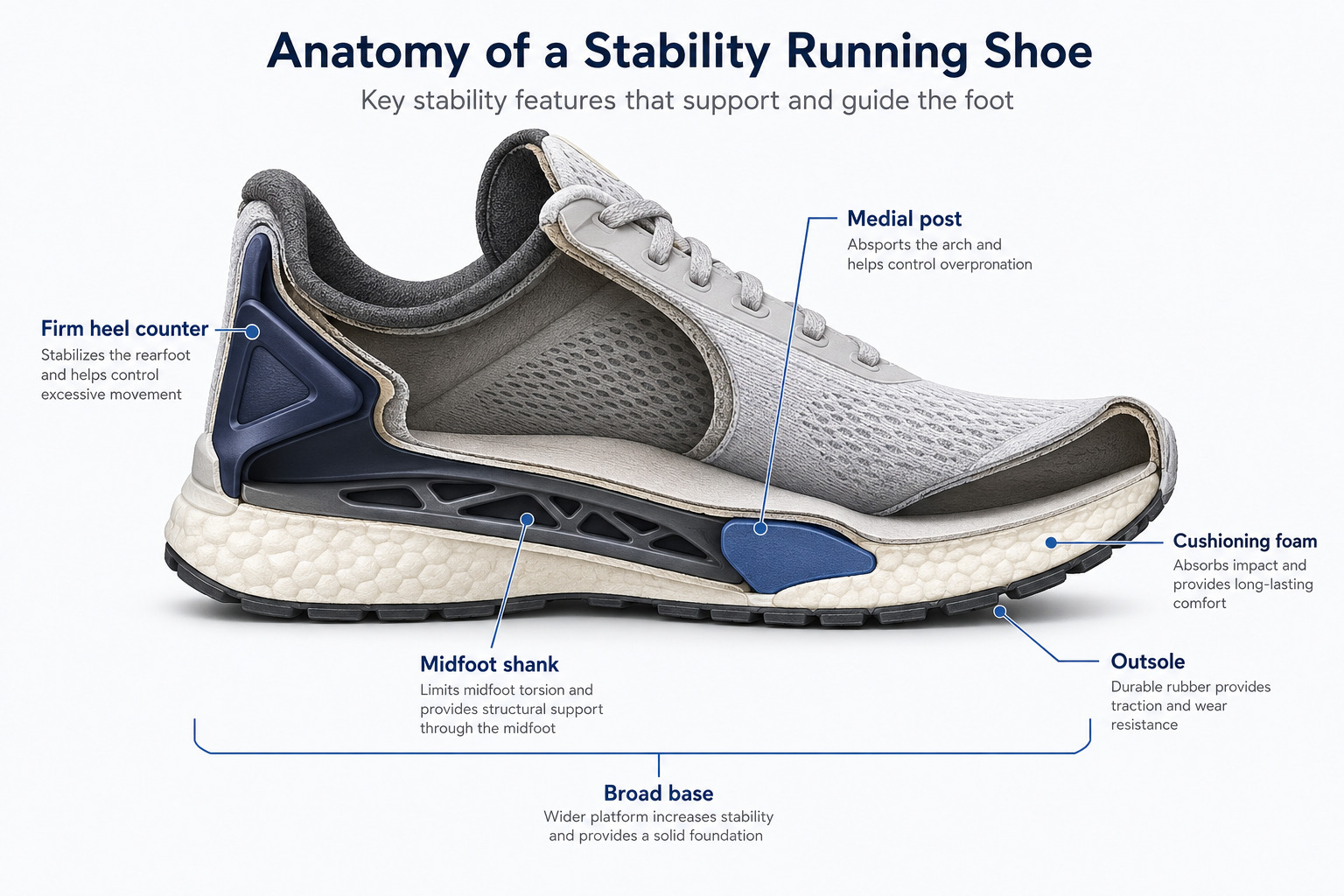
Stability features work by resisting motion, not absorbing it.
A medial post, firm heel counter, and broader base all resist the inward collapse that drives many common foot conditions. None of these features feel like cushioning - and that is the point.
Why people keep confusing the two
The confusion is partly linguistic and partly commercial. The word comfortable has absorbed both meanings in everyday footwear language. A shoe that feels good is comfortable. A shoe that resolves foot pain is also described as comfortable. But these are different mechanisms producing different results for different reasons.
The commercial pressure makes it worse. Maximum cushion is a marketing category. Max stack height, ultra-soft foam, plush underfoot feel. These are tangible sensations that translate immediately in a store. You step in, you feel the difference. Stability is harder to sell because its benefit is not felt in the store. It is felt over the first two weeks of wear when the nagging arch pain that has been building for months starts to quiet down. That is a harder story to tell at point of sale.
The result is a market where the softest shoes get the most attention and the most sales, while the shoes most likely to actually resolve mechanical foot pain sit next to them on the shelf feeling comparatively firm and getting overlooked.
When softness is actually what you need
Softness is not wrong. It is wrong for specific conditions and right for others. Understanding which side of that line you are on matters more than the general principle.
Softness is genuinely the right primary feature for conditions where impact load concentration is the core mechanical problem. Heel fat pad atrophy loses the natural cushioning layer inside the heel itself - external cushioning from the shoe compensates directly for that loss. Metatarsalgia involves concentrated pressure under the metatarsal heads. A soft, wide forefoot reduces that concentration. Stress fractures require impact reduction above almost anything else during recovery.
Softness also has legitimate value as a secondary property in a shoe that already provides stability. A stability shoe with a responsive, moderately cushioned midsole gives you both properties. The medial post controls motion. The foam manages impact. These are not mutually exclusive. The mistake is prioritizing one at the complete expense of the other when both are relevant to your condition.
When softness is the wrong answer and why it backfires
For the most common foot conditions, such as plantar fasciitis, flat feet, overpronation, posterior tibial tendon dysfunction, and Achilles tendinopathy, softness without stability is frequently counterproductive. Not ineffective. Actively counterproductive.
Here is the mechanism. Plantar fasciitis is driven by excessive tension on the plantar fascia. The thick band of tissue running from the heel to the ball of the foot. That tension is increased by overpronation, because inward collapse of the arch elongates the plantar fascia with every step. A maximally soft shoe allows that pronation to happen without resistance. The foot collapses inward, the fascia stretches, and the inflammation cycle continues regardless of how cushioned the midsole is. The cushion absorbs impact. It does nothing about the motion that is tearing the tissue.
Flat feet and overpronation follow the same logic. The problem is not impact. The problem is the arch collapsing under load. Soft foam collapses with it. A medial post resists it. These are not variations on the same solution. They are solutions to different versions of the problem, and applying the wrong one does not help.
Posterior tibial tendon dysfunction is perhaps the clearest example. The posterior tibial tendon runs along the inside of the ankle and is responsible for supporting the arch during the stance phase of gait. In PTTD, that tendon is overloaded, and often by years of insufficient support allowing the arch to collapse. A maximally cushioned neutral shoe in this context is essentially asking a compromised tendon to keep working without any structural assistance from the footwear. The softness feels good. The tendon continues to deteriorate.
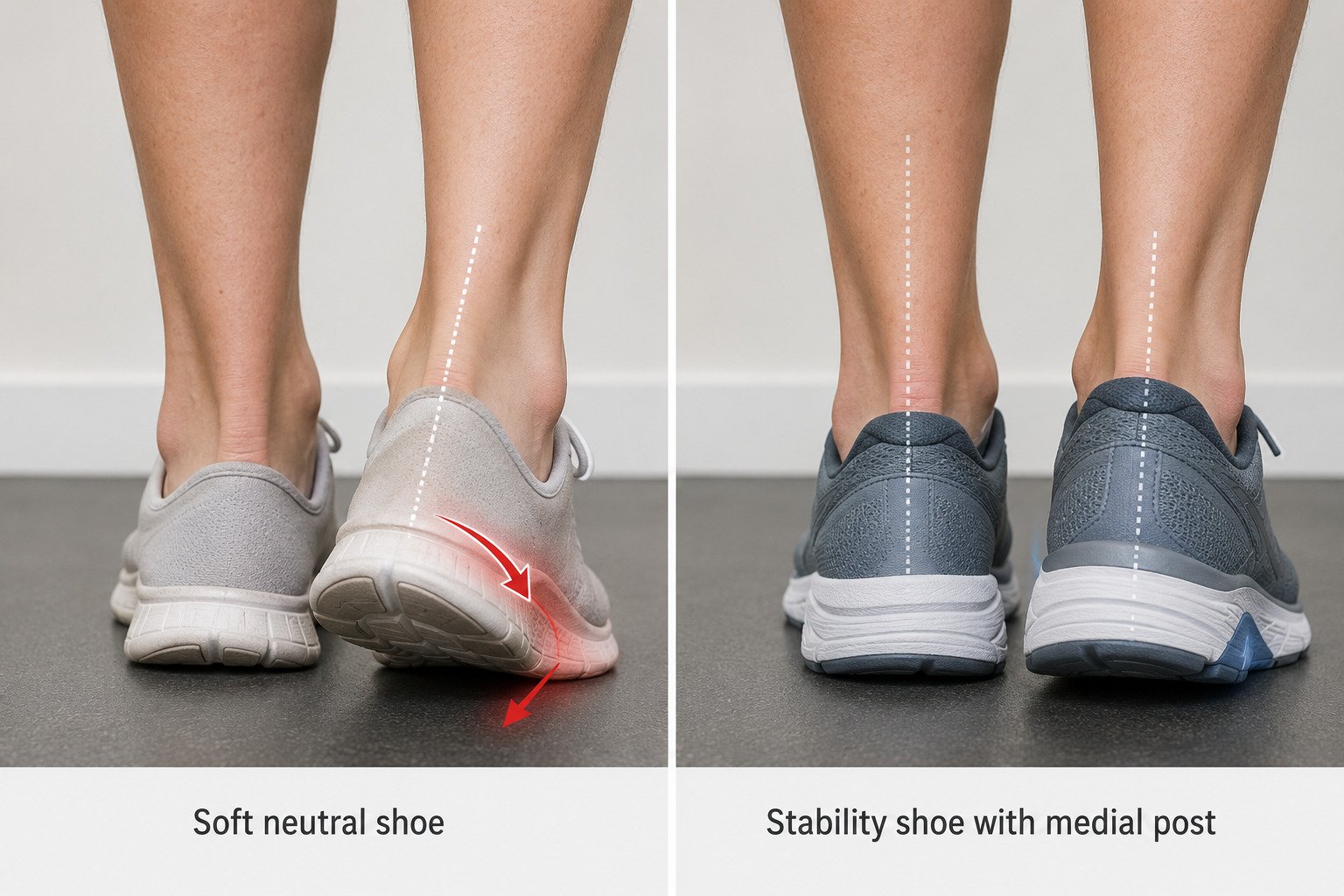
The same foot. Two different shoes. Completely different mechanical outcomes.
In a soft neutral shoe, the arch collapses under load without resistance. A stability shoe with a medial post controls that collapse. For overpronation-driven conditions, the difference in tissue load over a day of walking is significant.
The quick condition map
Not every foot condition maps neatly to one property over the other. But most of the common ones have a clear primary requirement.
Conditions where stability is the primary requirement
Plantar fasciitis driven by overpronation, flat feet, posterior tibial tendon dysfunction, chronic ankle instability, adult-acquired flatfoot, and medial knee pain with a foot pronation component. For all of these, a stability shoe with a medial post and firm heel counter addresses the root mechanical cause. Cushioning is secondary.
Conditions where cushioning is the primary requirement
Heel fat pad atrophy, metatarsalgia without a stability component, stress fractures during recovery, and general impact sensitivity in high-mileage walkers or runners with neutral gait patterns. For these, a higher-stack neutral shoe with responsive foam is the right starting point. Stability features are secondary or irrelevant.
Conditions that need both
Plantar fasciitis with a high-impact component, diabetic neuropathy where both pressure distribution and motion control matter, and rheumatoid arthritis affecting multiple joints in the foot. These conditions require a shoe that provides genuine stability structure alongside meaningful cushioning and not a tradeoff between them. Several current stability shoes deliver both well. The MySoleMatch quiz maps to these specifically.
What to actually look for when evaluating a shoe
The in-store test most people use is pressing down on the midsole with their thumb, tells you about softness. It tells you almost nothing about stability. Here is what to look for instead.
The medial post test. Hold the shoe heel-up and look at the midsole from the back. A stability shoe will have a visible difference in density or color on the inner edge of the midsole, which is the denser foam of the medial post. Some brands make this obvious. Others are subtle. If you cannot see it, press on the inner and outer edges of the midsole separately. A stability shoe will feel firmer on the inside.
The heel counter test. Squeeze the back of the shoe where it cups the heel. A firm heel counter should resist compression meaningfully. A soft, collapsible heel counter will crush easily between your fingers. For any condition involving rearfoot instability, a firm heel counter is not optional.
The torsion test. Hold the shoe at the toe and heel and twist. A shoe with good torsional stability will resist this significantly. A shoe built around softness and flexibility will twist with very little resistance. For arch-related conditions, a shoe that twists easily is a shoe that will allow your arch to do the same under load.
None of these tests replace a proper gait analysis. But they separate soft from stable in about thirty seconds, which is a more useful starting point than how the shoe feels when you step in it on a carpeted showroom floor.
The practical takeaway
When feet hurt, the right question is not what feels softest. It is what the foot is doing mechanically that is causing the pain, and what property in a shoe would address that mechanism directly.
For most of the common conditions that bring people to a platform like MySoleMatch: plantar fasciitis, flat feet, overpronation, posterior tibial tendon issues, and chronic arch pain, the answer is stability first. Not because softness has no value, but because motion control addresses the cause where cushioning only addresses the symptom.
A shoe that feels firm in the store and controls your foot's motion through every step of a twelve-hour day is doing more for your plantar fascia than the softest foam on the market that lets your arch collapse twelve thousand times before you sit down. The discomfort is in the tissue. The tissue is stressed by motion. The motion is what needs to be managed.
If you are not sure which category your condition falls into, the MySoleMatch quiz walks through your specific condition, foot zone, and activity pattern and maps the result to shoes evaluated against those exact requirements. Five steps. Condition-specific. No popularity rankings.
And if your condition is one where both properties matter, cushioning and control together, then those shoes exist too. The goal is not to choose between comfort and function. It is to understand what your foot actually needs before the shoe decision gets made.