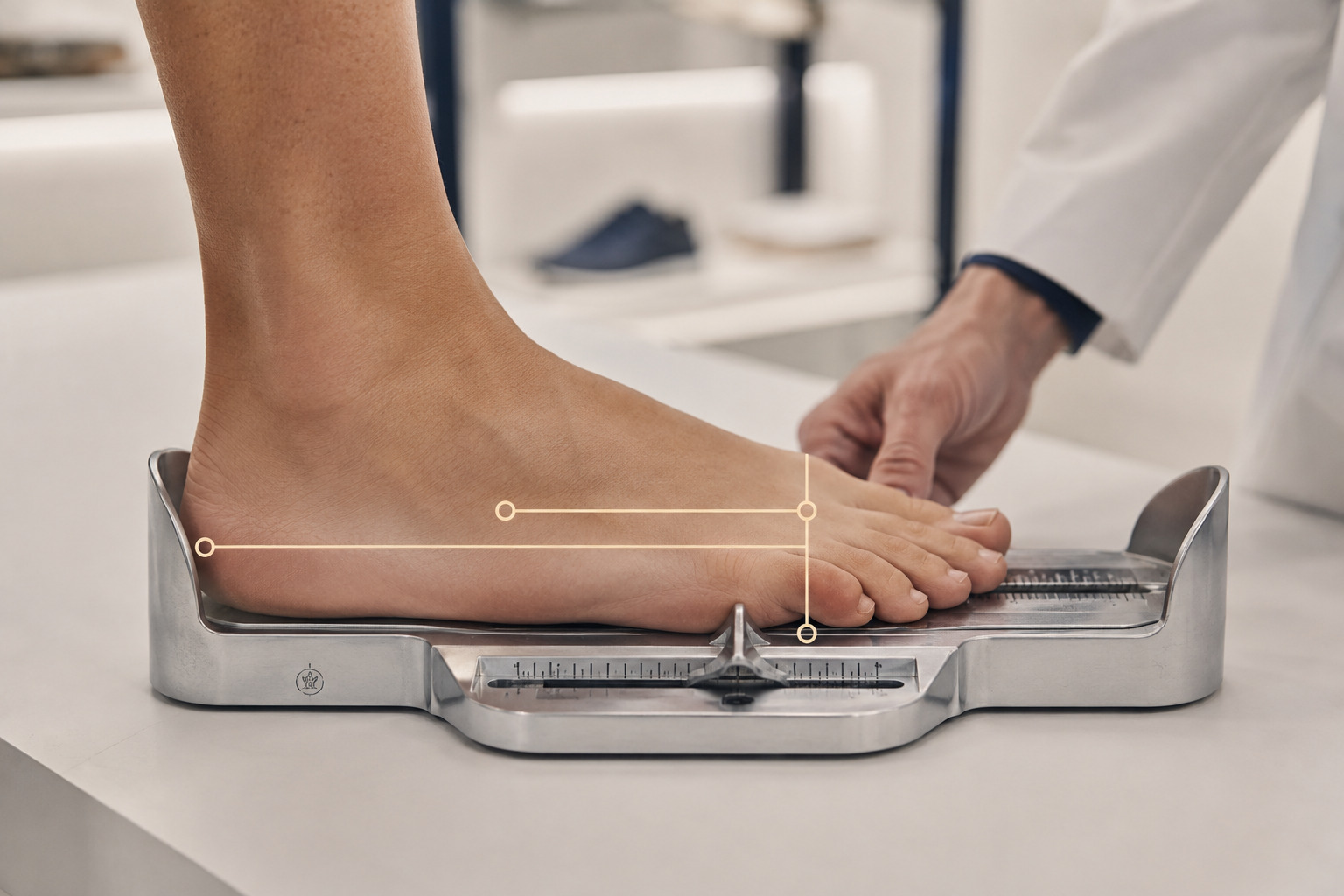
Most people know their shoe size. Almost no one knows their shoe width. And the ones who think they do typically know only one number, the label on the box, without understanding that this number describes only one of three distinct dimensions that determine whether a shoe actually fits.
This is not a minor gap in consumer knowledge. It is a structural failure in how footwear has been marketed and sold for generations. The shoe industry defaults almost universally to a single medium width in both men's and women's styles, designs its lasts, which are the foot-shaped molds around which shoes are built, around a narrow set of average measurements, and then sends people home to figure out for themselves why a shoe that fits perfectly in length creates pain, numbness, blisters, or pressure marks by the end of the day.
The consequence is not just discomfort. Clinical research and podiatric literature consistently document a direct relationship between prolonged use of incorrectly fitted shoes and the development and progression of bunions, hammertoes, Morton's neuroma, metatarsalgia, plantar fasciitis, and a range of other conditions that are far easier to prevent than to treat. Roughly twenty percent of adults have feet wider than the standard medium width that most shoes are built around, and many of them have been purchasing the wrong width their entire adult lives without knowing it.
Understanding why requires understanding what shoe width actually is. And it is not one thing. It is three.
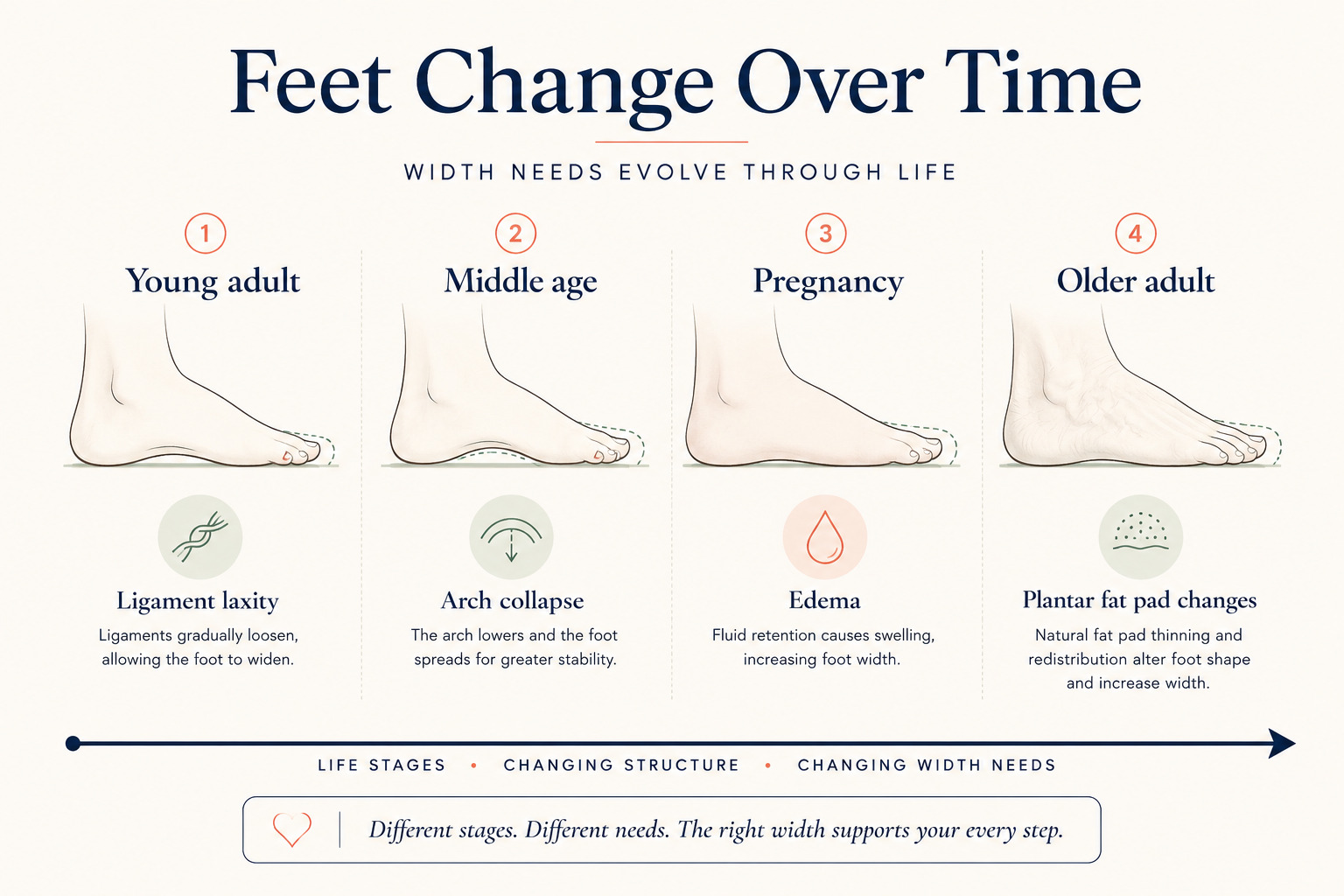
Width needs evolve across a lifetime.
Four distinct biological mechanisms, ligament laxity, arch collapse, pregnancy-related edema, and plantar fat pad redistribution, each cause the foot to widen in different ways at different life stages. A shoe size measured at twenty is rarely the correct width at fifty.
What the Width Label on the Box Is Actually Telling You
The width designation printed on a shoe box: D, 2E, 4E for men, B, D, 2E for women, refers specifically to the circumference measurement across the widest part of the forefoot, the ball of the foot at the metatarsal heads. Each step in the width system adds approximately one eighth of an inch across that measurement. Moving from a standard D width to a 2E adds roughly one quarter inch of forefoot circumference. Moving from D to 4E adds approximately three eighths of an inch.
This matters, but it describes only one dimension. The width code says nothing about heel width, nothing about midfoot volume, and nothing about how the internal space of the shoe is distributed between those regions. A shoe labeled 2E provides a wider forefoot than a shoe labeled D. It does not automatically provide a wider heel, a deeper toe box, or more internal volume through the midfoot. Those dimensions are determined by the last the shoe is built on, and they vary significantly between brands and models even within the same labeled width.
The naming system adds another layer of confusion. North American sizing follows the Brannock device standard, where for men D is medium, E is wide, 2E is extra wide, and 4E is double extra wide. For women the entire system shifts: B is medium, D is wide, and 2E is extra wide. A D width shoe for a man is a standard fit. A D width shoe for a woman is a wide fit. This means the same letter means something completely different depending on who the shoe is built for, and brands apply these designations inconsistently enough that the only reliable verification is the brand's own width chart for that specific model.
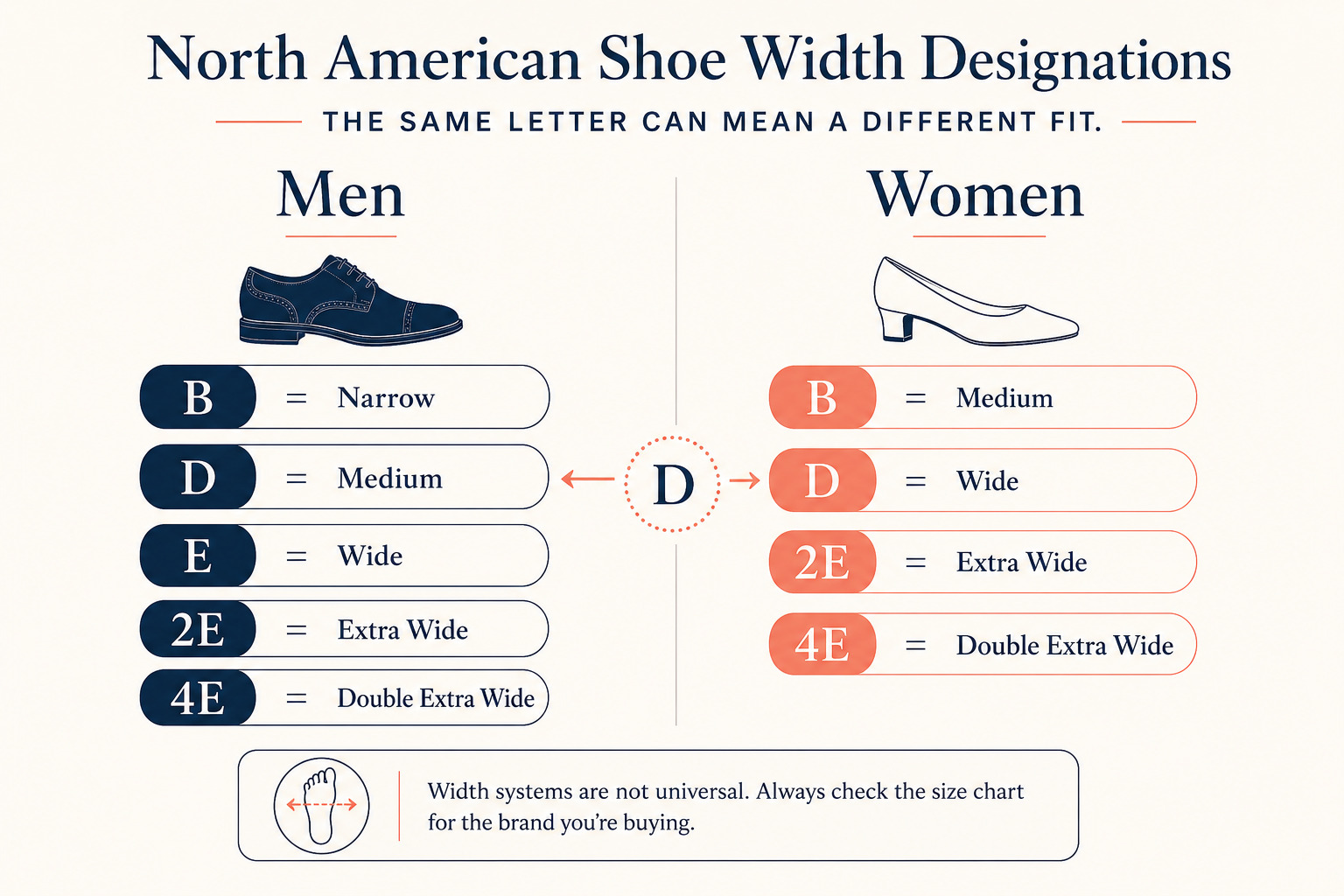
The same letter means something different depending on whose foot it is built for
Men's D is medium. Women's D is wide. The width designation system shifts entirely between genders, and brands apply it inconsistently across models. The only reliable reference is the specific width chart for the shoe you are buying.
The Three Dimensions That Width Labels Do Not Tell You
A correctly fitting shoe requires three separate dimensional matches between the foot and the shoe interior. Width labels address one of them. The other two are largely invisible in the purchasing process and are responsible for a significant proportion of fit problems that people attribute to the wrong cause.
Dimension One: Forefoot Width
This is the dimension the width label measures. It is the circumference across the ball of the foot at the metatarsal heads, the widest point of most feet. When a shoe is too narrow in the forefoot, the metatarsal heads are compressed laterally. This compression has documented clinical consequences. Board-certified podiatric physicians identify narrow shoe forefoot width as a primary mechanical driver of Morton's neuroma, where the interdigital nerve between the metatarsal heads is compressed repeatedly until it develops the fibrous thickening characteristic of the condition. The same compression accelerates bunion progression by pushing the big toe laterally toward the second toe and increasing the angular deviation of the first metatarsophalangeal joint over time. Hammertoe development is similarly linked to chronic forefoot compression that prevents the toes from lying flat.
What the forefoot width measurement does not capture is where the widest part of the shoe sits relative to the widest part of the foot. The Brannock device measures both heel-to-toe length and heel-to-ball length which is the distance from the heel to where the foot is widest, as separate values. When these two measurements are disproportionate, a shoe sized correctly for length will place the widest part of the shoe at a different point than the widest part of the foot. The result is a mismatch where the shoe appears to fit in length but creates either forefoot compression or midfoot looseness depending on which direction the disproportion runs.
Dimension Two: Heel Width
Heel width is the dimension most people have never considered and most shoe descriptions never mention. The heel of the foot is structurally distinct from the forefoot. Patent research in footwear engineering documents striking variability in heel volume among people with identical foot lengths and forefoot widths. Some feet have a narrow, tapered heel with a wide forefoot. Others have a broader heel that narrows toward the toes. Standard shoe lasts are built around an average relationship between heel and forefoot width that fits neither foot type precisely.
When heel width is wrong the consequences are immediately apparent but rarely attributed to the right cause. A heel cup that is too wide allows the heel to slip inside the shoe with each step. This slippage creates friction blisters at the back of the heel, alters heel strike mechanics, and over time contributes to Achilles tendon irritation from the instability. A heel cup that is too narrow creates medial or lateral pressure on the heel bone itself, producing pain that is often mistaken for plantar fasciitis or heel spur pathology when the actual cause is mechanical compression from a misfitting heel counter.
Some people with narrow heels and wide forefeet, a common foot shape that the podiatric literature notes requires careful attention to shoe construction, find that wide or extra-wide shoes accommodate the forefoot correctly but allow the heel to slip enough to affect gait. The solution in these cases is not a narrower shoe overall but a shoe built on a last that tapers appropriately from forefoot to heel, or the use of heel lock lacing patterns and heel cup inserts that compensate for the dimensional mismatch.
Dimension Three: Midfoot Volume
Volume is the dimension that width labels come closest to ignoring entirely. Shoe volume describes the total internal space of the shoe in three dimensions: width, depth, and girth, through the midfoot region between the heel and the ball of the foot. A shoe can have a correctly labeled width and still provide insufficient volume for a foot with a high arch, significant dorsal soft tissue bulk, post-surgical swelling, or the need to accommodate a custom orthotic.
This is why depth is a separate specification from width in therapeutic and diabetic footwear. Extra-depth shoes provide additional vertical clearance inside the shoe beyond standard construction, allowing the foot to sit without pressure on the dorsal surface and creating the space necessary for custom insoles or orthotics to function correctly without pushing the foot upward and creating new pressure points at the toe box ceiling.
For people with flat feet, midfoot volume is relevant in a different direction. Arch collapse causes the foot to spread and elongate under load, increasing both forefoot width and midfoot volume demand compared to a foot with a functioning arch. A shoe that fits correctly in a non-weight-bearing position may feel tight in the midfoot after standing for an hour as the arch progressively flattens and the foot spreads into the available internal space.
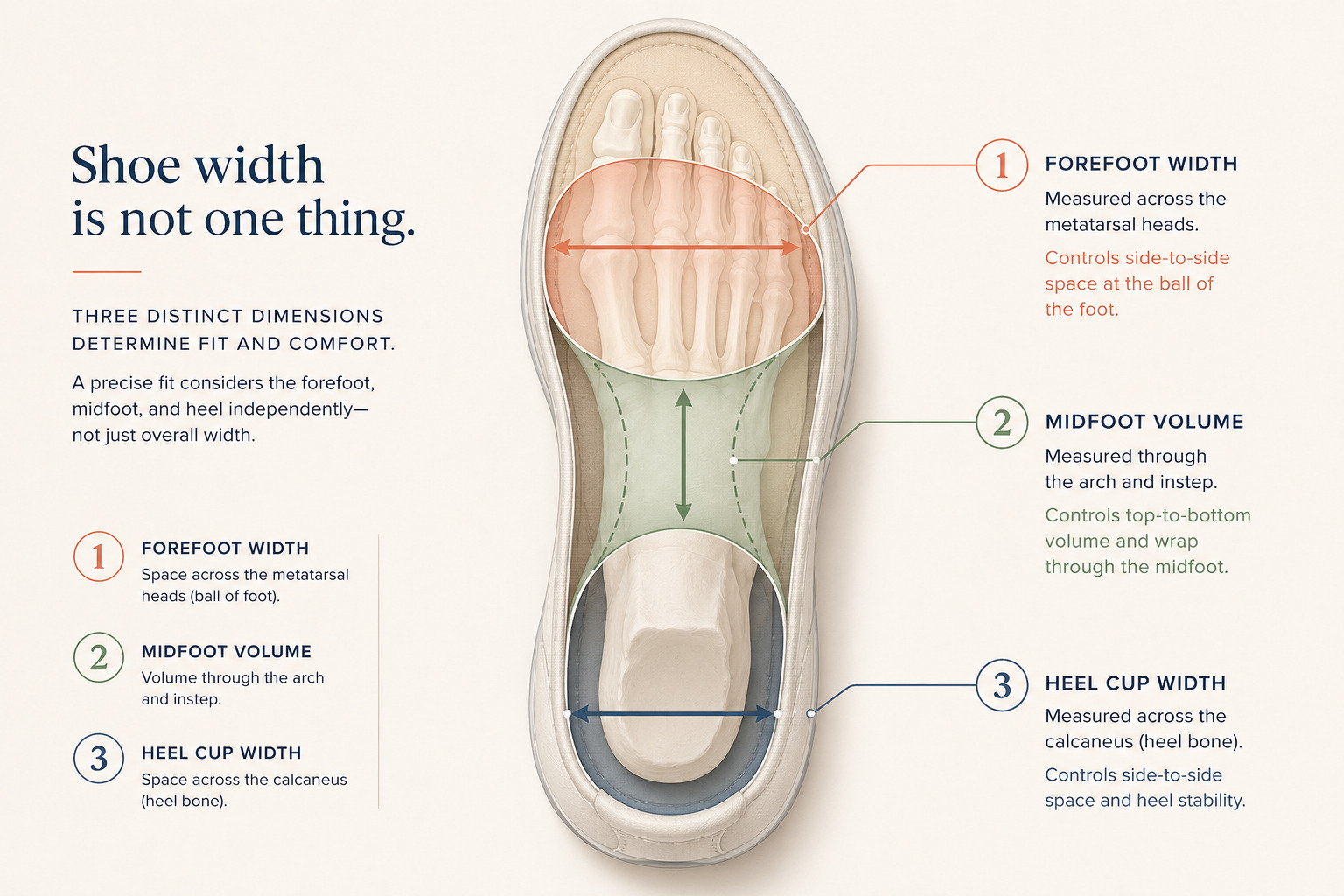
One width label. Three separate fit dimensions.
Forefoot width, heel cup width, and midfoot volume are three anatomically distinct dimensions. A shoe can be correctly sized in one and incorrectly sized in the others. Width labels address only the first. The other two are determined by the last the shoe is built on.
How Your Width Needs Change and Why Most People Do Not Know It
Foot width is not a fixed measurement that applies for life. It changes across a day, across years, and in response to health conditions and life events that most people do not associate with shoe fit.
Within a single day, feet swell measurably due to fluid accumulation from prolonged standing and walking. The forefoot widens as the plantar fat pad spreads under load and as venous pooling increases tissue volume in the lower extremities. A shoe fitted correctly in the morning may create genuine forefoot compression by mid-afternoon for someone on their feet through a full work shift. This is why podiatric guidance consistently recommends fitting shoes later in the day rather than first thing in the morning.
Across years, several changes compound. The plantar ligaments and soft tissue structures that maintain arch height gradually lose elasticity with age, allowing the arch to flatten and the foot to spread. The plantar fat pad thins, reducing the cushioning depth between the metatarsal heads and the ground while also changing the dimensional profile of the forefoot. Pregnancy causes significant ligament laxity that can permanently increase foot width even after the pregnancy ends. A person who correctly wore a D width at thirty may genuinely need a 2E by fifty regardless of weight change.
For people with diabetes, the width picture is more complex and more consequential. Diabetic peripheral neuropathy reduces or eliminates the sensation that would otherwise signal when a shoe is too tight. A shoe that creates pressure on a neurologically normal foot produces discomfort that prompts removal or adjustment. The same shoe on a neuropathic foot may be worn for an entire shift without any pain signal, while creating pressure points that progress to tissue breakdown and ulceration. For this reason, therapeutic footwear standards for people with diabetes include width and depth specifications that go well beyond what standard shoe fitting addresses.
How to Identify Your Actual Width Needs Across All Three Dimensions
The most accurate measurement comes from a Brannock device used correctly by someone trained to use it. The device measures heel-to-toe length, heel-to-ball length, and forefoot width as three separate values and indicates the appropriate size and width based on the combination. The heel-to-ball measurement matters because it identifies whether your forefoot sits proportionally to standard sizing or whether you need a shoe in which the flex point is positioned differently than average.
In the absence of a Brannock device measurement, a set of observable indicators reliably signals which dimensions are wrong. Pressure marks, redness, or skin irritation on the sides of the forefoot after wearing a shoe indicate forefoot width is insufficient. Blisters at the back of the heel, or a heel that slips with each step, indicate heel cup width is too large. A sensation of pressure across the top of the foot through the midfoot, or inability to wear the shoe with a custom orthotic without the foot feeling pushed upward, indicates insufficient midfoot volume. Numbness or tingling between the third and fourth toes is a specific signal of forefoot compression on the interdigital nerve that warrants immediate attention and a transition to a wider forefoot.
When shopping across brands, the same labeled width does not guarantee the same actual internal dimensions. A 2E in one brand may run narrower through the midfoot than a 2E in another brand built on a different last. The only reliable approach when switching brands is to verify the brand's specific width chart for the model in question rather than assuming consistency with a previously known size.
When Width Is a Clinical Requirement, Not a Preference
For most people, finding the right shoe width is a fit optimization that improves comfort and prevents progressive problems. For certain populations, it crosses from preference into clinical necessity.
People with bunions require sufficient forefoot width and toe box volume to prevent the shoe from exerting lateral pressure on the first metatarsophalangeal joint. Narrow shoes do not cause bunions in isolation, but they accelerate the angular progression of an existing bunion and create the chronic inflammation that produces pain. The bunion cannot reverse without surgical correction, but correctly fitted footwear is the most effective conservative intervention for slowing progression and managing symptoms.
People with hammertoes require both forefoot width and vertical toe box clearance. The contracted toe joint sits higher than a straight toe and contacts the ceiling of the toe box in a standard-depth shoe. This creates dorsal pressure on the proximal interphalangeal joint that produces the corns and calluses characteristic of hammertoe irritation. A shoe with adequate width and depth eliminates this contact entirely.
People with diabetes require therapeutic footwear specifications that address all three dimensions and add seamless interior construction to eliminate pressure points that neuropathic feet cannot sense. The consequences of width failure in this population extend beyond pain to tissue breakdown, infection, and in severe cases amputation. A risk profile that makes footwear width a medical decision rather than a shopping preference.
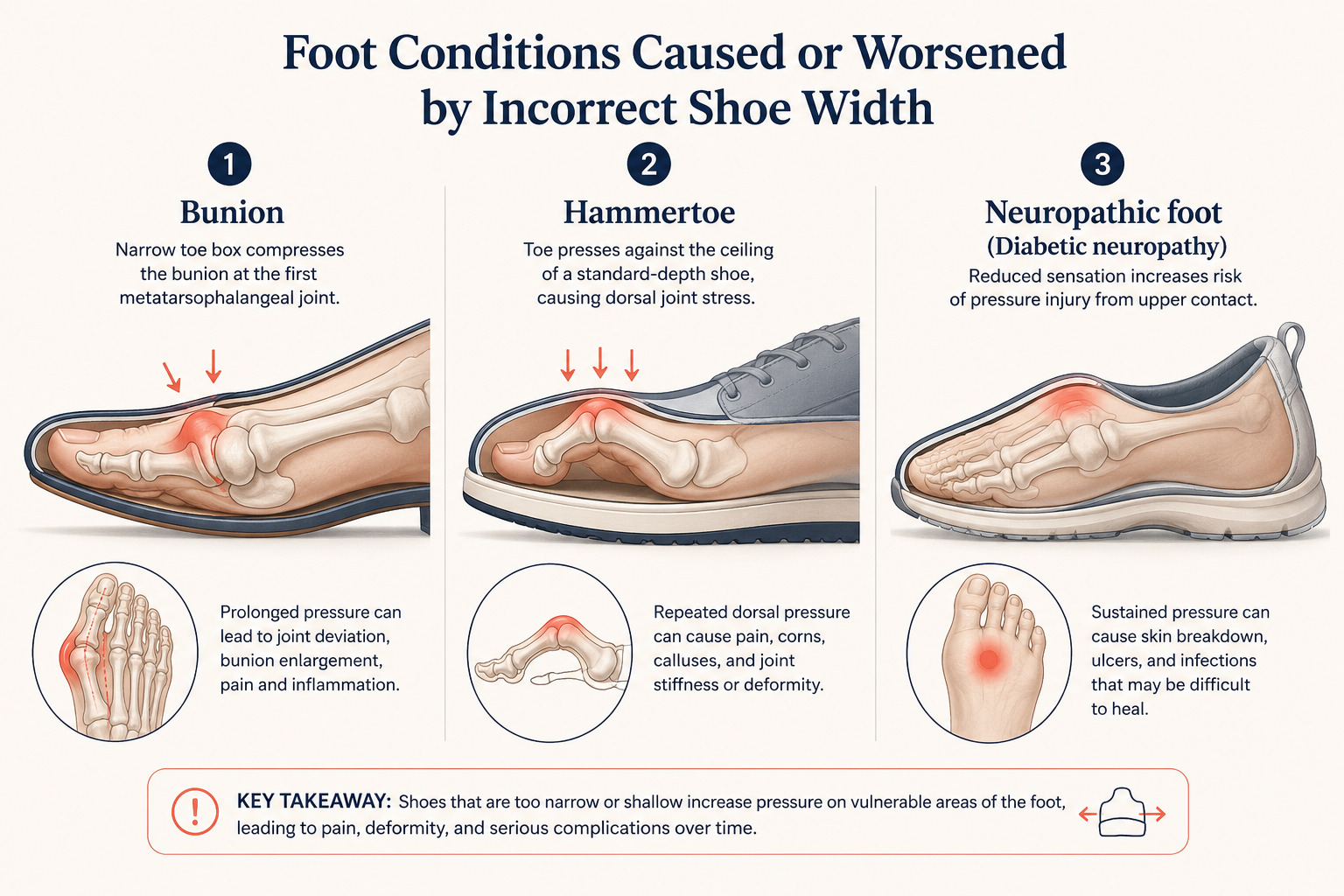
Wrong width is not a comfort issue for these populations
For people with bunions, hammertoes, or diabetic neuropathy, shoe width is a clinical requirement. Incorrect width accelerates joint deformity, drives dorsal toe pressure, and in neuropathic feet creates pressure points that cannot be felt but progress to tissue breakdown.
The diabetic footwear guide and the bunions condition page cover the specific APMA-verified shoes that address these width requirements across both standard and therapeutic categories. The shoe finder quiz routes to width-appropriate recommendations based on your foot profile and conditions.
Width Is a System, Not a Number
The letter or number on the shoe box is a starting point, not a guarantee. It tells you something about the forefoot circumference the shoe was built for. It tells you nothing about how that shoe's last handles the heel, how much internal volume exists through the midfoot, or whether the widest point of the shoe aligns with the widest point of your foot.
Getting all three dimensions right simultaneously is what an actual correct fit feels like. A shoe that fits correctly requires no adjustment period. It does not produce pressure marks, red lines, or friction blisters. The toes do not contact the ceiling of the toe box. The heel does not slip. The midfoot does not feel compressed across the top of the foot after an hour of standing.
If you have been unable to find a shoe that meets all of those criteria simultaneously, it is most likely because you have been optimizing for one dimension while remaining unaware of the others. The right width for your foot is the combination that addresses all three, and it may not be the same number across different brands, different shoe types, or even the same brand across different model years.
A board-certified podiatrist with access to a Brannock device and gait assessment can identify your actual three-dimensional fit requirements in a single appointment. The MySoleMatch podiatrist finder covers thirty-one cities with verified practicing podiatrists for anyone who wants to move from approximation to precision.