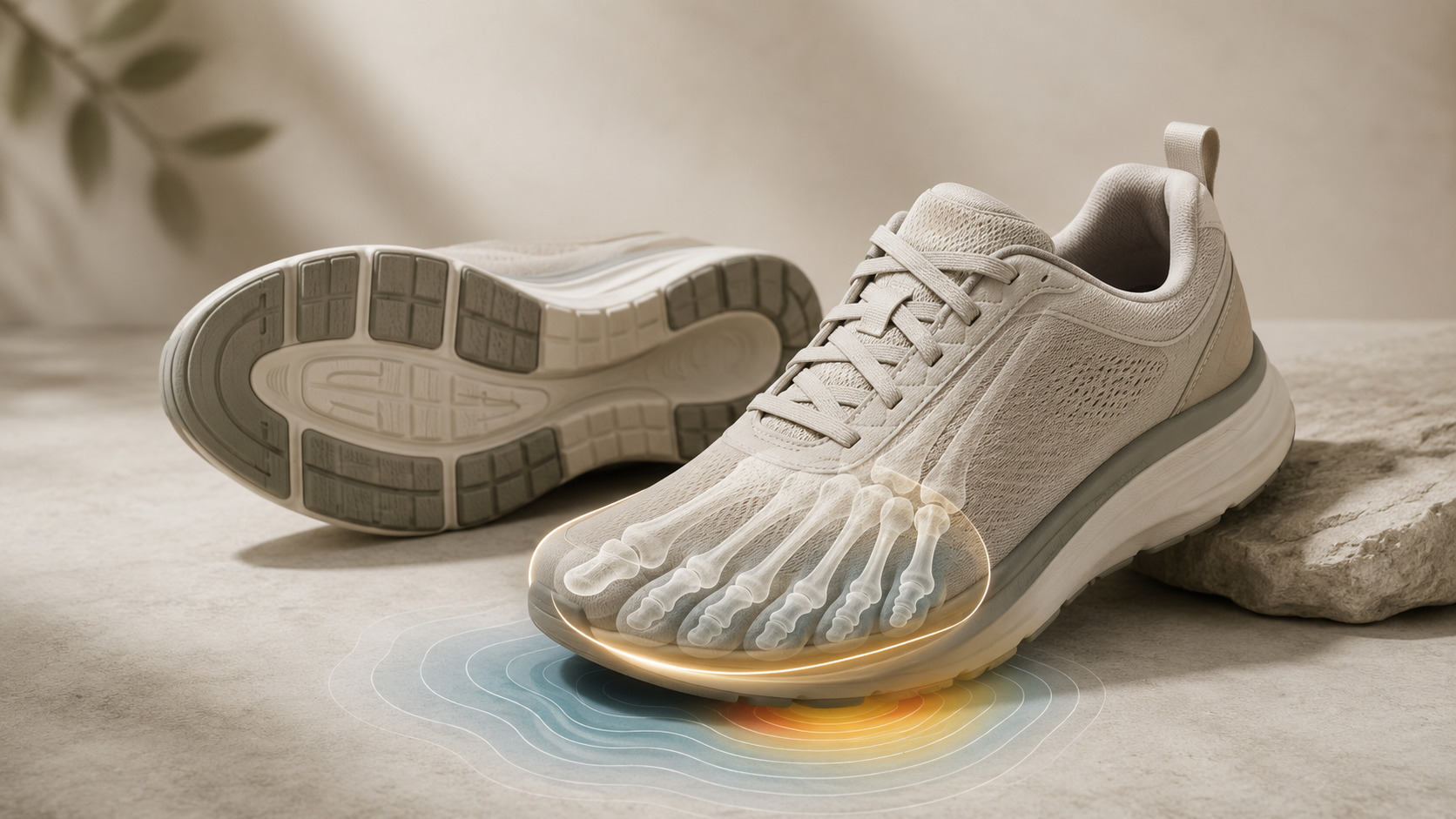
Wide toe box has become one of the most frequently searched features in footwear among people managing foot pain and forefoot conditions. It appears in product descriptions, podiatry recommendations, barefoot shoe marketing, and orthopedic footwear guides. The phrase has moved from clinical terminology into mainstream consumer language and like most things that make that journey, some meaning has been lost along the way.
Not everyone who wears wide toe box shoes needs them. Not everyone who needs them is wearing them. And a meaningful number of people who think they need a wider toe box actually need something else entirely. Such as extra depth, a wider overall last, or a different fit category altogether. This article untangles those distinctions, identifies the conditions where a wide toe box is clinically relevant, and explains what to actually look for when evaluating whether a shoe qualifies.
What wide toe box actually means and what it does not
The toe box is the front section of the shoe that houses the toes. A wide toe box is one that is broader across the forefoot, allowing the toes to spread naturally rather than being compressed together. The geometry of a wide toe box follows the natural shape of the human foot, which is widest at the toes, tapering back toward the heel, rather than the tapered or pointed geometry of fashion footwear that narrows toward the front.
This is not the same as a wide shoe. A wide shoe, typically designated as D, 2E, 4E, or wider in standard sizing, refers to the overall width of the shoe across the full length of the last. You can have a wide shoe with a narrow toe box. You can also have a standard-width shoe with a genuinely wide toe box. These are different measurements addressing different fit problems.
Extra depth is a third category that gets conflated with both. An extra-depth shoe has additional vertical space in the toe box, which is critical for conditions like hammertoes or diabetic neuropathy where the toes have structural deformity or where pressure on the top of the toe is the primary concern. Extra depth and wide toe box are often found together in therapeutic footwear, but they solve different parts of the problem.
Understanding which of the three you actually need in width, depth, or both, is the first step toward finding footwear that addresses your specific condition rather than just checking a generic box.
The conditions where a wide toe box is clinically relevant
Several common foot conditions have a direct, evidence-supported relationship with toe box geometry. For each of these, footwear that compresses the forefoot either causes the condition, accelerates its progression, or prevents recovery from it. These are not comfort preferences. They are clinical requirements.
Bunions (hallux valgus)
Bunions are among the most prevalent foot conditions in the United States. According to MedlinePlus Genetics, citing a peer-reviewed systematic review published in the Journal of Foot and Ankle Research, bunions affect approximately one third of adults in the United States, with prevalence increasing significantly with age. A PMC study describes hallux valgus as the most common forefoot problem in adults, noting its association with narrowed footwear as a contributing factor.
A bunion is a progressive deformity at the metatarsophalangeal joint of the big toe. The bony prominence that develops as the big toe deviates inward toward the other toes. Footwear that compresses the forefoot applies direct pressure to that joint with every step, which increases both pain and the rate of deformity progression. A wide toe box reduces that pressure by allowing the joint space rather than constricting it.
A wide toe box does not reverse a bunion. No shoe does. But it is one of the most consistently recommended conservative management strategies by podiatrists precisely because it removes the primary mechanical irritant, compression, from the equation. For anyone with a bunion, this is not an optional feature. It is the baseline requirement for footwear that does not actively worsen the condition.
Hammertoes
NIH StatPearls describes hammertoes as ranking among the most common deformities of the forefoot. A hammertoe is a flexion deformity of the interphalangeal joints of the lesser toes, meaning the toes curl downward at the middle joint rather than lying flat. The deformity creates pressure points at the top of the bent joint and at the tip of the toe, both of which are directly worsened by a toe box that pushes the toes together or limits vertical clearance. NIH StatPearls explicitly states that initial management of hammertoe deformity emphasizes footwear with a wider toe box alongside toe pads and appropriate orthotic support.
For hammertoes, the toe box requirement is specifically about both width and depth. The toe needs lateral space to avoid being compressed against adjacent toes, and vertical space to avoid the top of the bent joint rubbing against the upper of the shoe. Extra-depth footwear with a wide toe box addresses both dimensions. A wide toe box alone without sufficient depth may still cause dorsal irritation on the bent joint.
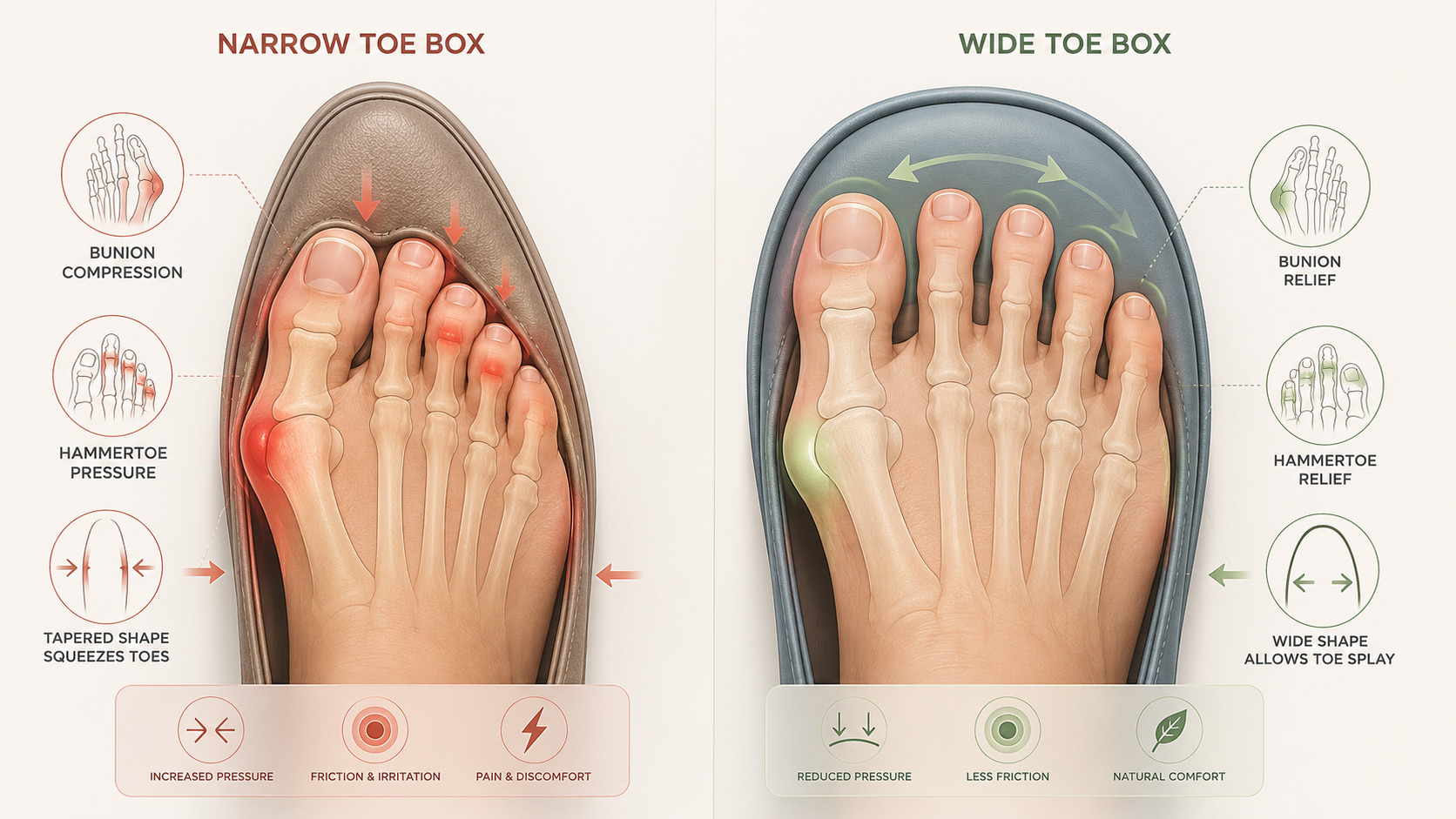
Compression is the problem. Space is the solution.
For bunions and hammertoes, the toe box geometry of the shoe either actively irritates the deformity with every step or removes the primary mechanical irritant. For these conditions, toe box width is a clinical requirement, not a comfort preference.
Diabetic neuropathy
Diabetic peripheral neuropathy affects an estimated 13.2 million people in the United States, according to a PubMed study citing the CDC's National Diabetes Statistics Report. A peer-reviewed review published in F1000Research notes that diabetic polyneuropathy has a lifetime prevalence of approximately 50% among people with diabetes, making it the most common diabetic complication.
For diabetic neuropathy, the stakes of footwear choice are higher than for any other condition on this list. When sensation is reduced or absent, pressure and friction that a healthy foot would detect and respond to goes unnoticed. A toe box that is too narrow creates pressure points that can progress to blisters, ulcerations, and in severe cases, complications requiring medical intervention. The foot cannot send the pain signal that would otherwise prompt a shoe change.
Therapeutic footwear for diabetic neuropathy is specifically designed around pressure redistribution. Wide toe boxes, extra depth, seamless interiors, and soft, non-abrasive materials are not comfort features in this context. They are protective requirements. If you have diabetic neuropathy, footwear choice is a conversation that should involve your podiatrist or endocrinologist and not end at a shoe store. The MySoleMatch diabetic neuropathy guide covers the full clinical requirements for this condition.
Metatarsalgia
Metatarsalgia is pain and inflammation in the ball of the foot, centered around the metatarsal heads. A narrow toe box concentrates pressure across the forefoot with every step, directly increasing the load on already inflamed metatarsal heads. A wide toe box allows the forefoot to spread naturally under load, which distributes that pressure across a broader surface area rather than concentrating it at the points of maximum sensitivity.
For metatarsalgia, the wide toe box requirement is often paired with a rocker sole or forefoot cushioning to further reduce peak pressure at the metatarsal heads. The toe box addresses the lateral compression component. The cushioning and rocker geometry address the impact component. Both are frequently needed together. Addressing only one without the other leaves half the mechanical problem unsolved.
Morton's neuroma
The American Academy of Orthopaedic Surgeons describes Morton's neuroma as a common cause of forefoot pain that is around eight times more common in women than men, typically affecting people between 30 and 60 years of age. It involves thickening of tissue around the digital nerves between the metatarsal heads, most commonly between the third and fourth toes, and is directly associated with compression of the forefoot.
The compression mechanism is straightforward. A narrow toe box squeezes the metatarsal heads together, compressing the nerve tissue between them. That compression is what produces the sharp, burning, or radiating forefoot pain characteristic of Morton's neuroma. A wide toe box allows the metatarsal heads to spread apart, reducing the compression on the affected nerve directly. For Morton's neuroma, a wide toe box is one of the first and most consistently recommended conservative interventions precisely because it addresses the mechanical cause rather than just managing the symptom.
Wide feet and structural forefoot width
Some people simply have feet that are wider across the forefoot than standard shoe lasts accommodate. This is a fit issue rather than a pathological condition, but it produces the same mechanical problem, which is forefoot compression, with the same downstream effects over time. People with structurally wide feet who consistently wear standard-width shoes are creating the conditions for bunion development, corns, calluses, and metatarsalgia even without an existing condition to manage.
For these individuals, a wide toe box is a preventive requirement as much as a therapeutic one. The foot needs the space it already has. Shoes that do not provide it are not neutral. They are actively reshaping the forefoot with every hour of wear.
Who does not actually need a wide toe box
Wide toe box has acquired enough cultural momentum in footwear and wellness communities that some people pursue it as a general health principle regardless of their specific foot geometry. That is worth examining honestly.
For people with narrow or average-width feet and no forefoot conditions, a wide toe box provides no clinical benefit and may actually reduce the fit security of the shoe. A toe box that is significantly wider than the foot it contains allows the foot to slide laterally inside the shoe, which reduces proprioceptive feedback, increases the risk of blisters from friction, and can destabilize gait. Fit matters in both directions. Too narrow is a problem. Too wide is also a problem, just a different one.
The principle that "toes should be able to spread" is clinically reasonable. But toe splay under load in a properly fitted shoe of any geometry is normal. The goal is not maximum lateral space. The goal is a toe box that accommodates the natural width of your specific forefoot under load without compressing it. That may be a wide toe box for some feet and a standard toe box for others.
Three things to actually evaluate when assessing toe box fit
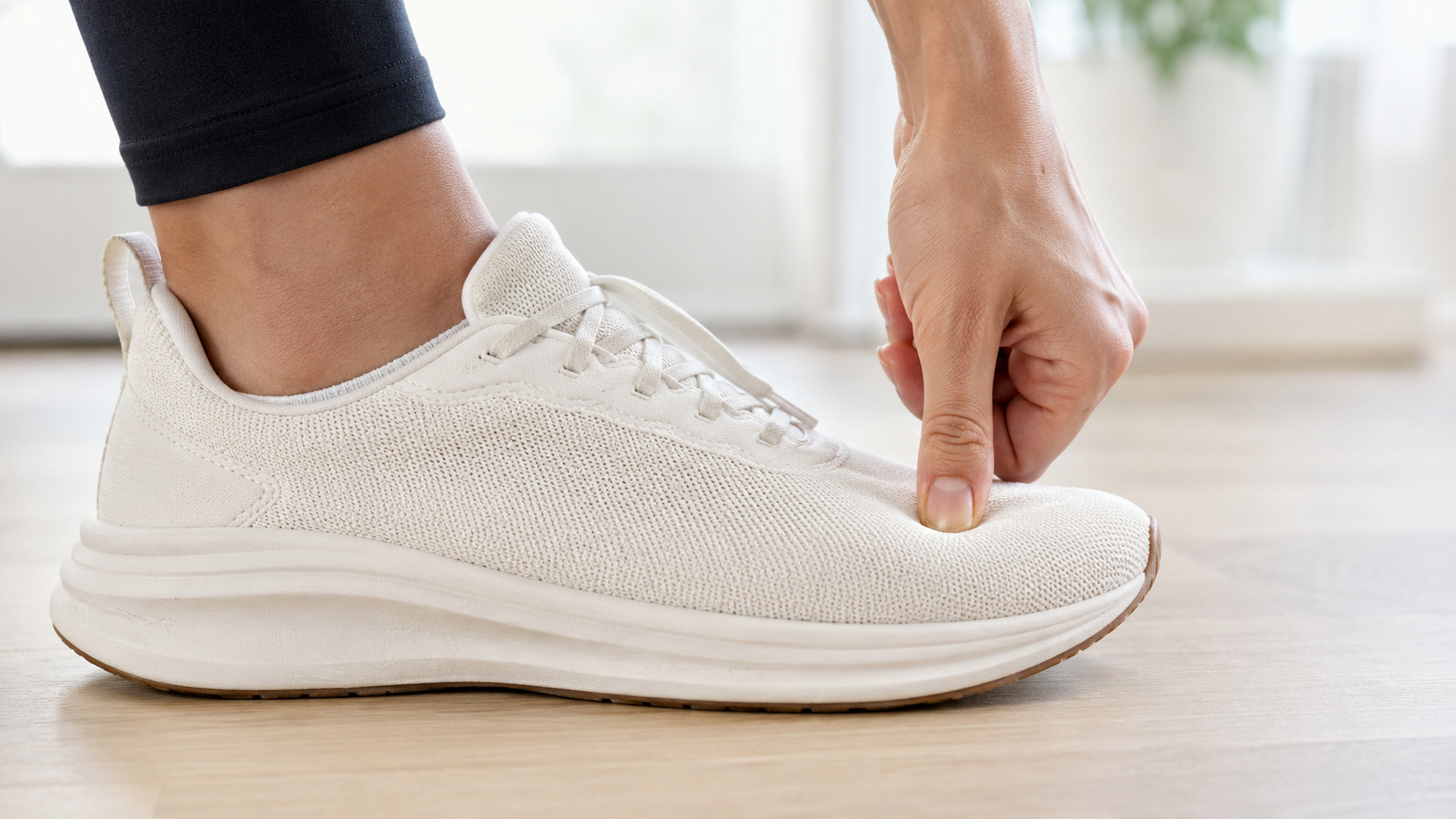
Fit assessment is specific to your foot. Not to the shoe's marketing claims.
A shoe labeled wide toe box still needs to be assessed against your actual foot geometry. The three checks below take under two minutes and tell you more than any product description will.
The thumb test for length and toe clearance
With the shoe on and laced to your normal tension, press down on the front of the upper directly above your longest toe. You should be able to feel approximately one thumb's width of space between the end of your toe and the front of the shoe. Less than that and the toe box is too short, compressing the toes lengthwise even if it is wide enough laterally. This matters because a wide toe box that is too short still creates pressure on the toes, just in a different direction.
The width check at the widest point of your forefoot
Stand in the shoe and look down. Your forefoot, particularly the area around the ball of the foot and the base of the toes, should not be visibly bulging over the midsole edge. If the side of your foot extends beyond the midsole platform, the shoe is too narrow regardless of how it is labeled. Conversely, if there is significant space on either side of your foot, the shoe may be wider than your foot needs and fit security will be compromised.
The dorsal clearance check for hammertoes and deformity
For anyone with hammertoes, prominent toe deformities, or diabetic neuropathy, vertical clearance matters as much as lateral width. With the shoe on, check whether any bent or prominent toe is making contact with the upper of the shoe. Even light contact becomes significant friction over the course of a day. An extra-depth shoe may be needed in addition to or instead of a wide toe box, depending on where the pressure is occurring.
What a wide toe box does not fix
A wide toe box addresses forefoot compression. It does not address arch collapse, overpronation, heel instability, or any of the rearfoot and midfoot conditions that drive the majority of chronic foot pain presentations. Someone with plantar fasciitis driven by overpronation needs a stability shoe with a medial post. Whether that shoe has a wide or standard toe box is secondary to whether it controls the rearfoot motion that is loading the plantar fascia.
This is the limitation of single-feature shopping. A wide toe box is the right primary requirement for the forefoot conditions described above. It is not a universal solution to foot pain. A shoe that provides a wide toe box but lacks the stability features needed for your specific rearfoot condition solves one problem while leaving the other untreated. For conditions involving both forefoot compression and rearfoot instability, which is common in people with bunions who also overpronate, the shoe needs to address both.
The distinction between softness and stability explored in a previous MySoleMatch article applies here directly. A wide toe box shoe can be maximally cushioned with no stability features, or it can be a structured stability shoe with a wide forefoot. Both exist. Which one you need depends on your full condition profile, not just the forefoot component of it.
The honest summary
Wide toe box is a clinically meaningful feature for a specific set of conditions. Such as bunions, hammertoes, diabetic neuropathy, metatarsalgia, Morton's neuroma, and structurally wide feet. For all of these, the mechanism is the same: removing forefoot compression removes the primary mechanical irritant that drives pain and deformity progression.
It is not a universal feature that benefits every foot. It is not interchangeable with wide fit or extra depth, both of which solve different fit problems. And it does not substitute for the rearfoot and midfoot support features that many of the same people also need.
The right question is not whether wide toe box shoes are better. The right question is whether your specific foot condition and your specific foot geometry, requires the forefoot space that a wide toe box provides. For the conditions above, the clinical evidence is clear that it does.
If you are not sure where your condition falls, the MySoleMatch quiz maps your specific condition to the full set of biomechanical requirements that matter, including toe box geometry, forefoot width, stability category, heel drop, and cushioning profile. The result is a condition-matched starting point, not a popularity ranking.
And if your condition is one where footwear choice has medical implications, particularly diabetic neuropathy or a severe structural deformity, the MySoleMatch podiatrist finder can help locate a specialist who can evaluate your specific foot and prescribe accordingly. Some footwear decisions are too consequential to make without a clinical evaluation behind them.