
Most people with foot pain do not see a podiatrist. They buy a new shoe. They add an insole. They search their symptoms, find a list of possible causes, self-diagnose, and repeat the cycle. When the pain persists they conclude that it is simply part of life, a consequence of age or activity or the kind of feet they were born with. They continue standing on it, walking on it, and ignoring it until the pain becomes severe enough to interrupt sleep or prevent basic daily function.
By that point, what was a manageable early-stage condition has often become a significantly more complex one. Plantar fasciitis that goes unaddressed for months becomes chronic fasciitis with structural changes to the tissue that require more intensive intervention. A bunion that progresses without footwear management reaches angular deviations that can only be corrected surgically. A diabetic foot wound that goes unnoticed becomes an infected ulcer on a timeline measured in days, not weeks.
The cultural default around foot pain is tolerance. The clinical reality is that early intervention produces better outcomes across nearly every foot condition, at lower cost, with less disruption to daily life, than intervention after symptoms have been ignored for months or years. Knowing when foot pain has moved beyond what a shoe can address is not a medical judgment that requires a degree. It requires knowing which signals to look for.
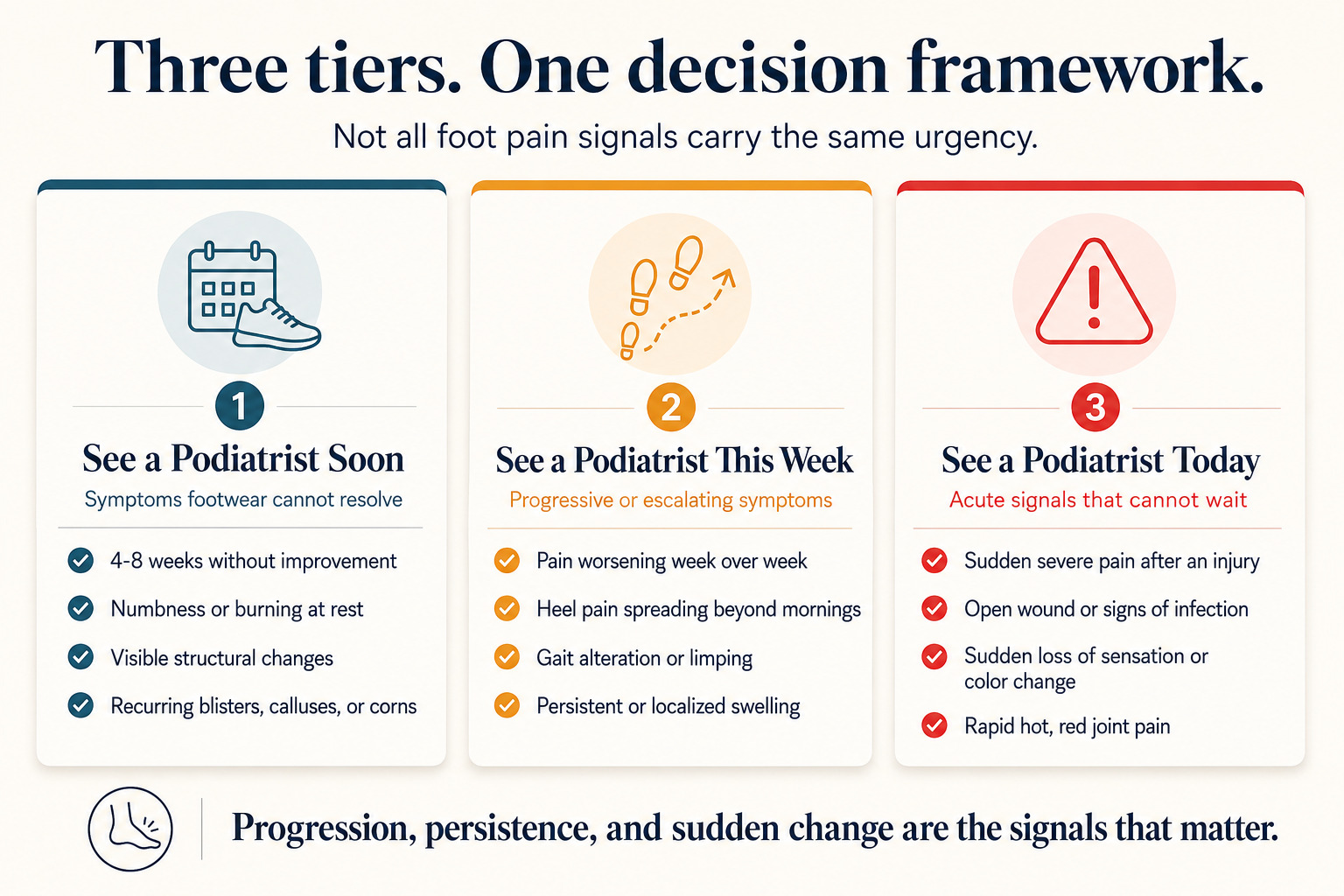
Three tiers. One decision framework.
Not all foot pain signals carry the same urgency. Some warrant a scheduled appointment within a few weeks. Others require action within days. A small number are same-day clinical emergencies. Knowing which tier your symptoms fall into is the starting point for every other decision.
See a Podiatrist Soon: Symptoms Footwear Cannot Resolve
The largest category of podiatrist-warranted foot pain is also the most commonly delayed: symptoms that have been present for four to eight weeks or longer without meaningful improvement despite wearing condition-appropriate footwear. This threshold is not arbitrary. Four to eight weeks of correctly fitted, supportive footwear is a reasonable trial period for early-stage plantar fasciitis, mild metatarsalgia, and early arch pain. If symptoms have not improved within that window, the footwear intervention alone is insufficient and clinical assessment is the correct next step.
Persistent numbness, tingling, or burning in the feet or toes that occurs at rest, not only during activity, is a signal that warrants podiatric assessment regardless of duration. Sensory symptoms at rest suggest nerve involvement that is not mechanical in origin and will not respond to shoe changes. The underlying cause requires diagnosis before any meaningful treatment can be applied.
Visible changes in foot structure that have developed or progressed recently belong in this category as well. A bunion that has increased in prominence over the past several months, a toe that has begun to contract, or an arch that has visibly flattened compared to earlier in life are structural changes that a podiatrist can assess, document, and address before they reach the threshold where surgical correction becomes the only remaining option.
Recurring blisters, calluses, or corns that return in the same location despite footwear changes indicate a chronic pressure point that is structural rather than shoe-driven. A podiatrist can identify the underlying biomechanical cause rather than treating the surface symptom repeatedly.
See a Podiatrist This Week: Progressive or Escalating Symptoms
A second category of signals carries a shorter timeline not because they are immediately dangerous but because they describe conditions with a documented pattern of rapid progression when left unaddressed.
Pain that is worsening week over week despite rest and appropriate footwear is in this category. Stable pain that responds to footwear and rest and returns only with activity is a different clinical picture than pain that is measurably worse this week than last week regardless of activity level. The latter trajectory indicates active tissue change that warrants assessment before the next stage of progression occurs.
Heel pain that was previously manageable in the mornings and has begun to occur throughout the day and into the evening describes a plantar fasciitis presentation that has moved from early-stage to moderate or advanced. The window for conservative management that avoids cortisone injection or extracorporeal shockwave therapy narrows as the condition advances. Earlier assessment preserves more conservative options.
Any foot pain that has begun to alter gait belongs here. Limping, favoring one foot, or unconsciously shortening stride to reduce load on a painful area creates compensatory mechanics that transfer abnormal stress to the ankle, knee, hip, and lower back. What begins as foot pain generates secondary problems in the kinetic chain above it when gait alteration persists for weeks or months without addressing the source.
Swelling that is persistent rather than activity-related warrants assessment this week. Feet that swell predictably during long shifts and resolve overnight are exhibiting normal circulatory behavior. Swelling that is present in the morning, that does not resolve with elevation, or that is localized to one area of the foot rather than diffuse describes a different process that requires diagnosis.
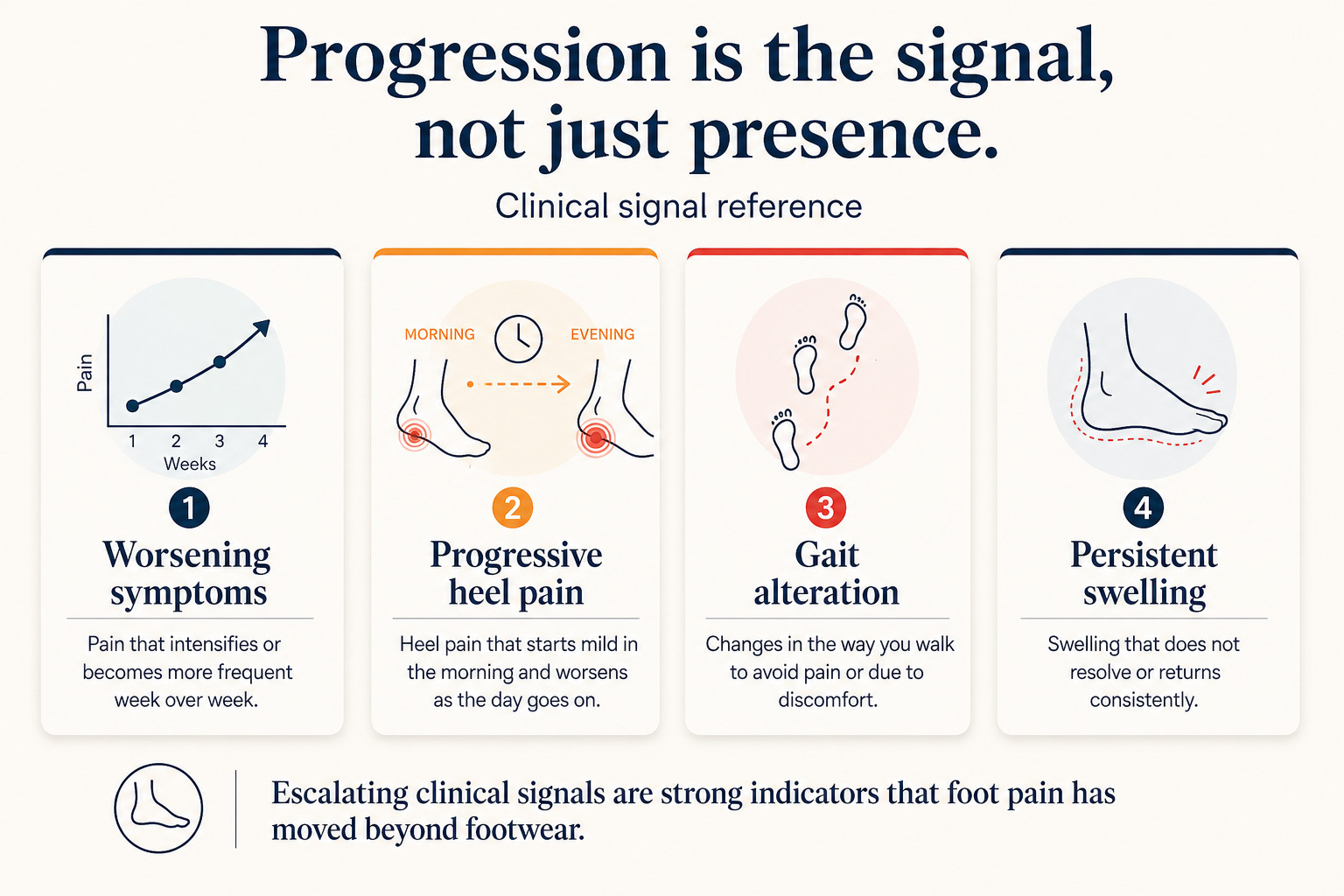
Progression is the signal, not just presence.
Stable foot pain that responds to rest and footwear is a different clinical picture than pain that worsens week over week. Gait alteration, progressive heel pain, and swelling that does not resolve with elevation each describe conditions with documented escalation risk that responds better to early intervention.
See a Podiatrist Today: Acute Signals That Cannot Wait
A smaller set of foot pain signals describes conditions where same-day or emergency care is the appropriate response. These are not cases where a scheduled appointment in two weeks is sufficient.
Sudden, severe foot or ankle pain following a specific incident, a fall, a misstep, a collision, or an audible pop or snap, requires immediate evaluation to rule out fracture, tendon rupture, or ligamentous injury. These injuries are not identifiable by symptom management and require imaging. Walking on an undiagnosed fracture produces displacement that converts a simple injury into a complex one.
Any open wound on the foot that is not healing within two weeks, that shows signs of infection including redness spreading beyond the wound margin, warmth, discharge, or odor, or that has developed in a location subject to pressure or friction requires same-day evaluation. Foot wounds that do not heal on a normal timeline signal compromised circulation or immune response that extends beyond wound care.
Sudden loss of sensation in the foot or a significant change in the color of the foot or toes, particularly pallor, blue discoloration, or mottled appearance, describes a possible vascular event that warrants emergency evaluation rather than a podiatrist appointment.
Severe, throbbing pain in a joint that comes on rapidly, particularly in the big toe joint, accompanied by redness and warmth, describes the classic presentation of an acute gout attack. This is not a footwear problem. It is a metabolic event that requires medical management to resolve the acute episode and address the underlying uric acid levels that produced it.
If You Have Diabetes: The Timeline Compresses Entirely
Everything above applies to people with neurologically intact feet and normal circulation. For people with diabetes, the urgency framework collapses into a single rule: any foot symptom that would be a "see a podiatrist soon" signal for a non-diabetic foot is a "see a podiatrist this week" signal for a diabetic foot, and any wound, ulcer, blister, or skin break is a same-day clinical event regardless of how minor it appears.
Diabetic peripheral neuropathy removes the pain signal that would otherwise identify a pressure injury before it progresses. A blister that a neurologically intact foot would feel and protect within hours may go entirely unnoticed on a neuropathic foot until it has developed into an open wound. Compromised circulation in diabetic feet slows healing to a fraction of normal speed and reduces the immune response available to fight infection at the wound site.
The clinical standard for diabetic foot care includes a podiatrist assessment at minimum once annually for people with well-controlled diabetes and no active neuropathy, and more frequently for people with active neuropathy, prior ulceration, or peripheral arterial disease. This is not a conservative recommendation. It is the standard of care documented in the American Diabetes Association guidelines and reflected in therapeutic footwear coverage criteria under Medicare Part B.
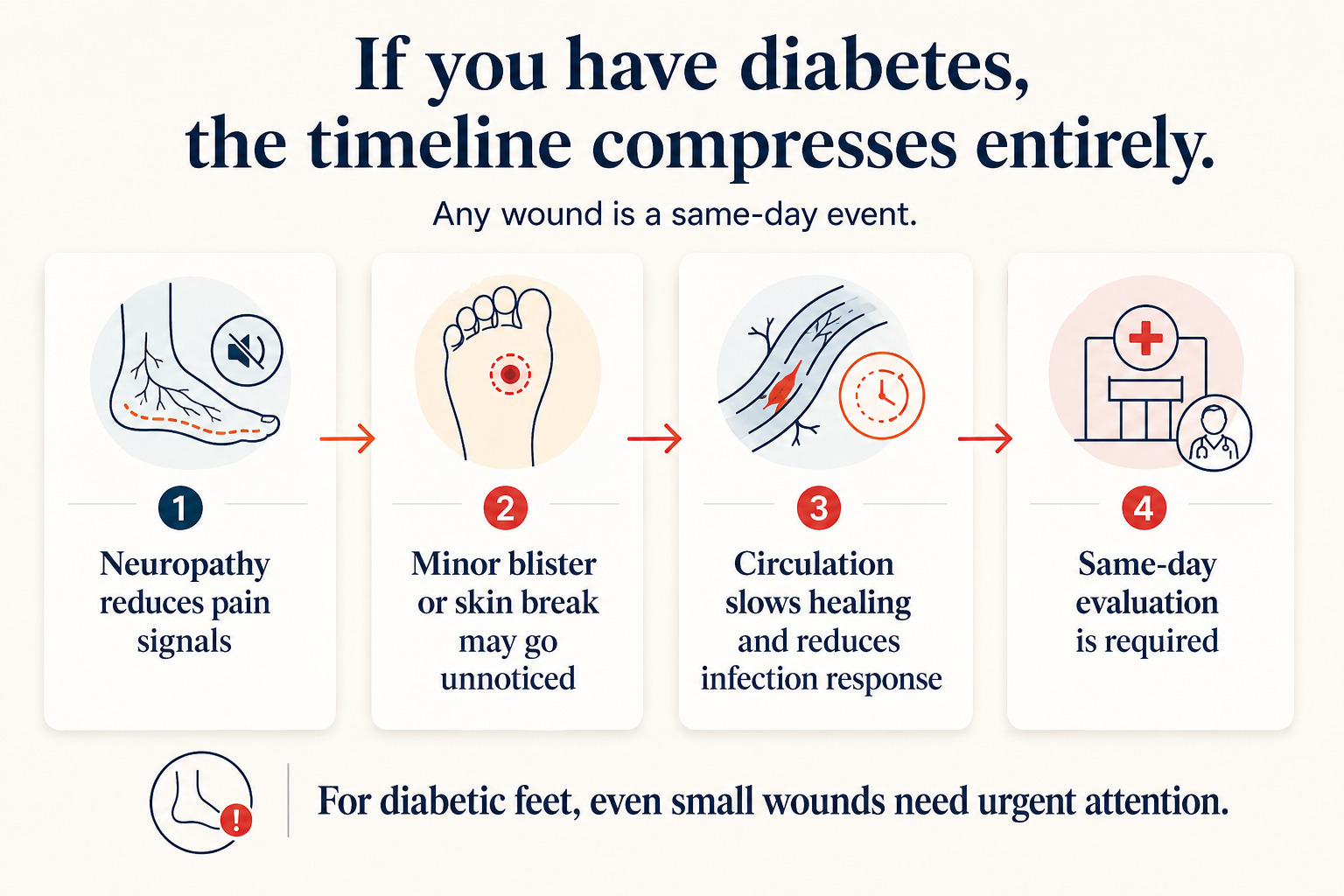
For diabetic feet, any wound is a same-day event.
Diabetic peripheral neuropathy removes the pain signal that would otherwise identify a pressure injury before it progresses. Compromised circulation slows healing and reduces infection response. Any skin break on a diabetic foot warrants same-day podiatric evaluation regardless of how minor it appears.
What a Podiatrist Can Do That a Shoe Cannot
A board-certified podiatric physician is a licensed specialist in the diagnosis and treatment of foot and ankle conditions. The clinical tools available in a podiatric assessment extend significantly beyond anything achievable through footwear selection.
Diagnostic imaging identifies stress fractures, bone spurs, joint degeneration, and soft tissue pathology that are invisible to symptom assessment alone. Gait analysis identifies the specific biomechanical patterns driving a condition, allowing treatment to address the mechanism rather than the symptom. Custom orthotics fabricated from a precise cast or scan of the individual foot provide dimensional correction that no off-the-shelf insole can replicate. In-office procedures including corticosteroid injection, extracorporeal shockwave therapy, and minimally invasive surgical techniques address conditions that have progressed beyond the reach of conservative management.
None of these interventions are accessible through a shoe purchase. They are the clinical layer that sits above footwear optimization and that becomes the appropriate intervention when footwear optimization has run its course.

Thirty-one cities. Verified practicing podiatrists.
The MySoleMatch podiatrist finder covers thirty-one cities with verified practicing podiatrists, terrain profiles, seasonal foot health alerts, and featured provider slots. No directory guesswork. Verified data sourced from the NPI Registry.
Foot pain that has been present for weeks, that is worsening, that is altering how you walk, or that falls into any of the acute signal categories above has moved beyond what a shoe recommendation can address. The correct next step is a clinical assessment, not another round of footwear research.
The MySoleMatch podiatrist finder covers thirty-one cities with verified practicing podiatrists. For everyone else, the shoe finder quiz routes to condition-matched, APMA-verified recommendations for anyone still in the footwear optimization stage. Both are the right next step. The question is only which one applies to where you are right now.