
The alarm goes off. You swing your legs over the side of the bed, put your feet on the floor, and take your first steps toward the bathroom. And something is wrong. There is pain in your heel, or your arch, or the back of your ankle. Sharp enough to make you hesitate. Enough to change how you walk those first few steps.
Then, after five or ten minutes, it fades. By the time you have made coffee it is barely noticeable. By midmorning you have almost forgotten about it. Until tomorrow, when it happens again.
This pattern, pain at first contact that eases with movement, is one of the most clinically recognizable patterns in podiatric medicine. It has a name in podiatric literature: post-static dyskinesia. It is not random discomfort. It is your body telling you something specific about what happened while you slept and what is happening inside your foot when weight is suddenly applied to tissue that spent hours in a shortened, unloaded state.
The challenge is that several different conditions produce this same morning pattern, and the right response depends entirely on which one you have. This article explains the mechanism behind each, how to tell them apart by where the pain sits and how it behaves, and what that means for the footwear decisions you make.
Why Morning and Not Any Other Time of Day?
While you sleep, your foot rests in a naturally plantarflexed position, meaning the toes point slightly downward and the ankle relaxes into a gentle downward angle. This is not a problem position. It is simply where gravity and muscle relaxation take the foot when there is no weight bearing load on it.
The problem is what that position does to the soft tissue structures inside the foot over six, seven, or eight hours. Tendons shorten. Fascia contracts. Fluid accumulates in tissue that would normally be dispersed by movement. The foot, in short, stiffens around the position it has been held in all night.
Then you stand up. Full body weight, applied immediately, to tissue that is contracted, stiff, and not yet hydrated by the circulatory activity that walking creates. The first steps force that tissue to lengthen rapidly under load. If the tissue is healthy, it adapts quickly and you feel nothing beyond a brief awareness of stiffness. If the tissue is irritated, inflamed, or structurally compromised, that rapid lengthening under load produces pain.
The pain typically eases after a few minutes because movement warms the tissue, stimulates blood flow, and mechanically disperses the fluid that accumulated overnight. The relief is real. It is also not the same thing as healing.
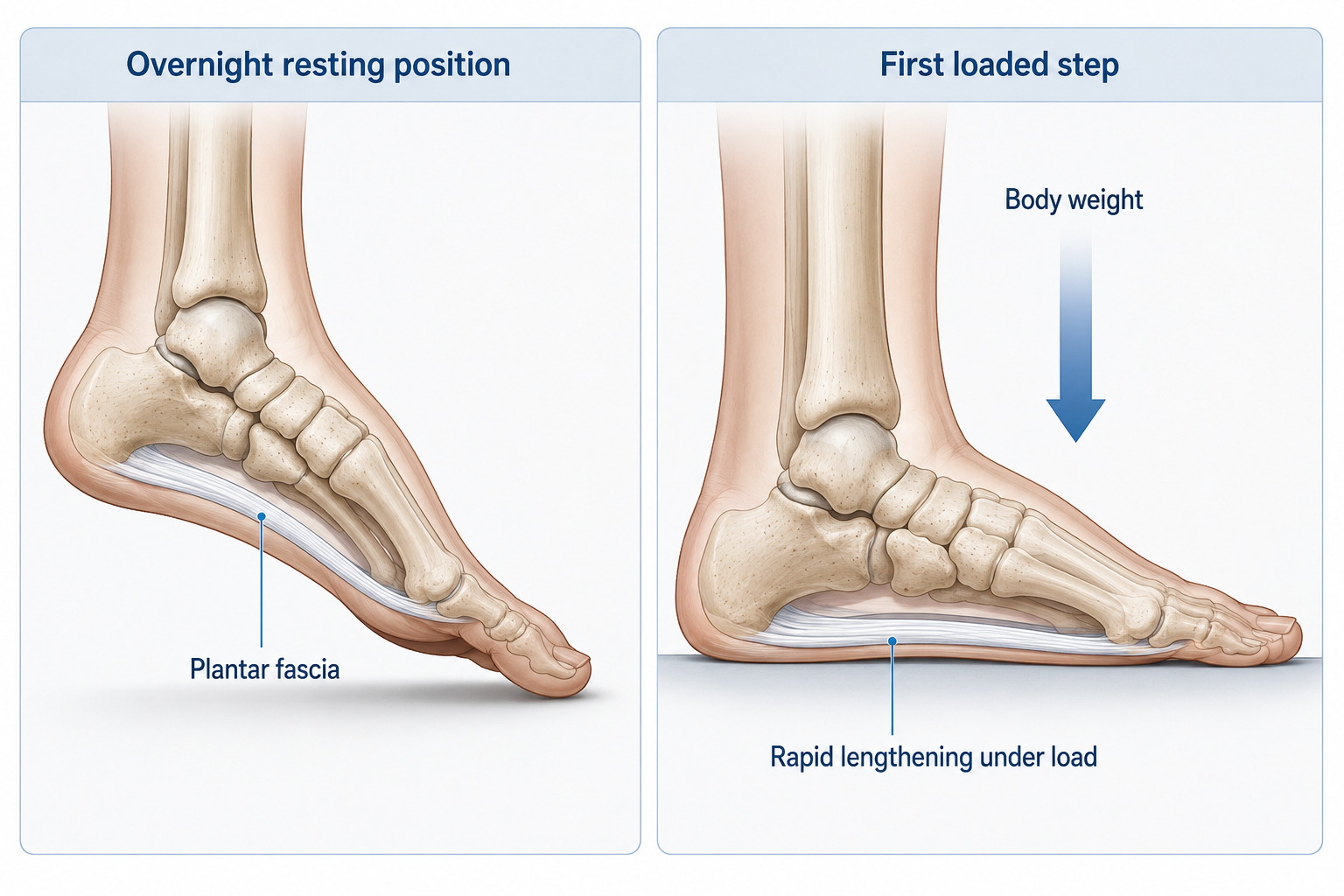
Why the first steps hurt most
During sleep the foot rests in a plantarflexed position, shortening the fascia and tendons. Standing applies full body weight to tissue that has spent hours in a contracted state.
When the Pain Is in Your Heel or Arch: Plantar Fasciitis
The most common cause of morning foot pain by a significant margin is plantar fasciitis. Plantar fasciitis is a clinical diagnosis involving degeneration of the plantar fascia, the thick band of connective tissue that runs along the underside of the foot from the heel bone to the base of the toes. It supports the arch and absorbs load during every step.
The morning pain of plantar fasciitis has a specific character that distinguishes it from other causes. It concentrates at the heel, usually at the inner front edge where the fascia attaches to the calcaneus. It is sharp and stabbing at first contact. It is worst with the very first steps and typically improves within five to fifteen minutes of walking. It can return later in the day after prolonged standing or at the end of a long shift, though usually with less intensity than the morning presentation.
The mechanism is well established in podiatric literature. During sleep, the plantar fascia shortens in the plantarflexed position. When you stand, the shortened fascia is forced to elongate rapidly under the full load of your body weight. In tissue that is already irritated and has accumulated microtears from repetitive strain, that sudden lengthening produces the sharp pain characteristic of the condition.
Two risk factors appear consistently in the clinical literature: tight calf muscles and limited ankle dorsiflexion. When the calf is tight, the ankle cannot flex sufficiently during the gait cycle. The foot compensates by placing additional strain on the plantar fascia with each step, driving cumulative microtrauma that the tissue cannot adequately repair between loading cycles. This is why plantar fasciitis is common not only in runners and people who stand all day, but also in people who work at desks for long periods and then suddenly increase activity, their calves have shortened from prolonged sitting and the fascia absorbs the consequence.
From a footwear perspective, what the plantar fascia needs is a shoe that reduces the strain at the calcaneal attachment during each step. That means adequate heel cushioning to absorb ground reaction force, enough arch support to prevent the fascia from being stretched flat with every footfall, and in many cases a modest heel drop to reduce the pull of a tight Achilles tendon on the heel bone. The plantar fasciitis condition page lists the specific shoes that meet these criteria, all APMA verified.
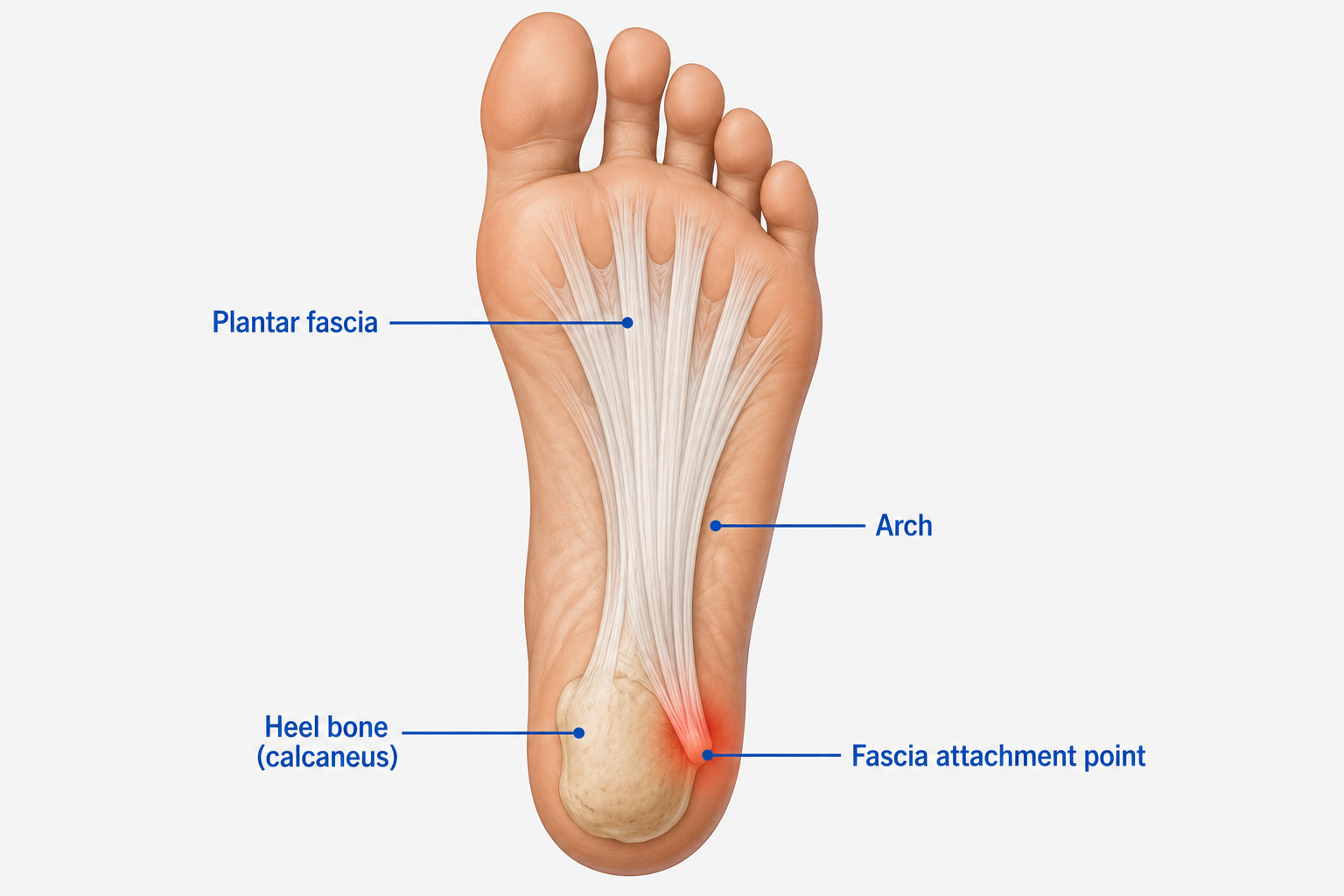
Where plantar fasciitis pain originates
Plantar fasciitis pain concentrates at the calcaneal attachment, the inner front edge of the heel where the fascia originates. This is the point of maximum traction stress during the first steps of the morning.
When the Pain Is at the Back of the Ankle: Achilles Tendinopathy
If the pain sits at the back of the ankle or the back of the heel rather than the underside of the foot, the morning pattern points toward Achilles tendinopathy rather than plantar fasciitis. The location is the primary differentiator.
Achilles tendinopathy involves structural changes in the collagen matrix of the Achilles tendon, the large tendon that runs from the calf muscles to the heel bone. When the tendon is irritated and overloaded over time, the normally tightly packed collagen fibers spread apart and allow fluid to accumulate within the tendon substance during periods of inactivity. Overnight, as the foot rests in a plantarflexed position and circulation decreases, that fluid builds and sensitizes local nerve endings within the tendon.
The first steps of the morning stretch and load a tendon that has stiffened around the accumulated fluid. The result is the characteristic stiffness and pain at the back of the ankle on those first steps, which then gradually improves as walking disperses the fluid and the tendon warms up. Sports physiotherapists use the duration of this morning stiffness as a clinical indicator of tendon load tolerance, the longer it persists before resolving, the more the tendon's capacity is being exceeded.
Clinically, there are two distinct presentations of Achilles tendinopathy that respond differently to treatment. Mid-portion tendinopathy affects the tendon two to six centimeters above the heel bone and is the more common presentation in runners and active individuals. Insertional tendinopathy affects the point where the tendon meets the heel bone itself and requires a different approach. Deep sustained calf stretching, which helps mid-portion cases, can compress and worsen insertional presentations. This distinction matters because what works for one can aggravate the other.
From a footwear standpoint, Achilles tendinopathy typically benefits from a shoe with meaningful heel elevation to reduce the stretch placed on the tendon during the gait cycle, and a firm heel counter to stabilize the heel and reduce the lateral stress that irritates the tendon insertion. See the Achilles tendinitis condition page for APMA-verified options that address both presentations.
When the Heel Pain Does Not Ease Quickly: Heel Spurs
Heel spurs are bony calcium deposits that develop on the underside of the calcaneus, usually at the point where the plantar fascia attaches. They are not, as commonly believed, the direct source of pain in most cases. Most people with heel spurs on imaging studies have no pain at all, and the spur itself is rarely the primary pathology.
What causes pain is the surrounding soft tissue, specifically the inflamed plantar fascia and bursae adjacent to the spur. The spur develops as a response to chronic traction stress at the calcaneal attachment over time. When those surrounding tissues are inflamed, the morning pattern is similar to plantar fasciitis but often persists longer before easing with movement, and the tenderness under the heel is frequently more focal and palpable.
Because heel spurs are a downstream consequence of the same mechanical environment that produces plantar fasciitis, the footwear approach is essentially the same: heel cushioning to absorb impact at the spur site, arch support to reduce traction on the fascia at the calcaneal attachment, and avoidance of thin-soled or flat footwear that transfers ground force directly to the heel bone. The heel spurs condition page covers the specific APMA-verified options.
When the Arch Hurts or the Pain Is Diffuse: Flat Feet
People with flat feet, where the arch makes full or near-full contact with the ground during standing, often experience a different pattern of morning foot pain. Rather than concentrated heel pain, the discomfort is frequently more diffuse, centered along the arch or the inner ankle area, and accompanied by a feeling of fatigue or aching that starts early and builds through the day.
The mechanism is biomechanical. Without a functional arch to distribute load, the plantar fascia, the posterior tibial tendon, and the ligaments of the midfoot are placed under sustained strain during every step. Flat feet are also closely associated with tight Achilles tendons and restricted ankle motion, creating a compounding mechanical environment where multiple structures are simultaneously overloaded.
Flat feet do not always hurt. Many people have structurally flat feet throughout their lives with no significant pain. Pain tends to emerge when activity level increases, footwear support decreases, body weight changes, or age-related ligament laxity allows the arch to collapse further than it previously did. When morning arch pain becomes a daily pattern, it is typically a signal that the current footwear is not providing the structural support the foot needs to function without excessive soft tissue strain.
The flat feet condition page lists the stability and motion control shoes that address this specifically, with width options for feet that have also spread with arch collapse over time.
When the Stiffness Is in the Joints and Eases Slowly: Arthritis
Morning joint stiffness in the foot that takes longer than ten to fifteen minutes to ease with movement, and that feels more like joints warming up than tissue stretching, points toward arthritis rather than soft tissue conditions. Podiatric literature refers to this as start-up pain, a pattern of stiffness and aching that occurs after periods of immobility, particularly overnight, and that improves as the joints are moved and warmed.
Osteoarthritis affects the cartilage within foot joints, most commonly the big toe joint, the midfoot joints, and the ankle. As cartilage degrades, joints lose their smooth movement and develop inflammation during periods of loading. Overnight inactivity allows inflammatory fluid to settle around the affected joints, producing the characteristic morning stiffness. Movement gradually disperses this fluid and the joints move more freely, though pain typically returns with sustained activity.
Rheumatoid arthritis presents differently. As an autoimmune condition, it can affect multiple joints simultaneously and tends to produce morning stiffness that is more pronounced and longer lasting than osteoarthritis. Feet are frequently among the first joints affected in rheumatoid arthritis, and morning stiffness that persists for more than thirty minutes and affects multiple areas of the foot simultaneously warrants evaluation by both a podiatrist and a rheumatologist.
Footwear for arthritic feet has specific requirements: a rocker sole geometry to reduce the bending stress on stiff joints during toe-off, a wide and deep toe box to accommodate joint swelling that increases through the day, and cushioning that absorbs the ground reaction force that cartilage can no longer buffer effectively. The foot osteoarthritis condition page and rheumatoid arthritis condition page cover these requirements and the specific APMA-verified shoes that address each presentation.
How to Tell Them Apart Without a Diagnosis
Location is the most reliable first indicator. Pain on the underside of the heel or arch points toward plantar fasciitis or heel spurs. Pain at the back of the ankle points toward Achilles tendinopathy. Diffuse arch pain that builds through the day points toward flat feet and posterior tibial tendon strain. Joint stiffness that takes time to ease and affects specific points in the foot points toward arthritis.
The duration of morning relief also matters. Plantar fasciitis pain typically improves within five to fifteen minutes of walking. Achilles tendinopathy stiffness usually eases within a similar window. Arthritis start-up pain can take longer, and in rheumatoid arthritis may last thirty minutes or more. Pain that does not ease at all with movement, or that is accompanied by swelling, warmth, or redness, is a different category of concern that warrants prompt evaluation.
None of these distinctions are a substitute for a clinical examination. A board-certified podiatrist can confirm the diagnosis, assess gait, and identify whether the issue is purely soft tissue, structural, or systemic. The MySoleMatch podiatrist finder covers thirty-one cities with verified practicing podiatrists if you want to move beyond self-assessment.
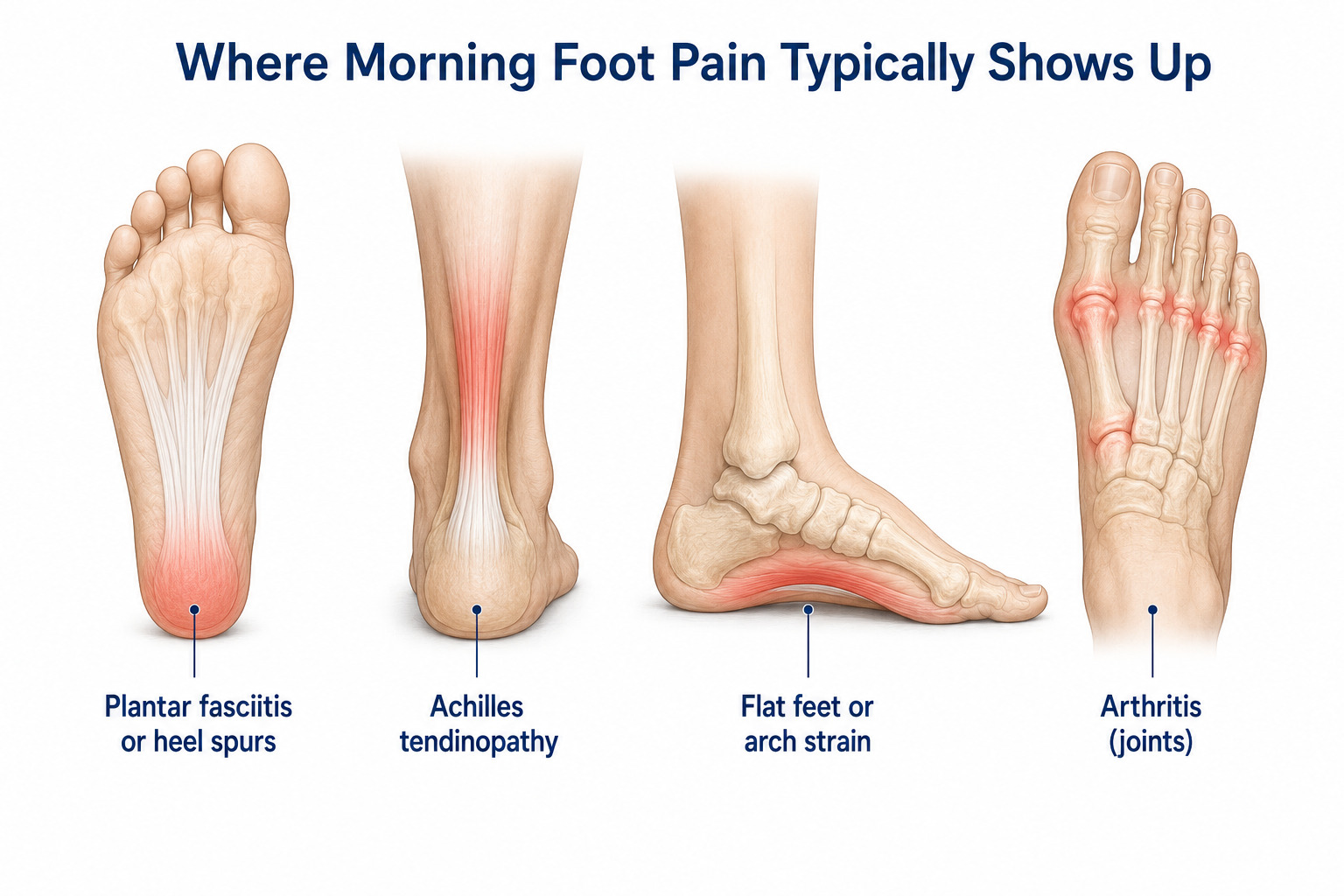
Where morning foot pain typically shows up
Location is the most reliable first indicator. Where the pain sits on the foot points toward a specific structure and condition before any clinical examination takes place.
What Footwear Can and Cannot Do
The right shoe does not treat a condition. It modifies the mechanical environment the foot operates in, reducing the strain on the specific structure that is already irritated and allowing the body to recover rather than re-injure itself with every step.
For plantar fasciitis and heel spurs, the right shoe reduces the ground reaction force at the calcaneal attachment and prevents the fascia from being overstretched with each footfall. For Achilles tendinopathy, it reduces the stretch placed on the tendon and stabilizes the heel. For flat feet, it provides the arch support the foot structure cannot provide itself. For arthritis, it smooths the gait cycle and reduces bending stress on stiff joints.
What footwear cannot do is replace physical therapy for chronic tendon pathology, correct a structural deformity that has progressed beyond conservative management, or substitute for a diagnosis that requires imaging or clinical examination to confirm. In any case where morning pain has been present for more than two weeks without improvement, where it is accompanied by swelling or visible changes in the foot, or where it is affecting how you walk through the day, professional evaluation is the appropriate next step.
The Pattern Is Information
Morning foot pain that resolves with movement is not something to dismiss as normal aging or the price of being on your feet. It is a repeatable, specific signal from the foot's soft tissue and joint structures about what is being asked of them and whether they can meet that demand without further breakdown.
The fact that it eases after a few minutes is not reassurance that everything is fine. It is the foot's way of managing what has already become a chronic pattern. The question is whether the footwear you step into each morning is reducing that pattern or reinforcing it.
Use the condition pages to find shoes matched to your specific pain location and presentation. Use the shoe finder quiz if you are not yet sure which condition you are dealing with. And if the pattern has been going on long enough that you have built a morning routine around managing it, it is time to put a name to it.