
This article describes forefoot pain patterns to help you understand what may be happening and what questions to ask. It is not a substitute for a clinical examination. If forefoot pain persists beyond four to six weeks, has not responded to footwear changes, or is accompanied by swelling, redness, or numbness, a board-certified podiatrist can identify the specific cause and rule out conditions that require more than footwear modification.
You check your shoe. Nothing there. You adjust your sock. Still the same feeling. A persistent sensation under the ball of the foot, like something small and hard is sitting just below the skin that you cannot remove no matter what you do.
It is one of the most common descriptions podiatrists hear from patients presenting with forefoot pain. The pebble sensation, sometimes accompanied by burning, aching, or a feeling that the padding under the foot has simply worn away, points toward a specific region of the foot and a specific category of mechanical problem.
Understanding what is happening in that region, and what conditions produce that particular sensation, is the first step toward making sense of why the feeling persists and what kind of footwear environment the foot actually needs.
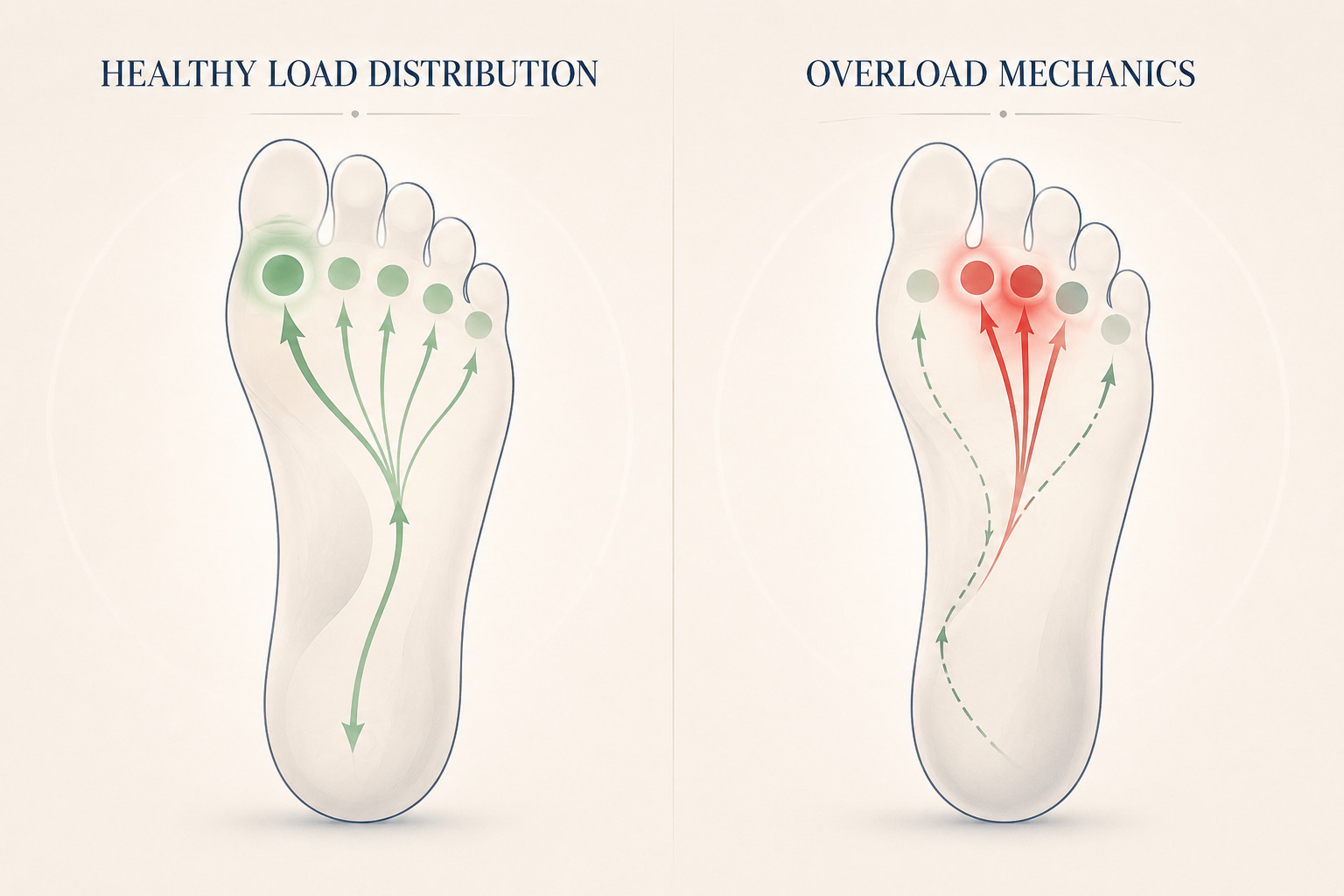
When load distribution breaks down
Normal gait distributes push-off pressure primarily through the first metatarsal head. When this distribution is disrupted by structural factors, footwear, or muscle weakness, the second and third metatarsal heads absorb load they are not designed to sustain repeatedly.
What the Ball of the Foot Actually Is
The ball of the foot is not a single structure. It is the region where the five metatarsal bones end in rounded heads that make contact with the ground during walking and running. During normal gait, pressure moves sequentially from the heel at initial contact, across the outer edge of the foot through midstance, and then concentrates at the metatarsal heads during the push-off phase before transferring to the toes.
The first metatarsal, which runs to the base of the big toe, is the widest and is designed to bear the largest share of push-off load. The second through fourth metatarsals are progressively narrower and are not designed to sustain the same level of repetitive pressure. When something disrupts the normal distribution of load across these five heads, whether from structural factors, footwear, activity level, or systemic conditions, one or more metatarsal heads absorbs more force than it is built to handle. That concentrated, repetitive overloading is what produces the pain, burning, and pebble sensation patients describe.
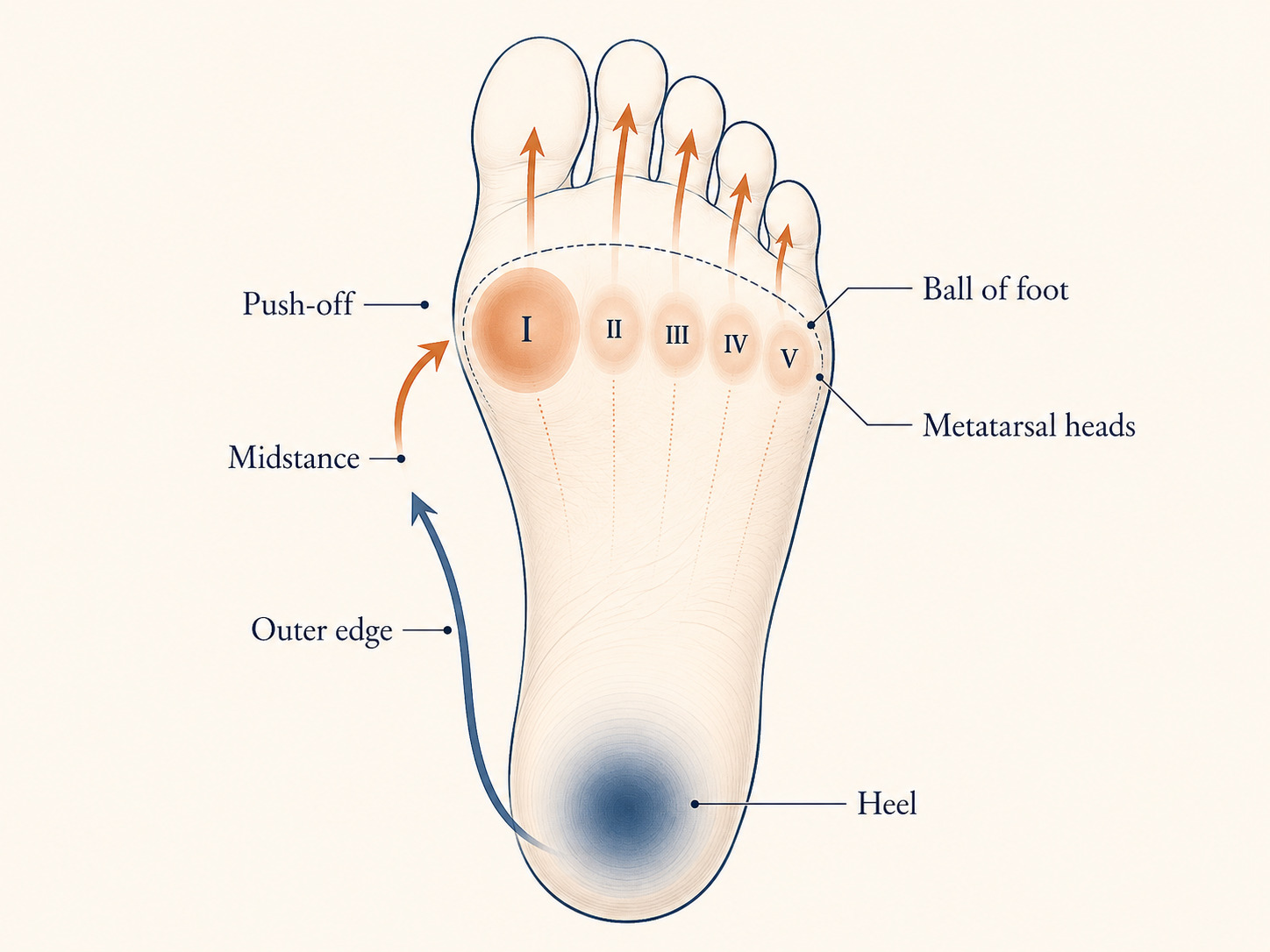
Five bones, one pressure system
The five metatarsal heads bear the majority of push-off load during every step. The first metatarsal is built to handle the largest share. When that distribution is disrupted, the narrower second and third heads absorb force they were not designed to sustain repeatedly.
What Metatarsalgia Is and What It Is Not
The clinical term for pain in the ball of the foot is metatarsalgia. It is worth understanding immediately that metatarsalgia is a symptom description, not a specific diagnosis. Board-certified podiatric physicians consistently emphasize this distinction because it directly affects how the condition should be evaluated and managed. The spectrum of conditions that produce forefoot pain ranges from straightforward mechanical overloading that responds well to footwear modification, to plantar plate tears, Morton's neuroma, capsulitis, sesamoiditis, and stress fractures, each of which requires a different treatment approach.
One structural factor worth understanding specifically is the plantar fat pad. This is the layer of specialized adipose tissue that sits between the metatarsal heads and the ground, acting as the foot's natural shock absorber in the forefoot region. In a healthy foot, the plantar fat pad is thick, resilient, and well-anchored beneath the metatarsal heads. As it ages, or in response to certain systemic conditions including rheumatoid arthritis and diabetes, it thins, migrates forward, and loses the structural integrity that makes it effective. When this happens, the metatarsal heads have significantly less natural cushioning between them and the ground with every step. The sensation of walking on something hard and round is frequently the metatarsal head itself, now closer to the walking surface than it was designed to be. This distinction matters because a diminished fat pad responds differently to footwear than simple mechanical overloading does, and it is one of the reasons forefoot pain in older adults and people with systemic conditions can be more persistent and more resistant to standard footwear changes.
This matters practically because footwear changes that help one cause of forefoot pain may do very little for another, and some causes of ball of foot pain worsen with continued activity if the underlying structural problem is not identified. If forefoot pain has not responded to four to six weeks of footwear modification, or if the pain is focal over a single metatarsal rather than distributed across the forefoot, clinical evaluation is the appropriate next step rather than continued shoe experimentation.
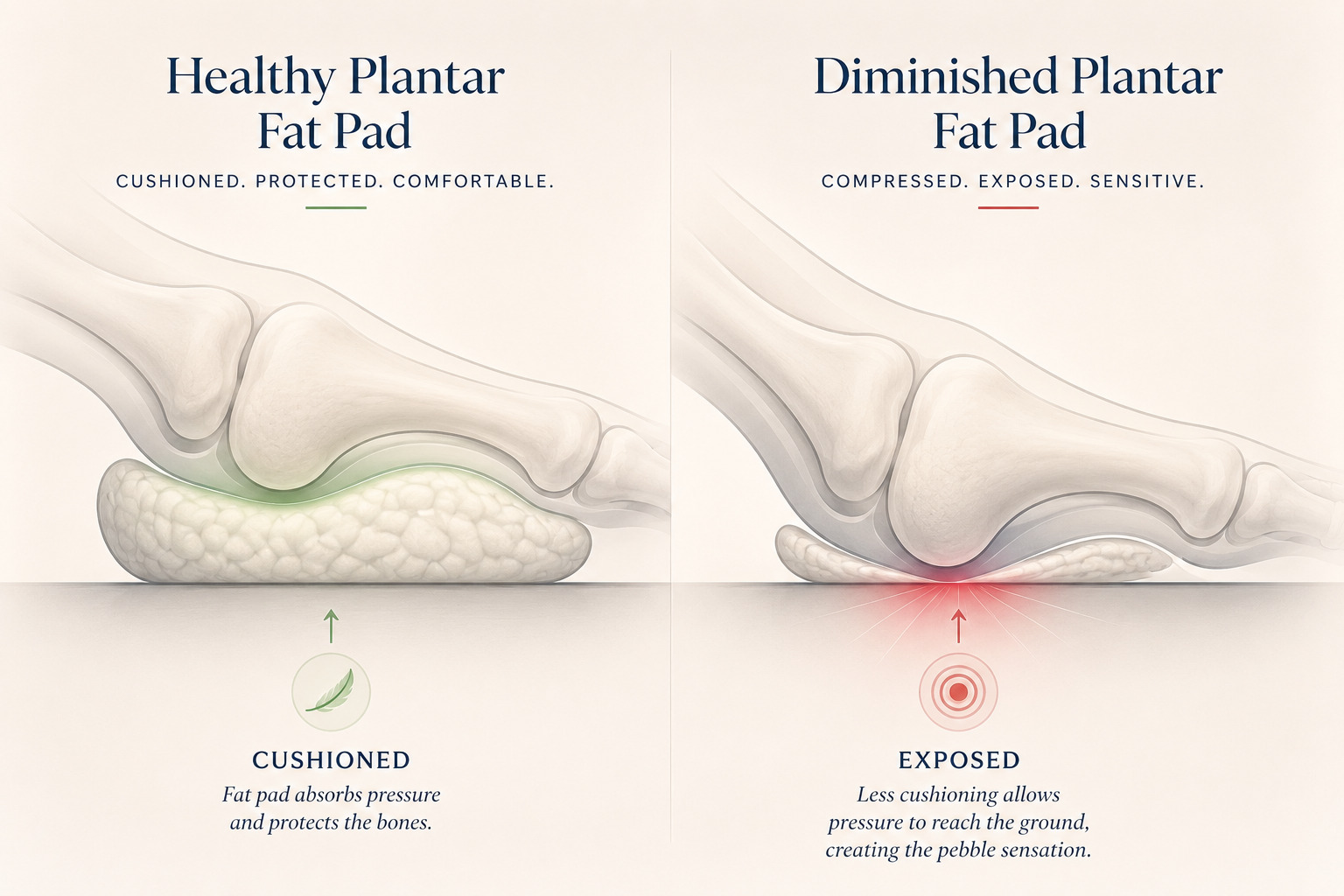
Healthy fat pad versus diminished fat pad
A healthy plantar fat pad cushions the metatarsal heads from ground contact with every step. When it thins or migrates forward with age or systemic conditions, the metatarsal heads sit closer to the walking surface and the foot loses its primary natural shock absorber in the forefoot.
What Disrupts Normal Load Distribution
Several factors can shift pressure away from the first metatarsal and concentrate it on the lesser metatarsal heads. Understanding which factor applies to your foot matters because it affects both what footwear will help and whether footwear alone is sufficient.
Structural foot shape is one of the most consistent contributors. A high arch concentrates load at the heel and ball of the foot rather than distributing it across the full footstrike. Mayo Clinic notes that a second toe that is longer than the big toe shifts more weight than normal to the second metatarsal head, a pattern sometimes called Morton's foot structure. Both high arches and this metatarsal length relationship are structural features that do not change with footwear but whose mechanical consequences can be significantly modified by the right shoe environment.
Toe deformities compound the problem. Bunions at the base of the big toe disrupt the first ray's ability to bear its share of push-off load, transferring that force to the second and third metatarsal heads. Hammertoes alter how the toes contact the ground during push-off, effectively driving the metatarsal heads further into the ground with each step. Both conditions are documented causes of secondary forefoot pain in the clinical literature.
Footwear is one of the most modifiable contributors. High heels shift body weight forward onto the forefoot, concentrating load on the metatarsal heads with every step. Clinical research documents that heels above two inches transfer approximately seventy-five percent of body weight to the forefoot during standing and movement. Narrow toe boxes compress the metatarsal heads laterally, preventing the natural spreading of the forefoot under load and increasing pressure at the central metatarsal heads. Thin, flexible soles provide no barrier between the metatarsal heads and the ground surface.
Activity level and surface hardness matter as well. Persistent stress from repetitive loading on hard surfaces, particularly concrete and tile, can lead to chronic irritation of the periosteum and adjacent soft tissue surrounding the metatarsal heads. This is why the condition is common not only in runners and retail workers but also in people who have recently increased their activity level after a period of reduced movement, where the foot's load tolerance has not adapted to the new demand.
What the Sensation Actually Feels Like and Why
The pebble description is clinically accurate in a specific sense. The plantar fat pad, the layer of specialized adipose tissue that sits between the metatarsal heads and the ground, naturally thins and migrates with age and with certain systemic conditions. When this pad is diminished or displaced, the metatarsal heads have less natural cushioning between them and the ground. The sensation of walking on something hard and round is the metatarsal head itself, now closer to the walking surface than it should be.
Alongside the pebble sensation, patients commonly describe a burning or aching pain that intensifies during standing, walking, and running, particularly during the midstance and push-off phases of gait when load on the forefoot is highest. The pain often reduces with rest and returns quickly upon weight bearing. In more persistent cases, the forefoot becomes tender to the touch across the metatarsal heads, and some patients develop compensatory changes in how they walk to avoid loading the painful area, which over time can produce secondary pain in the knee, hip, or lower back.
What Footwear Can Actually Do About It
For mechanical forefoot pain where the cause is load distribution rather than a structural injury requiring clinical intervention, footwear modification is consistently the first line of conservative management in the podiatric literature. Three specific shoe characteristics have the strongest evidence base for reducing forefoot pressure.
A rocker sole geometry is the most clinically significant. Peer-reviewed research published in PMC in 2025 confirms that rocker sole footwear produces favorable clinical outcomes for forefoot load distribution disorders including metatarsalgia, with pressure analysis studies demonstrating reduced peak pressure at the metatarsal heads during gait. The rocker pivot point transfers the push-off load away from the metatarsal heads by completing the gait cycle without requiring full toe dorsiflexion, reducing the duration and intensity of forefoot loading with each step. Clinical data from board-certified podiatric physicians indicates that a well-designed rocker sole can reduce peak forefoot pressure by thirty to sixty percent compared to a flat sole.
Forefoot cushioning depth is the second critical factor. Adequate cushioning under the metatarsal heads absorbs impact and distributes pressure across a larger surface area, reducing the concentration of force at any single metatarsal head. The cushioning must sit correctly under the metatarsal region specifically, not only at the heel. A high heel stack with inadequate forefoot depth does not address the problem.
A wide toe box is the third element. Forefoot compression from a narrow toe box prevents the natural spreading of the foot under load and increases lateral pressure across the metatarsal heads. A shoe with adequate forefoot width allows the foot to spread naturally during push-off, distributing load more evenly and reducing the concentration of pressure at the central metatarsal heads. For patients with bunions or hammertoes contributing to forefoot pain, adequate toe box width is not a comfort preference but a mechanical requirement.
A removable footbed that accommodates a metatarsal pad or custom orthotic is worth noting as a fourth practical consideration. A metatarsal pad placed just proximal to the metatarsal heads, meaning behind them rather than under them, redistributes weight off the heads themselves and onto the metatarsal shafts. When this is done correctly it can provide significant relief even in shoes that do not have ideal rocker geometry. It requires a removable insole to implement properly.
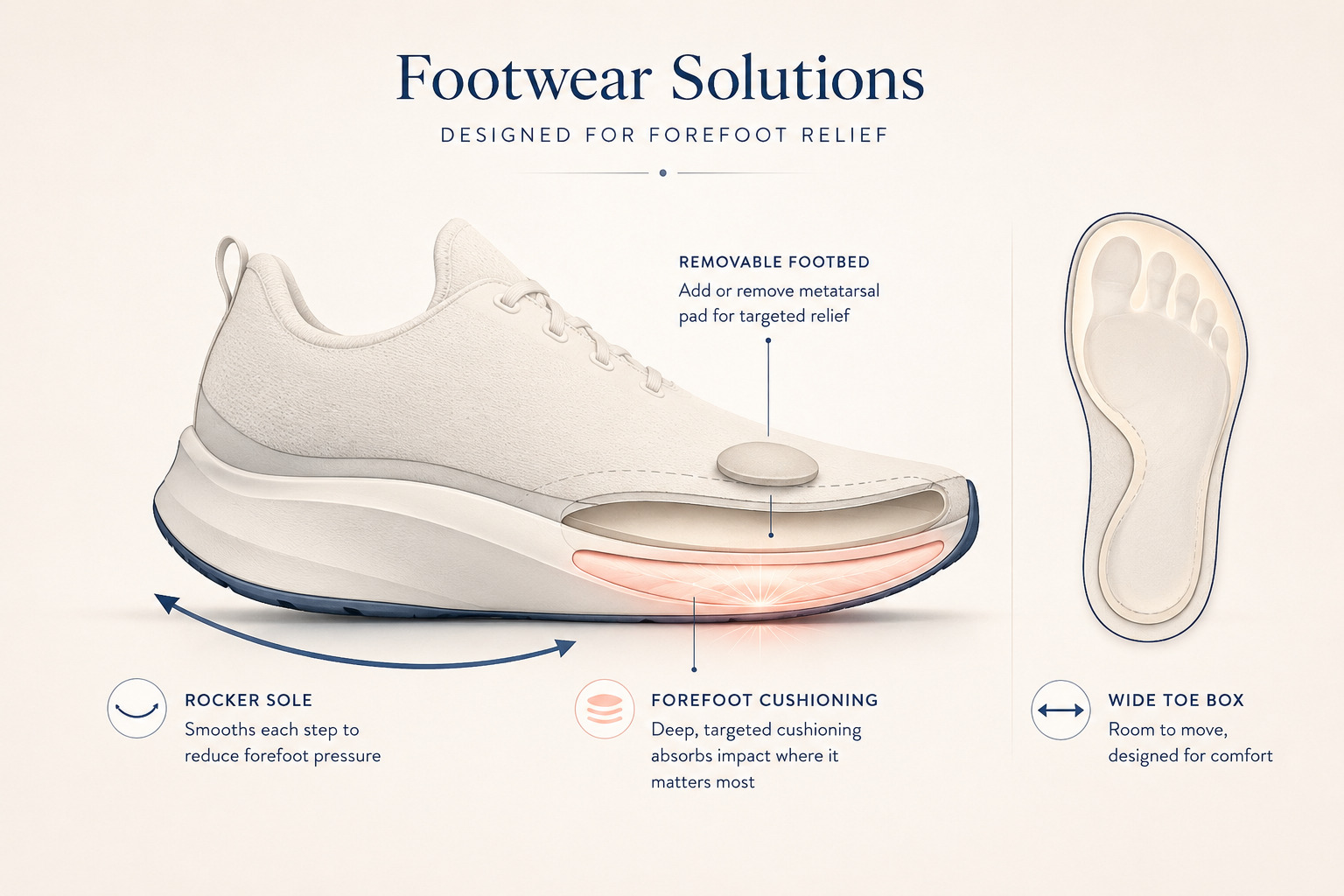
Four shoe features with evidence for forefoot pressure relief
Rocker sole geometry, forefoot cushioning depth, wide toe box, and a removable footbed for metatarsal pad placement are the four characteristics with the strongest clinical basis for reducing metatarsal head loading. Most standard shoes address at most one or two of these.
What Footwear Cannot Do
If the forefoot pain is produced by a plantar plate tear, a stress fracture of a metatarsal, Morton's neuroma, or sesamoiditis, a better shoe will not resolve it. These conditions require clinical diagnosis, and some require intervention beyond conservative management. A stress fracture in particular can worsen significantly with continued activity if it is mistaken for mechanical forefoot pain and managed with footwear changes alone.
The distinguishing factor that podiatrists use clinically is the specificity and character of the pain. Mechanical forefoot pain tends to be distributed across the ball of the foot and responds at least partially to load reduction and cushioning. Pain that is focal over a single metatarsal, that is accompanied by significant swelling or bruising, or that has a sharp electric or shooting quality between the toes rather than under the forefoot, suggests a cause that warrants imaging and clinical evaluation before footwear decisions are made.
The MySoleMatch podiatrist finder covers thirty-one cities with verified practicing podiatrists. If forefoot pain has been present for more than four to six weeks, has not responded to footwear modification, or is affecting how you walk through the day, a clinical examination is the right next step.
The Pebble Sensation Is Specific Information
The feeling of walking on a pebble that is not there is not vague discomfort. It is a description of what happens when the metatarsal heads, the rounded ends of the bones in the ball of your foot, are bearing more load than the surrounding tissue can adequately buffer. That overloading has a cause, and the cause determines what will actually help.
For many people, the right combination of rocker sole geometry, forefoot cushioning, and adequate toe box width produces meaningful relief within four to eight weeks. For others, the underlying cause requires a clinical diagnosis before footwear decisions will make sense. Knowing which situation you are in is what the metatarsalgia condition page and the shoe finder quiz are designed to help you determine.
If the pebble has been there long enough that you have started changing how you walk to avoid it, that is the signal that footwear alone may not be the full answer. That compensatory gait change is your body solving one problem while quietly creating others further up the kinetic chain.