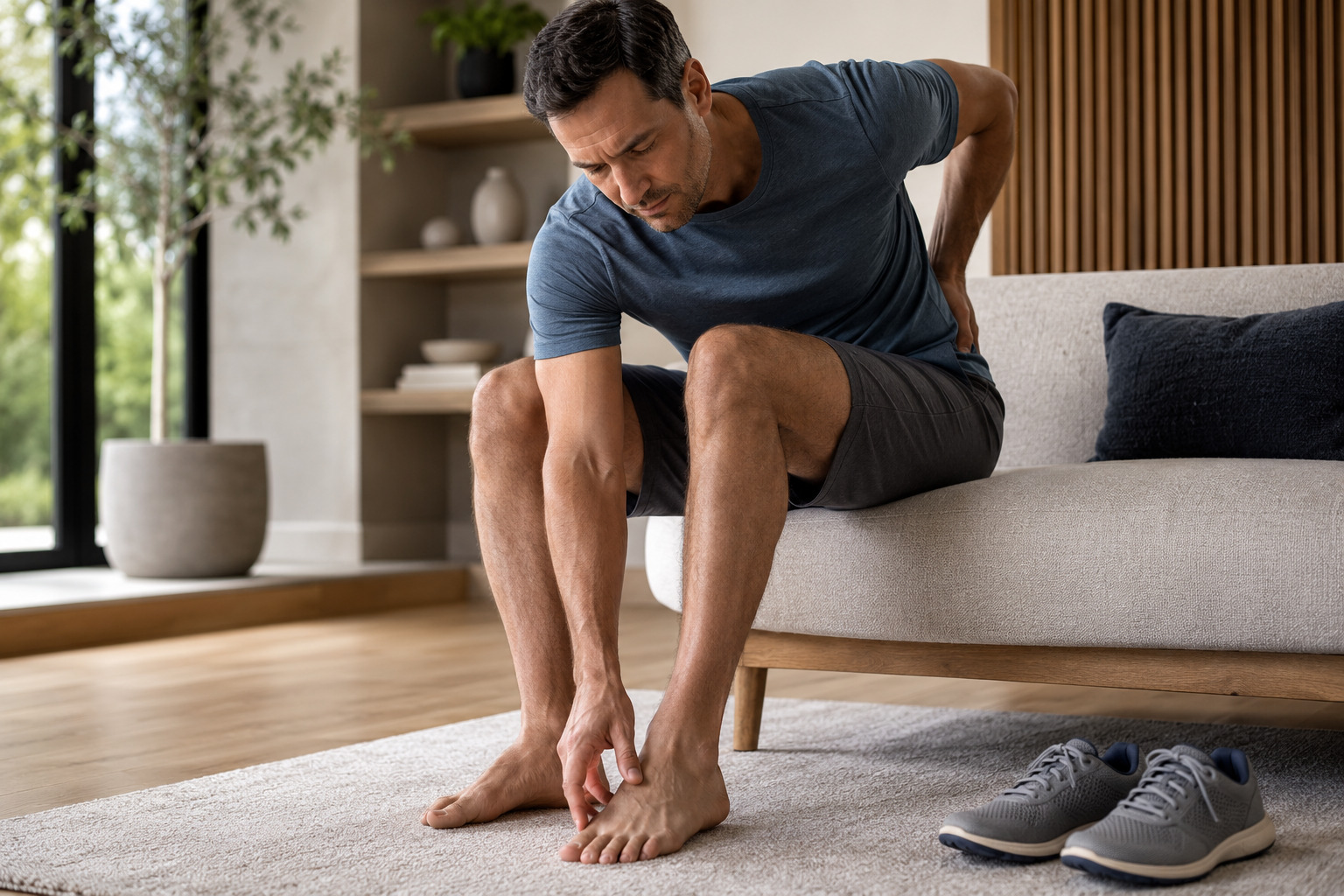
The claim shows up constantly in fitness content, physical therapy offices, and shoe marketing alike. Your feet are the foundation. Fix the foundation and the rest of the chain falls into line. It is a satisfying idea, and like most satisfying ideas about the body, the real research is more complicated and more interesting than the soundbite.
The kinetic chain is a real biomechanical concept, not a wellness metaphor. The question worth answering honestly is where the evidence for it is strong, where it is theoretical, and where it has actually been tested and come back weaker than the popular version of the claim suggests.
The mechanism, in plain terms
During a normal walking or running stride, the foot is supposed to pronate, rolling slightly inward, as it absorbs impact. In a biomechanically efficient foot, that inward roll is controlled and brief. In a foot with a collapsed or underperforming arch, the pronation becomes excessive and prolonged through the stride.
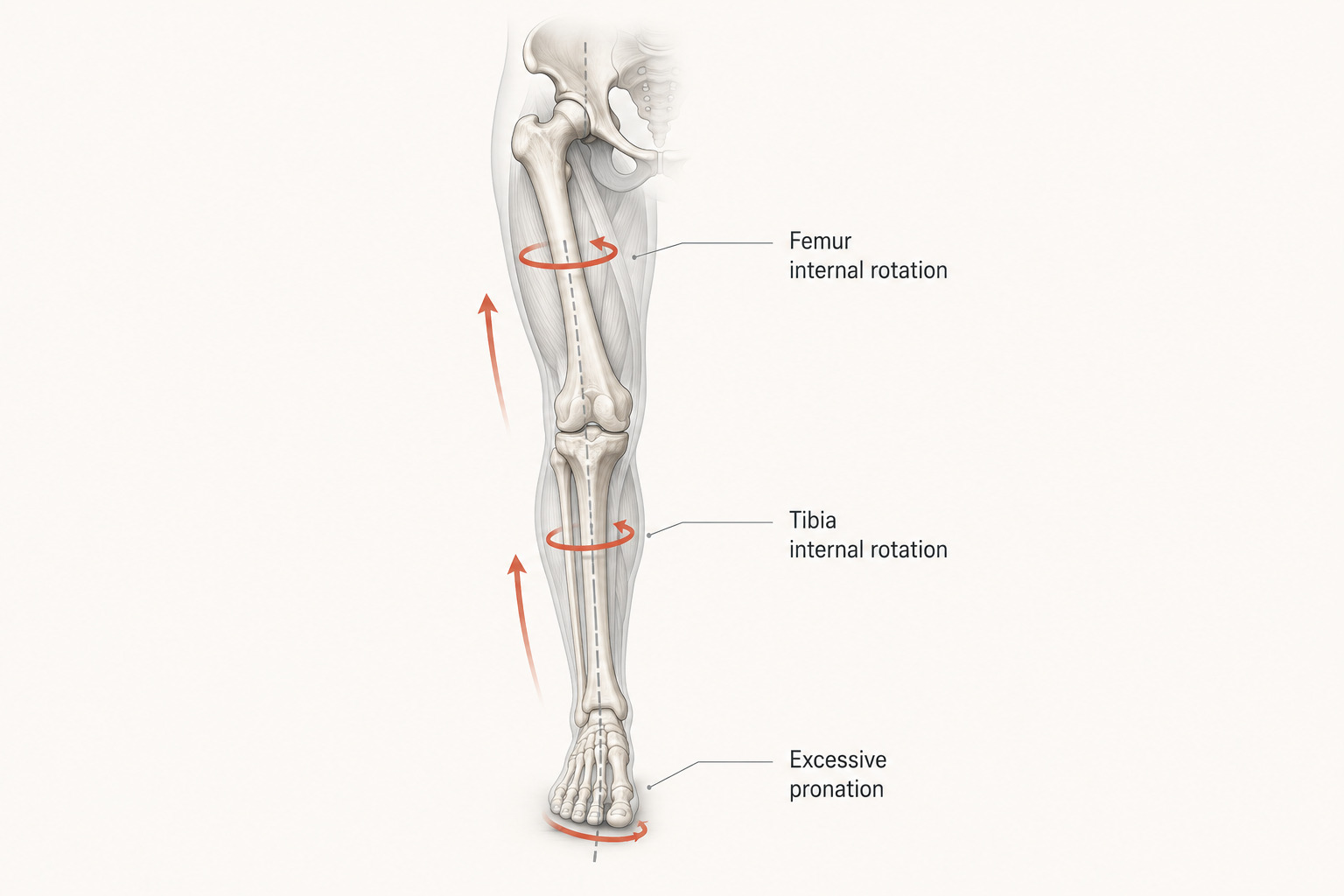
One joint's excess motion becomes the next joint's problem
The model, first proposed by physical therapist Dominic Tiberio in the 1980s, describes how excess pronation drives internal rotation up the leg through the tibia and femur. It is a mechanical coupling, not a guess.
Because the leg bones are mechanically linked at the joints, that excess inward roll at the foot translates into internal rotation of the tibia, and from there into internal rotation of the femur at the hip. This model was first proposed by physical therapist Dominic Tiberio in the 1980s and remains the standard explanation for how a distal foot problem could plausibly create load higher up the leg. It is a coherent mechanical theory. Whether it reliably produces pain at each joint is a separate question, and the answer differs depending on which joint you ask about.
What the evidence actually shows at the knee
This is the joint most commonly blamed on foot mechanics, and the evidence here is the most mixed of the three. A systematic review published in the Journal of Foot and Ankle Research examined static foot posture as a risk factor across multiple lower limb injuries and found strong evidence linking a pronated foot posture to medial tibial stress syndrome, commonly known as shin splints. For patellofemoral pain, the anterior knee pain syndrome most often associated with runners, the same review found only very limited evidence of an association, with small effect sizes.
A separate 2022 systematic review and meta-analysis of randomized controlled trials examined whether foot orthoses, which are designed specifically to control excess pronation, actually improve patellofemoral pain. The result was mixed in an informative way. Orthoses improved knee function and sport and recreation scores, but showed no significant effect on pain intensity itself. In other words, controlling the foot mechanics changed how the knee performed without necessarily changing how much it hurt.
The honest summary at the knee is that the mechanical link is real and measurable, the association with shin splints specifically is well supported, and the association with anterior knee pain is plausible but has consistently produced smaller and less consistent effects than the popular narrative implies.
What the evidence shows at the hip and lower back
This is where the research is, somewhat counterintuitively, stronger than it is at the knee. A 2024 systematic review and meta-analysis published in PLOS One, covering more than 100,000 participants across thirteen studies, found a statistically significant association between flat feet and low back pain. The same analysis found strong evidence linking increased foot pronation to elevated low back pain risk, moderate evidence for increased hip internal rotation, and more limited evidence for knee internal rotation specifically.
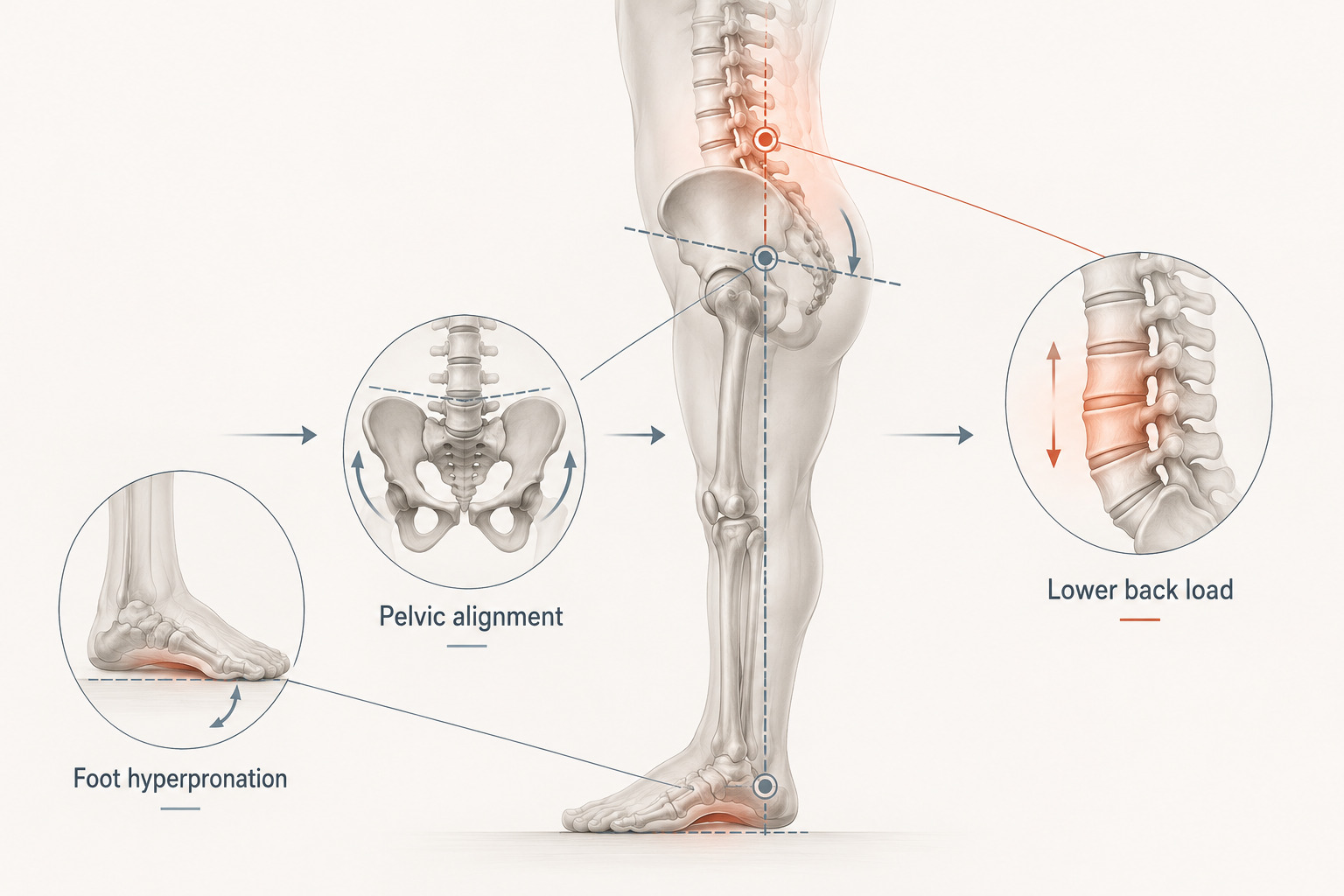
The pelvis sits between the foot and the spine, and it feels both
Research on hyperpronation and chronic low back pain describes a plausible chain: altered foot mechanics change pelvic positioning, which changes the load pattern the lower spine has to manage.
Separate gait analysis research comparing people with pronated feet and chronic low back pain to a control group found measurable differences in ankle, knee, and hip motion, along with elevated muscle activity in the gluteus medius and lower back muscles during walking. Other work has found that people with low back pain and pronated feet show higher vertical ground reaction force and loading rate than people with pronation alone, suggesting the combination compounds rather than simply coexists.
None of this proves that a flat foot causes low back pain in any individual case. Association is not causation, and low back pain has many contributing factors that have nothing to do with the feet. What it does establish is that, of the three joints commonly cited in the kinetic chain story, the low back has the most consistent research support, not the knee, which is often the one people assume is best proven.
Why the proximal side of the chain matters too
Research on this topic increasingly points in both directions at once. Weakness or poor motor control in the hip and core muscles, sometimes called the lumbo-pelvic hip complex, has been shown to influence hip rotation and femoral position during gait independently of what the foot is doing. Several of the injuries historically blamed entirely on excessive foot pronation may actually reflect a two way relationship, where proximal weakness at the hip and distal foot mechanics both contribute and potentially reinforce each other.

The chain runs in both directions
Hip and core strength influence how much rotational load reaches the knee and foot. Footwear addresses one end of the chain. It was never designed to address all of it.
This matters practically. It means a stability shoe that controls pronation is addressing one legitimate link in a longer chain, not the entire chain by itself. Someone with weak hip abductors and a mildly pronated foot may get more relief from targeted hip strengthening than from a firmer medial post, and someone with a significantly collapsed arch and strong proximal musculature may see the opposite. This is part of why footwear alone resolves some cases of knee, hip, or back pain and does very little for others, even when the shoes themselves are well chosen.
What this means for footwear decisions
Stability and motion control shoes exist because the mechanical premise behind them, controlling excess pronation to reduce downstream rotational load, is well established. The research summarized here supports using supportive footwear as a reasonable first intervention for someone with flat feet or overpronation who is also experiencing shin splints or low back discomfort, where the evidence for a real connection is comparatively strong.
It also supports tempering expectations for knee pain specifically. A supportive shoe may improve how the knee functions during activity without eliminating the pain itself, and that is a genuinely different outcome than the one most people expect when they buy a stability shoe hoping their knee pain will resolve. Full detail on stability and motion control categories, and how to tell which one a given foot actually needs, is covered in the MySoleMatch flat feet and overpronation guide.
When it is time to look past the shoe rack
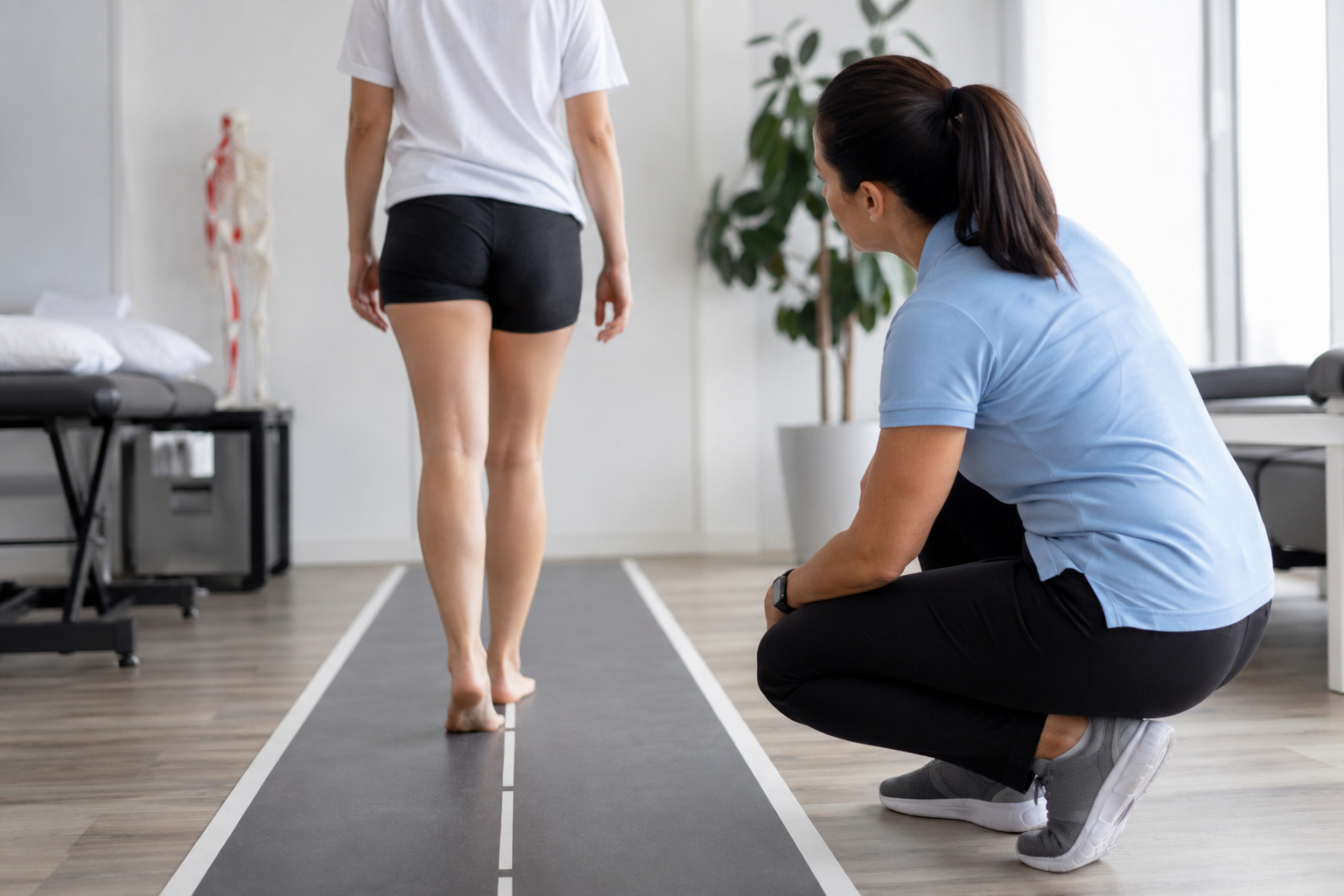
Some questions only a gait assessment can answer
A podiatrist or physical therapist can determine whether the dominant issue is at the foot, the hip, or both, using an assessment that a shoe alone cannot replicate.
Persistent knee, hip, or low back pain that does not meaningfully improve after a genuine trial of appropriate, well fitted footwear is a reasonable point to involve a professional rather than continuing to experiment with shoes alone. A podiatrist can assess foot mechanics directly, and a physical therapist can evaluate hip and core strength and control, which this research suggests is at least as relevant as the shoe itself for a meaningful share of cases.
The kinetic chain is real. The idea that fixing your feet automatically fixes your knees, hips, and back is a simplification of it. The evidence supports a genuine connection, strongest at the low back, more limited at the knee, and dependent throughout on what is happening at the hip and core at the same time. Footwear is one legitimate lever in that system. It was never the only one.