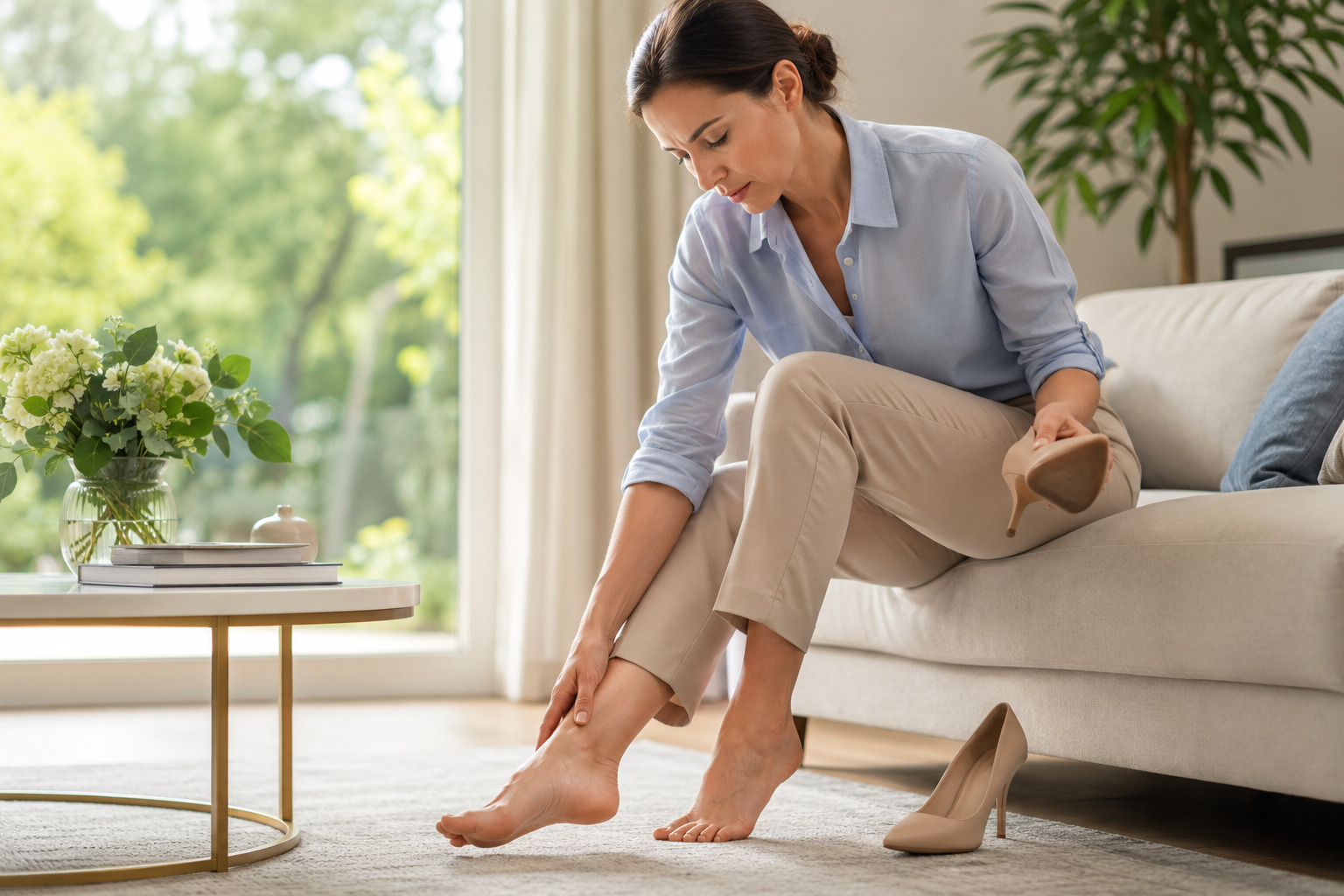
If you have high arches and you have been buying stability shoes, you have been buying the wrong shoe for your foot. Not a slightly suboptimal shoe. The wrong category entirely. And if you have been buying motion control shoes, the situation is worse. Both categories are engineered for a gait mechanics problem that high-arched feet do not have. Applying that solution to a foot that moves in the opposite direction does not produce a neutral outcome. It produces a harmful one.
The assumption that high arches are the structural opposite of flat feet is intuitive but clinically incorrect. Flat feet pronate excessively, collapsing inward with each step. High arches supinate, rolling outward. Stability and motion control shoes are built to resist inward collapse. A foot that already rolls outward wearing a shoe designed to push it further inward is being loaded in a direction that amplifies the mechanical stress the condition already creates. The shoe that helps one foot type actively works against the other.
Roughly ten percent of adults have high arches. A significant proportion of them have spent years wearing shoes chosen on the intuition that more arch support addresses an arch problem. The clinical reality is that high arches do not need support. They need cushioning. And understanding why requires understanding what a high arch actually does to force distribution with every step.
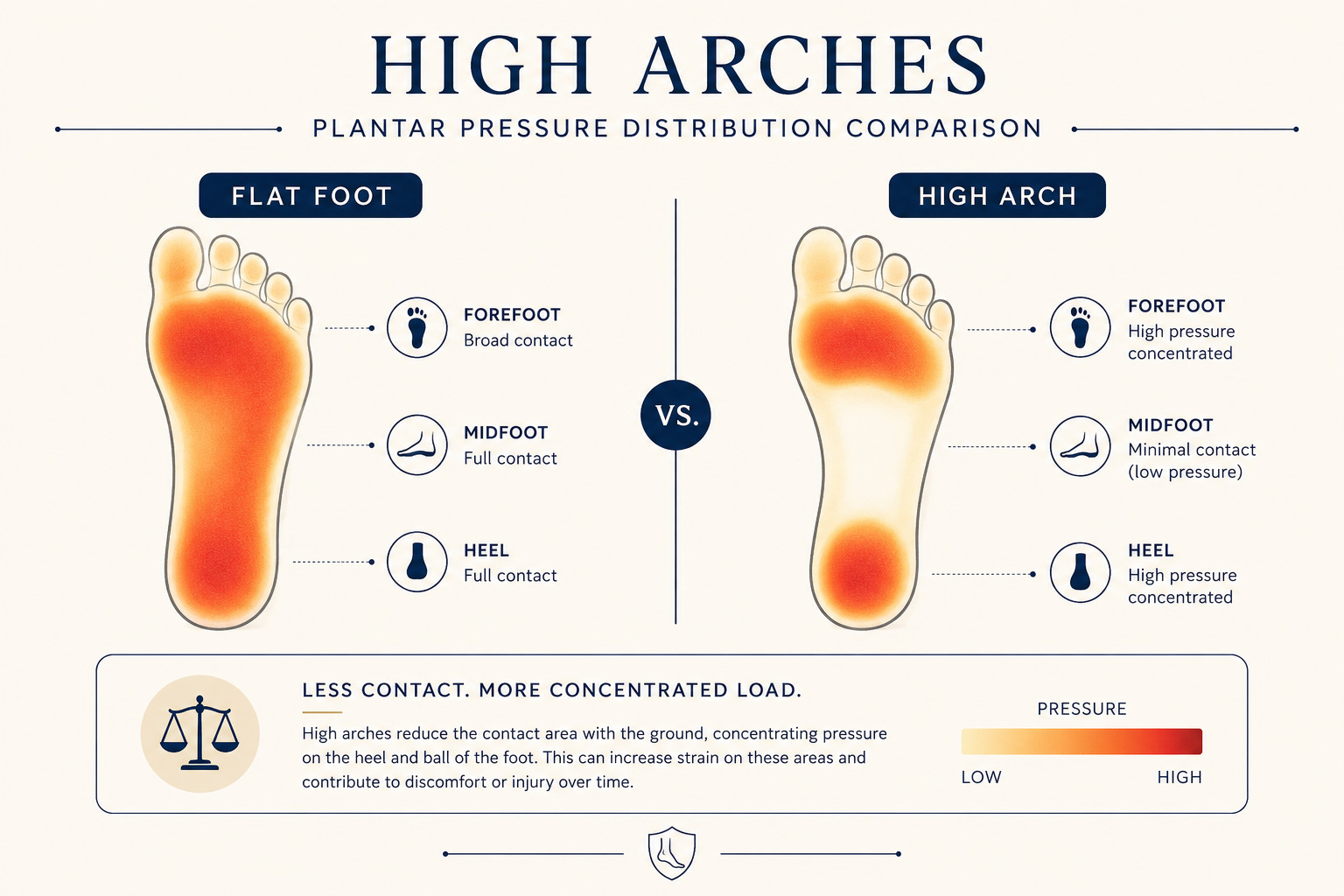
Less contact. More concentrated load.
A flat foot distributes body weight across a broad plantar surface. A high-arched foot contacts the ground only at the heel and ball, concentrating the same body weight into a fraction of the surface area. Every step generates higher peak pressure at those two points than a lower-arched foot would experience under identical conditions.
What a High Arch Actually Does to Every Step You Take
A normal foot arch functions as a dynamic shock absorber. It partially flattens under body weight during the loading phase of each step, spreading force across a broad plantar surface, then recoils to assist with push-off. The arch's ability to deform slightly and recover is what allows it to distribute load efficiently across the entire foot.
A high arch, clinically known as pes cavus, does not deform under load. It stays elevated, leaving only the heel and the ball of the foot in contact with the ground. The midfoot is essentially suspended above the surface, contributing nothing to load distribution. The same body weight that a lower arch spreads across a broad surface is instead concentrated into two relatively small contact zones with every step.
The mechanical consequence of this concentration is measurably higher peak pressure at the heel and metatarsal heads than lower-arched feet experience under identical conditions. Over the course of a day of standing and walking, the cumulative load at those two points is significantly greater than the foot's soft tissue structures were designed to absorb without adequate cushioning between them and the ground.
The rigidity of the high arch also means the foot cannot attenuate impact before transmitting it upward through the ankle, knee, hip, and lower back. A compliant arch absorbs a portion of each footstrike before it reaches the skeletal chain above it. A rigid cavus arch transmits impact with almost no attenuation at all. The shoe is the only remaining opportunity to absorb that energy before it reaches the body.
Three Things That Go Wrong When the Shoe Does Not Compensate
High arches left unaddressed by appropriate footwear produce a predictable cluster of secondary conditions. They do not all appear simultaneously, and they do not appear in every person with high arches, but each one follows directly from the mechanical reality of reduced ground contact and concentrated impact load.
The first is stress fracture risk. Concentrated, repetitive impact at the heel and metatarsal heads without adequate cushioning to attenuate it creates cumulative bone stress that exceeds the remodeling capacity of the tissue. Stress fractures of the metatarsals and calcaneus are documented at higher rates in high-arch populations than in the general foot health population. The bones are not structurally weak. They are taking more load per unit area than the shoe is absorbing on their behalf.
The second is lateral ankle instability. The supinated position of the high-arched foot places the ankle in a mechanically compromised posture during stance phase. The foot contacts the ground on its lateral border rather than distributing weight evenly across the heel. This positions the ankle joint at a greater inversion angle with every step, increasing the probability of lateral ankle sprain during any change of direction, uneven surface contact, or misstep. People with high arches who experience frequent ankle sprains are not simply unlucky. They are operating with a structural predisposition to inversion injury that appropriate footwear and sometimes ankle bracing can meaningfully reduce.
The third is plantar fasciitis, arriving by a different mechanism than in flat-footed individuals. In flat feet, plantar fasciitis develops from excessive tensile strain as the arch collapses and stretches the fascia repeatedly. In high arches, it develops from concentrated heel impact load at the fascial insertion point, compounded by the tight calf and Achilles complex that frequently accompanies rigid cavus foot. The condition looks the same clinically. The mechanical driver is different. The footwear solution is also different, which is why condition-specific guidance that does not account for arch type can produce recommendations that fail one population while helping the other.
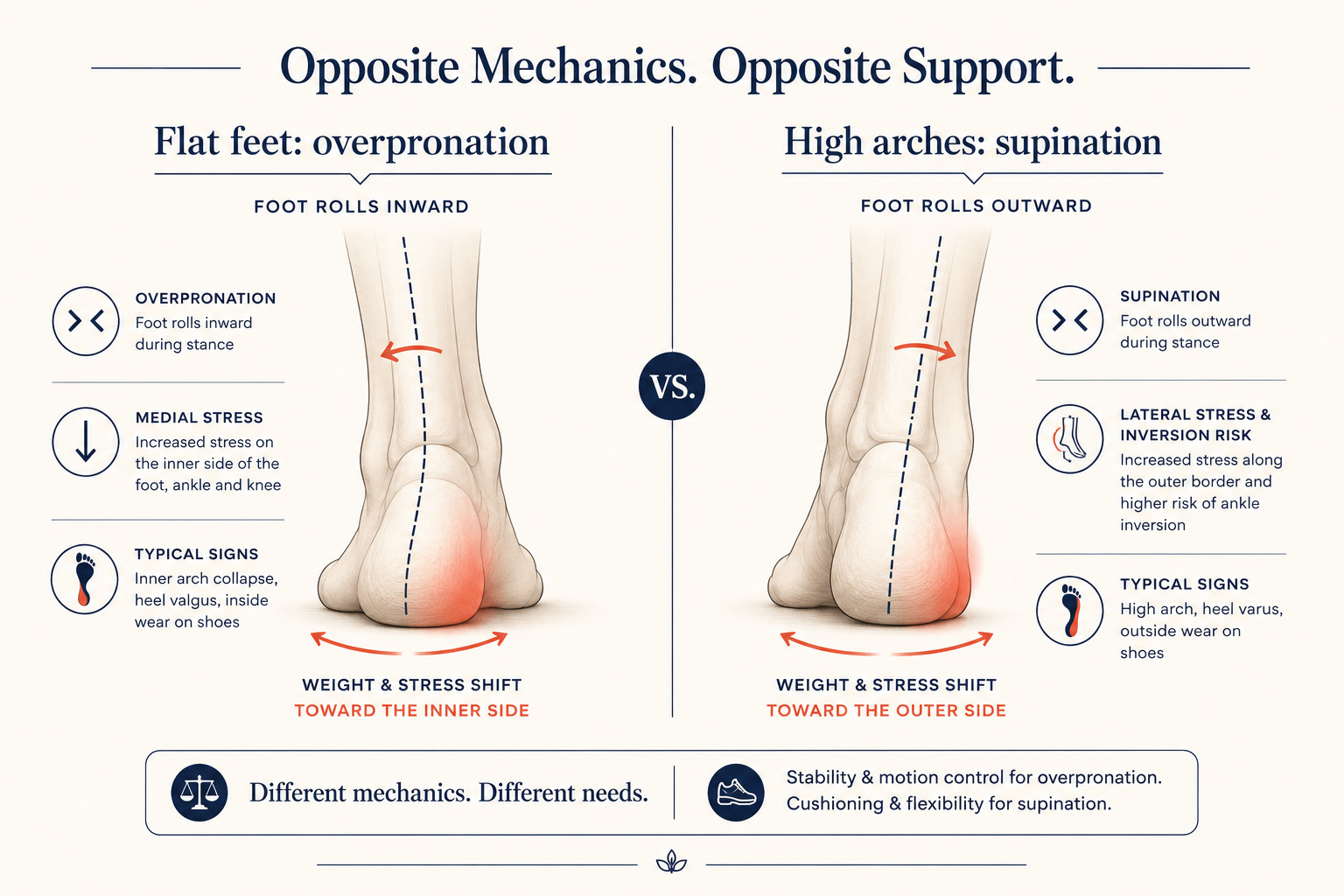
Opposite mechanics. Opposite shoe requirements.
Flat feet overpronate, collapsing inward. High arches supinate, rolling outward onto the lateral foot border. Stability and motion control shoes resist inward collapse. Applied to a supinating foot, the same construction amplifies outward rolling rather than correcting it. The shoe category that helps flat feet actively works against high arches.
What the Correct Shoe for High Arches Actually Does
The shoe requirement for high arches follows directly from the mechanical problem. The foot generates concentrated impact at the heel and metatarsal heads and transmits it upward without attenuation. The shoe must absorb as much of that impact as possible before it reaches the foot. Maximum cushioning in a neutral construction is the correct category. Not moderate cushioning. Not firm support. Maximum cushioning with no medial post or stability geometry that would amplify the supination already present.
Heel drop in the range of six to ten millimeters serves a specific function for high-arch feet. It places the heel in a slightly elevated position relative to the forefoot, reducing the tension in the Achilles tendon and calf complex that commonly accompanies rigid cavus foot. This tension reduction lessens the tractional load on the plantar fascia insertion and marginally reduces the peak heel strike force. Zero drop shoes are contraindicated for high arches because they eliminate this buffer and maximize the load transmitted to the heel fat pad and plantar fascia attachment point with every step.
A deep heel cup in the shoe provides rearfoot stability that the supinated foot position reduces. By cradling the heel and preventing excessive lateral rock during stance phase, the heel cup partially compensates for the inversion-prone ankle posture that high arches create. A wide midsole base extends the platform under the lateral foot, further reducing the tipping moment that drives inversion sprains.
Toe box width matters for high arches more than most people realize. The rigid cavus arch frequently produces claw toes or hammertoe deformity over time as abnormal muscle tension redistributes across the foot. A shoe with a wide, deep toe box accommodates early toe contracture and prevents the dorsal pressure on the proximal interphalangeal joints that accelerates the deformity.
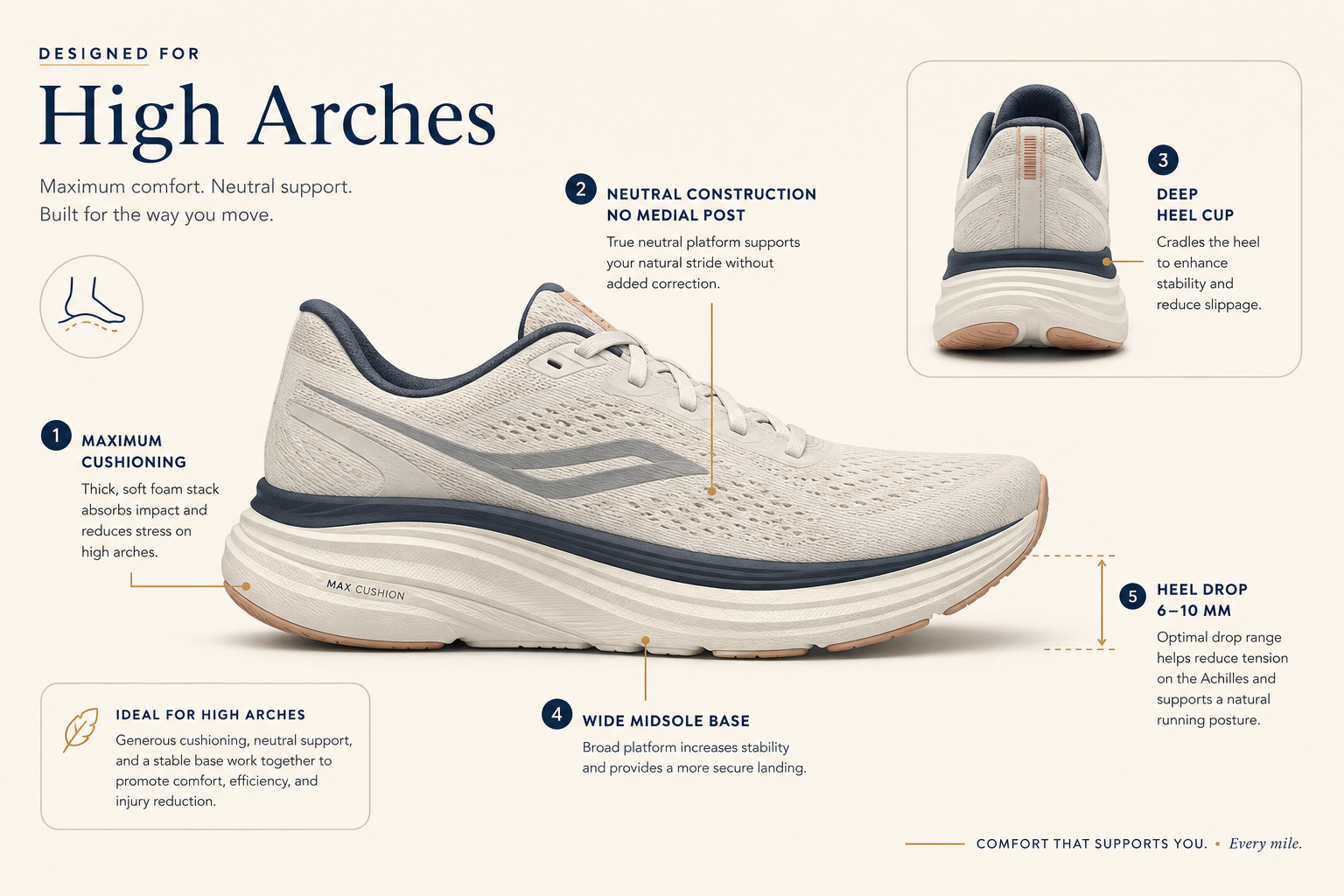
Maximum cushioning. Neutral geometry. Deep heel cup.
The correct shoe for high arches provides maximum midsole cushioning to absorb concentrated heel and forefoot impact, neutral construction with no medial post that would amplify supination, a deep heel cup for rearfoot stability, and a wide midsole base to reduce lateral ankle tipping. These four features address all four mechanical consequences of the rigid cavus arch.
Where Orthotics Fit Into the High Arch Picture
Custom orthotics for high arches work by a different mechanism than orthotics for flat feet, and understanding the difference prevents a common error. Flat foot orthotics provide a raised medial support structure that holds the arch up against the force of body weight. High arch orthotics do the opposite. They fill the gap under the arch, bringing the ground surface up to meet the elevated arch and distributing body weight across the midfoot region that the rigid cavus arch leaves unloaded.
The effect is a meaningful reduction in peak pressure at the heel and metatarsal heads by recruiting the midfoot surface area that a standard shoe insole cannot reach. An off-the-shelf insole with a raised arch profile is not the correct tool for this purpose. It adds height in the midfoot but does not conform to the specific contour of a rigid cavus arch. A custom orthotic fabricated from a cast or precision scan of the individual foot fills the exact three-dimensional gap that exists between the floor of the shoe and the bottom of that specific arch.
For flexible high arches, those that partially flatten under body weight, a well-cushioned neutral shoe may be sufficient without orthotic intervention. For rigid high arches that do not deform under load, the combination of a maximum-cushion neutral shoe and a custom orthotic provides the most complete mechanical compensation available through conservative management.
The distinction between flexible and rigid cavus is not something that can be reliably determined through self-assessment. A podiatric evaluation that includes a Coleman block test and gait assessment identifies arch flexibility, rules out neurological causes of cavus deformity, and determines whether conservative management is sufficient or whether further intervention is warranted.
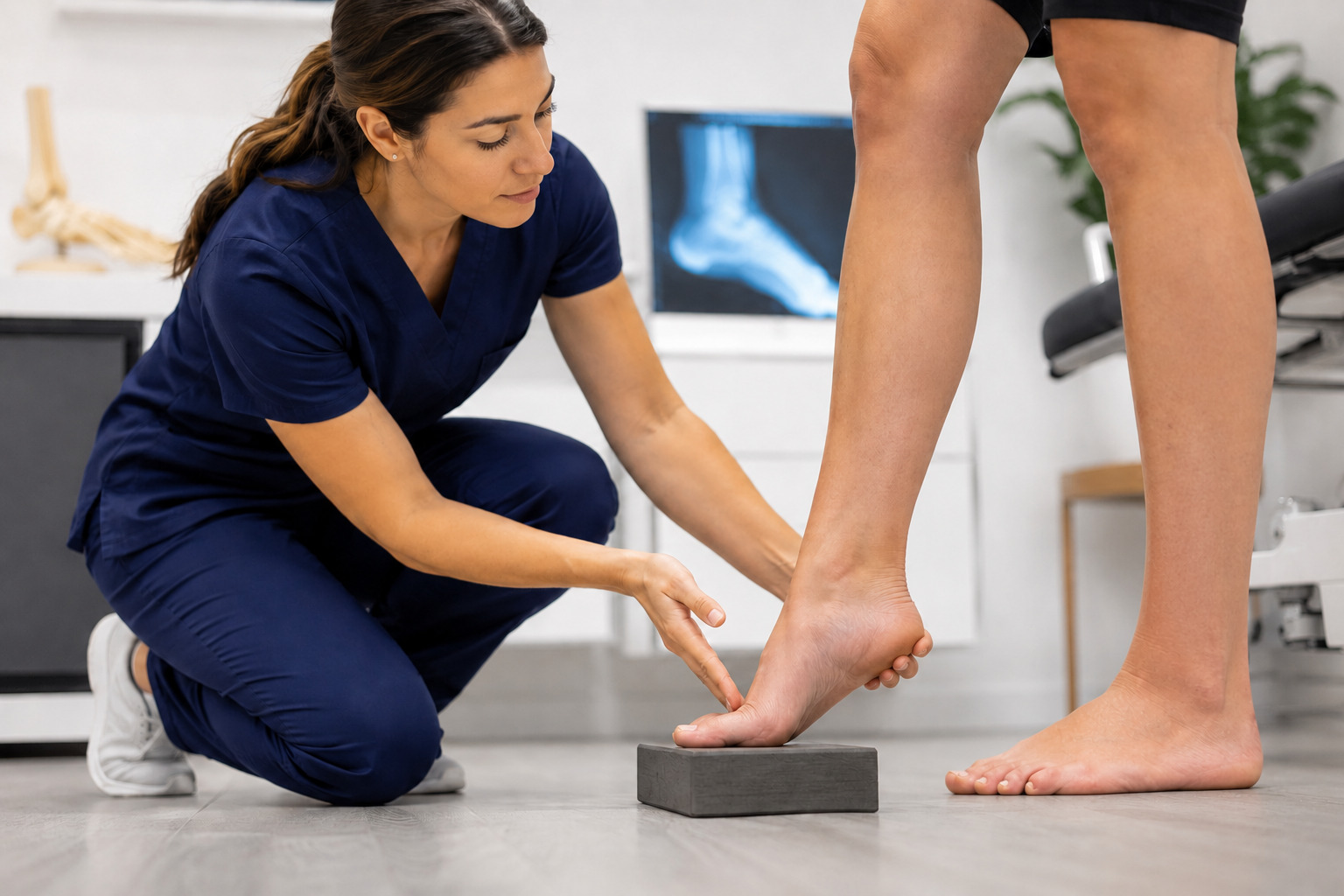
Flexible or rigid. The distinction changes everything.
The Coleman block test is the standard clinical assessment for determining whether a high arch is flexible or rigid. A flexible cavus responds well to cushioned footwear and custom orthotics. A rigid cavus that does not deform under load may have a neurological cause requiring specialist referral. Self-assessment cannot reliably make this distinction.
The Summary Your Shoe Purchase Depends On
High arches are not an arch support problem. They are a cushioning and load distribution problem. The foot already has too much arch. What it lacks is the ability to spread impact across a broad surface, attenuate force before it reaches the skeletal chain above, and maintain stable ankle mechanics during stance and push-off.
The shoe that addresses those three deficits is a maximum-cushion neutral shoe with a deep heel cup, a wide midsole base, and a six to ten millimeter heel drop. It is not a stability shoe. It is not a motion control shoe. It is not a zero drop shoe. And it is not a minimalist shoe regardless of how that category is marketed.
If you have high arches and you have been wearing the wrong category, the shoe finder quiz routes to APMA-verified maximum cushion neutral recommendations matched to your foot profile. The high arches condition page covers the full catalog of verified shoes across every brand. And if ankle instability, stress fractures, or persistent heel pain have been part of the picture, the MySoleMatch podiatrist finder covers thirty-one cities with verified practicing podiatrists who can assess whether the flexible or rigid distinction applies to your foot and what the correct next step is from there.