
Most people assume the feet only become a diabetes concern after diagnosis. The research tells a different story. Nerve fiber changes in the feet have been documented in people who do not yet meet the clinical threshold for type 2 diabetes at all. The feet, it turns out, are often early. The diagnosis is usually late.
According to the Centers for Disease Control and Prevention, more than 115 million American adults are living with prediabetes, and roughly eight in ten of them do not know it. That is not a niche population. That is more than one in three adults in the country, walking around every day in shoes that were never chosen with any of this in mind.
The condition that has no symptoms, until it does
Prediabetes is a stage where blood glucose runs higher than normal but not yet high enough to meet the diagnostic criteria for type 2 diabetes. It is frequently described to patients as a warning, a number on a lab report, something to address before it becomes real. The research on nerve and vascular changes complicates that framing considerably.
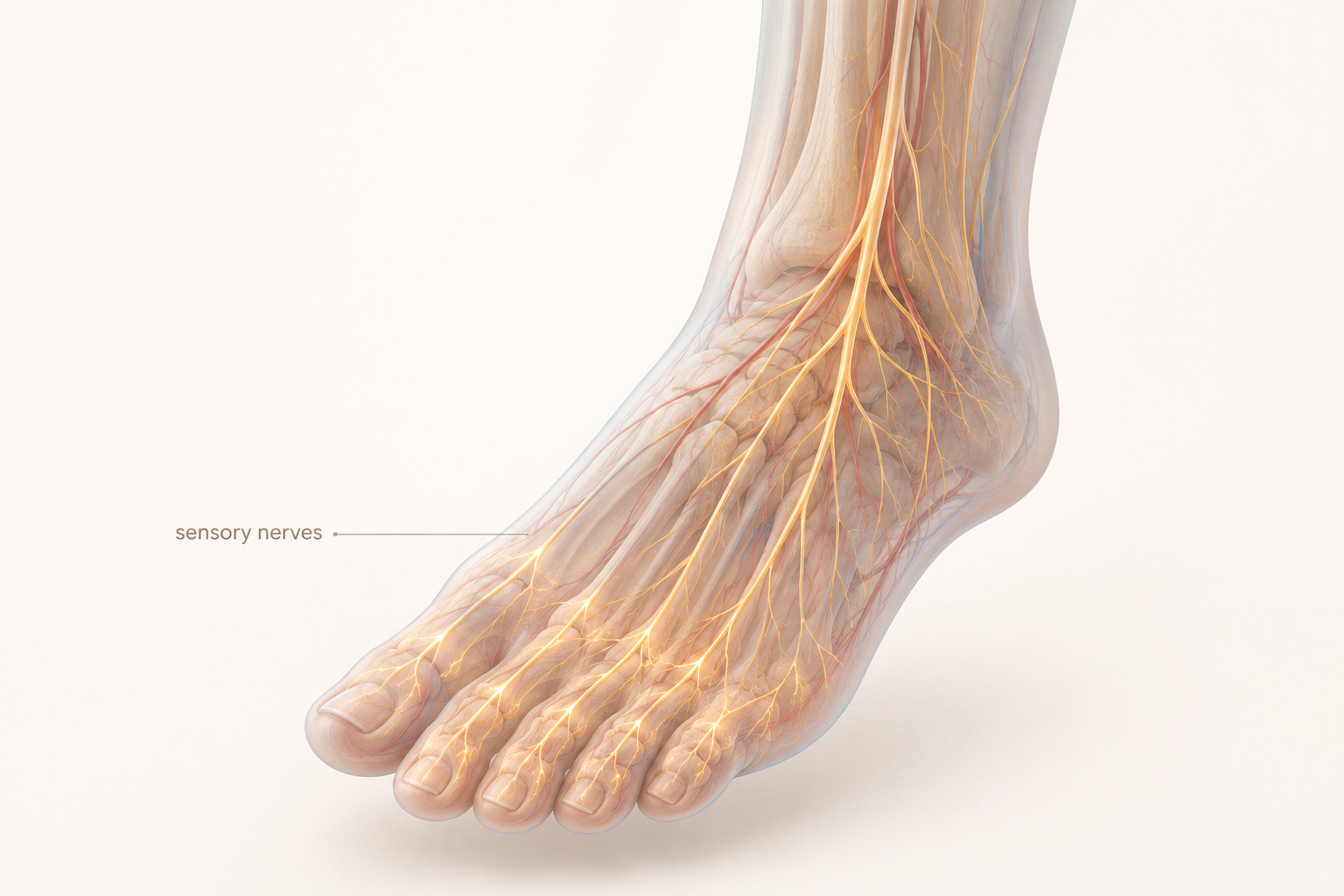
Nerve damage does not wait for a diagnosis code
Small nerve fiber studies have found measurable degeneration in people with prediabetes, before any diabetes diagnosis has been made. The feet are often where this shows up first.
A review published by researchers at the University of Liverpool's Institute of Cardiovascular and Metabolic Medicine found that small nerve fiber degeneration, the kind that eventually produces the numbness and burning associated with diabetic neuropathy, can be detected at the prediabetes stage, before the onset of full type 2 diabetes. The same review notes that small fiber damage tends to precede large fiber involvement, meaning the earliest nerve changes are also the hardest to notice without specific testing.
A separate cross sectional study of prediabetic adults, published in 2025, used a validated neuropathy screening instrument alongside kidney and retinal markers and found measurable microvascular involvement in a meaningful share of participants who had not yet progressed to diabetes. The pattern across this research is consistent. The damage associated with elevated blood sugar does not begin on diagnosis day. It begins earlier, and the feet are one of the first places clinicians look for it.
Why the feet specifically
The nerves that supply sensation to the feet are the longest in the human body, running from the spinal cord all the way to the toes. Long nerves are more vulnerable to the kind of metabolic stress that elevated blood sugar creates, which is part of why neuropathy symptoms so reliably begin in the toes and feet before appearing anywhere else. This is sometimes described clinically as a length dependent pattern. The longest nerves are affected first and most severely.
The feet also depend heavily on small blood vessels to deliver oxygen and nutrients to skin, soft tissue, and the nerves themselves. Elevated blood glucose affects small vessel function before it affects larger arteries, which is why early circulatory changes are often detectable in the feet and in the eyes well before they show up in a stress test or an EKG.
The danger of a number you cannot feel
Reduced sensation is the central problem with any stage of diabetic nerve involvement, prediabetic or not. A healthy nerve registers a blister forming, a hot spot from a seam, a pebble in a shoe, and sends a pain signal that prompts a person to stop and fix it. As small fiber function declines, that early warning system gets quieter before it disappears altogether.
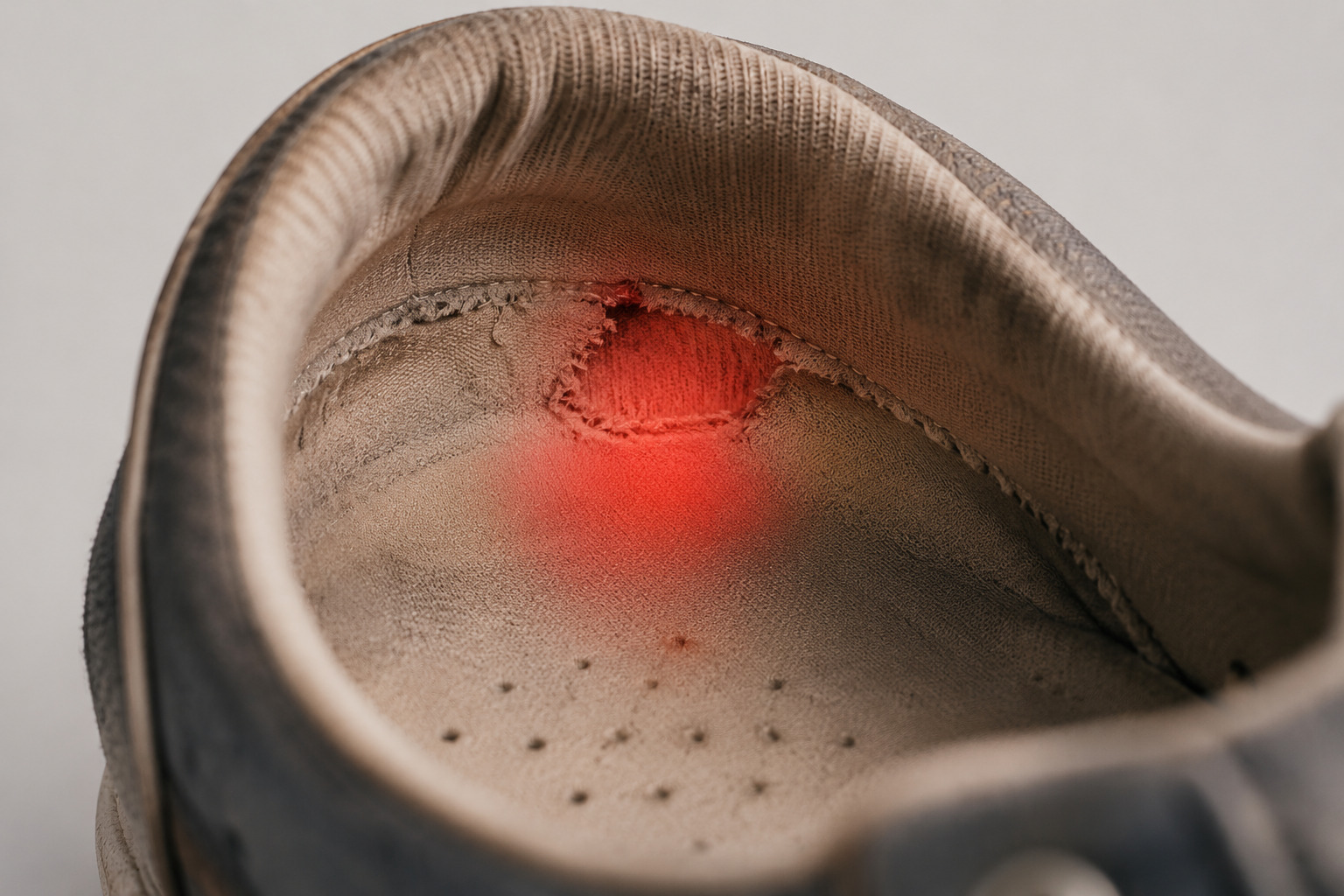
The problem is rarely the shoe. It is what the shoe is doing that nobody feels
A seam, a tight toe box, or a worn insole creates the same friction regardless of nerve function. The difference is whether the wearer feels it early enough to do something about it.
This is precisely why the American Podiatric Medical Association recommends that anyone with diabetes or prediabetes schedule an appointment with a podiatrist, rather than waiting for symptoms to appear. The organization states plainly that podiatrists are trained to identify and treat the foot conditions associated with diabetes, including neuropathy, and that involving a podiatrist early measurably reduces the risk of amputation down the line. The recommendation is not limited to people who have already been diagnosed.
What this means for the shoes you choose today
A prediabetic foot is not yet a diabetic foot, and the full therapeutic shoe protocol built for confirmed diabetic neuropathy, extra depth, seamless interiors, custom total contact insoles, is a clinical decision that belongs to a podiatrist working with a specific patient's test results. What prediabetes does change is the cost benefit calculation on a handful of ordinary footwear decisions that most people never think twice about.
Interior seams that sit directly over the toes or the ball of the foot matter more when sensation cannot be fully trusted to flag irritation early. A toe box that is genuinely too narrow, not fashionably snug but mechanically compressive, matters more for the same reason. So does the habit of wearing one pair of shoes every day until it visibly wears out, since a worn midsole redistributes pressure unevenly across the foot in ways a fully sensate foot would notice and a foot in early nerve decline might not.

The daily foot check is not just a diabetic patient instruction
If reduced sensation is even a possibility, a thirty second visual check after removing shoes catches what feeling alone may not.
None of this requires treating every prediabetic foot like a diagnosed diabetic foot. It requires treating fit, seam placement, and shoe age as more than a comfort preference, and pairing that with a habit a podiatrist would recognize immediately: looking at the bottoms of your feet after you take your shoes off, even when nothing hurts. Especially when nothing hurts.
The signal that should move someone from shoe choice to medical appointment
Footwear adjustments are not a substitute for diagnosis or treatment, and there is a clear line where this stops being a shoe story and becomes a medical one. Tingling, burning, or numbness in the toes or feet, especially if it is worse at night, any sore or cut that is not healing on a normal timeline, skin color or temperature changes in one foot compared to the other, or any wound that does not hurt the way an equivalent wound should, are all reasons to see a podiatrist or physician directly, not reasons to shop differently first.
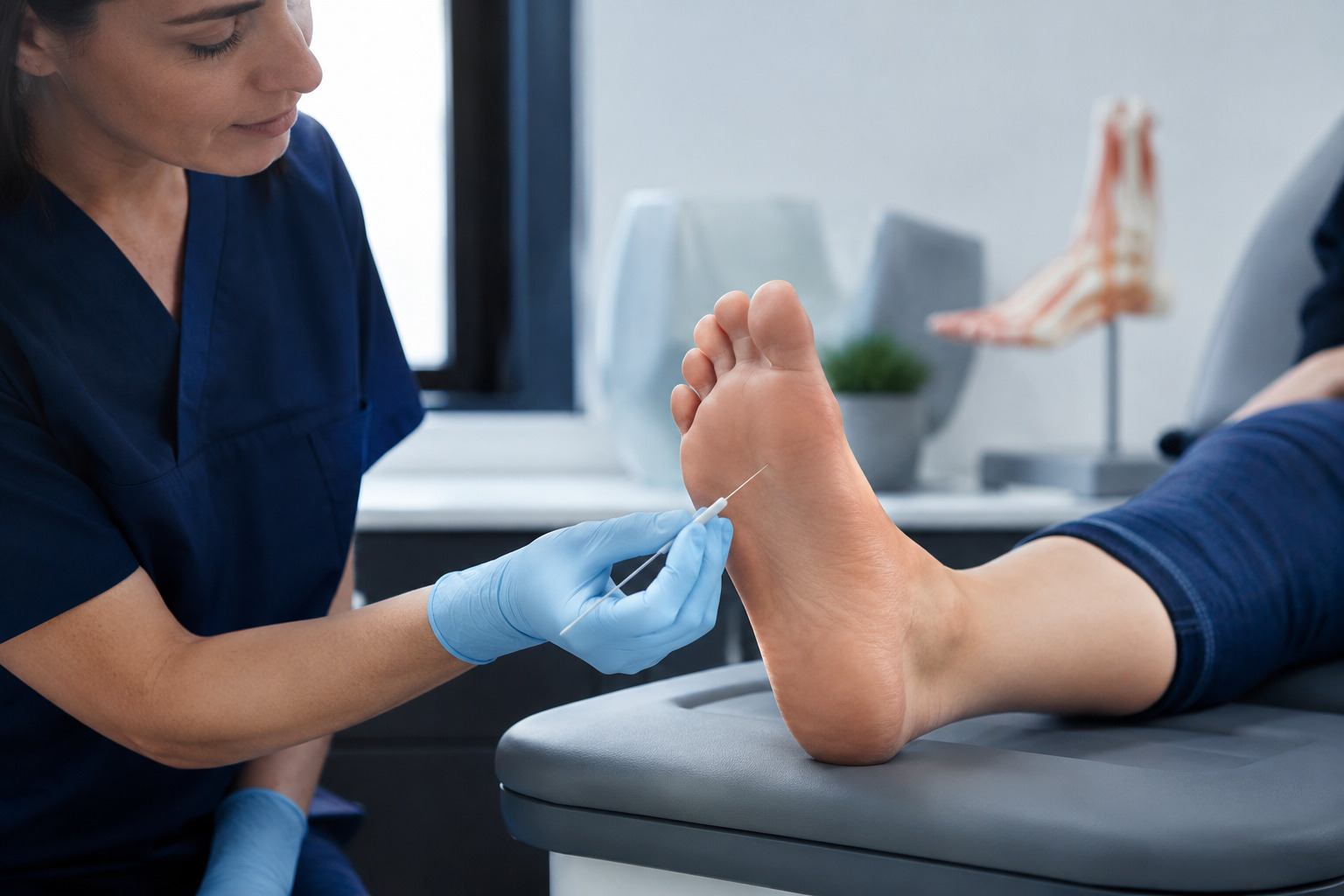
A monofilament test takes minutes and answers the question guessing cannot
Podiatrists use a simple, painless monofilament tool to test protective sensation directly. It is the test that turns a suspicion into an answer.
Annual foot exams are a standard recommendation for anyone with a diabetes or prediabetes diagnosis, and they involve no more than a brief, painless sensation test that most patients are surprised to learn takes only a few minutes. Given that roughly eight in ten adults with prediabetes do not know they have it, a foot exam is sometimes the first place this entire conversation actually starts. The MySoleMatch diabetic neuropathy condition page covers what that exam looks for and what footwear principles apply once neuropathy is confirmed, and the full diabetic footwear guide covers shoe selection in detail for anyone already managing a diagnosis.
The honest takeaway is not that everyone with tired feet has prediabetes. It is that blood sugar and foot health are connected earlier and more directly than most people are told, and that the shoes sitting in your closet right now are either accounting for that or they are not.