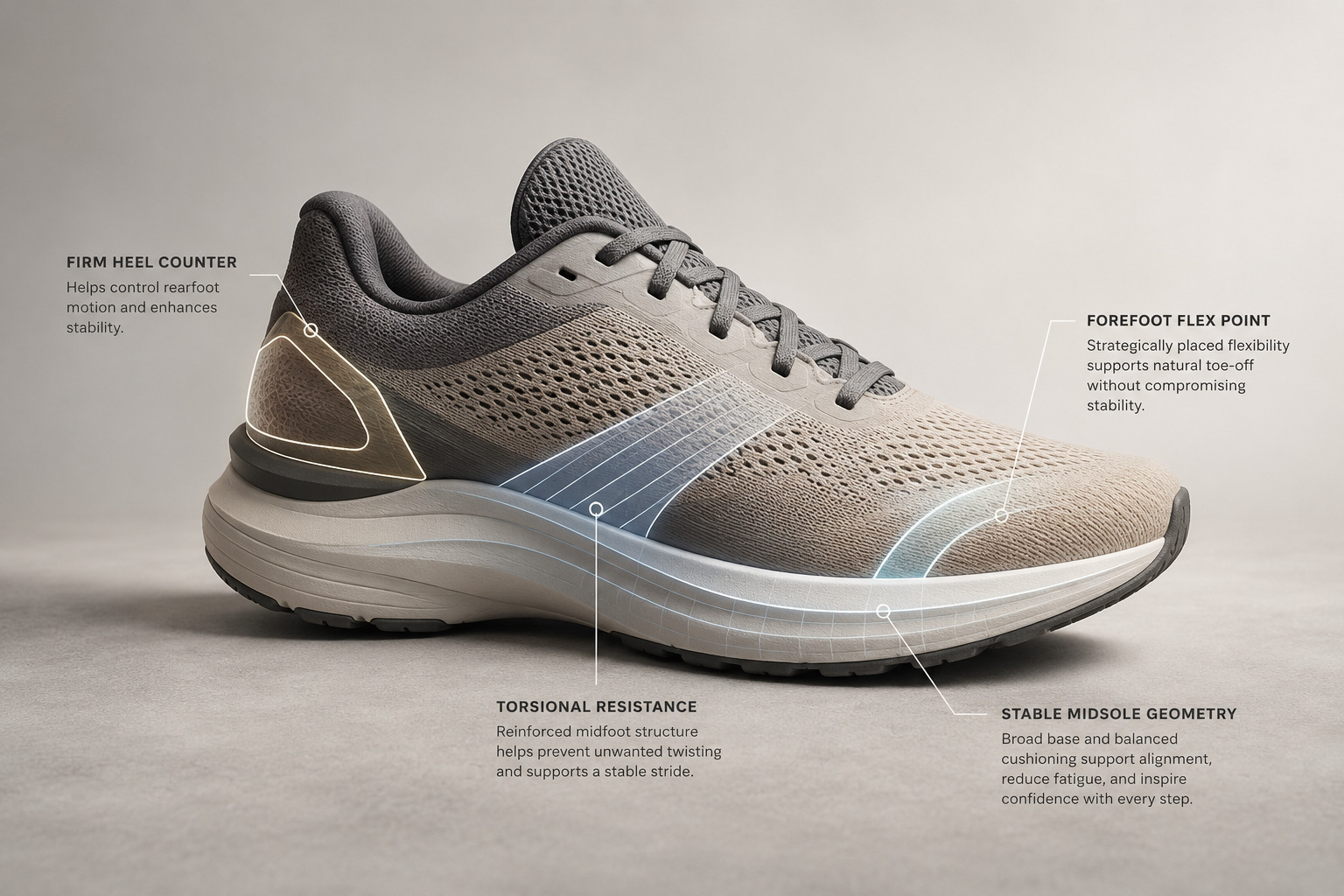
Walk into any shoe store and look for a shoe marketed toward foot pain. Within seconds you will find the word. Supportive. It appears on stability trainers and maximally cushioned neutral shoes. It appears on orthopedic sandals and motion control boots. It appears in podiatrist recommendation lists, insurance footwear guides, and brand marketing copy for shoes that have almost nothing in common structurally.
The word has been repeated so many times, across so many products and contexts, that it has become functionally meaningless as a guide to choosing footwear. Two shoes both accurately described as supportive can have structurally opposite designs. They can provide opposite mechanical effects on the same foot. And for someone managing a specific foot condition, choosing the wrong one is not a neutral outcome. It is a choice that can actively worsen the condition it was supposed to help.
This is not a problem with any individual brand or product. It is a language problem. The word supportive was never given a standardized clinical definition in consumer footwear. Without one, it fills with whatever meaning a given context requires. For brands, it means comfortable and well-constructed. For podiatrists, it means structurally sound in specific ways. For consumers, it means whatever relieved their pain last time. None of those three definitions are the same, and the gap between them is where most footwear mistakes get made.
How widespread incorrect footwear choice actually is
Before examining what supportive means, it is worth understanding the scale of the underlying problem that generic supportive recommendations are failing to solve.
A systematic review published in the Journal of Foot and Ankle Research, available on PMC, found that between 63 and 72 percent of participants across included studies were wearing shoes that did not accommodate either the width or length dimensions of their feet. The same review found evidence that incorrect footwear fitting was associated with foot pain and disorders including lesser toe deformity, corns, and calluses. A separate narrative review published on PMC noted that research suggests over 60 percent of women and 30 percent of men suffer from pain when wearing shoes, with a clear correlation between ill-fitting shoes and specific foot pain presentations.
These are not people wearing obviously wrong shoes. Most of them are wearing shoes described on the packaging, in reviews, or by well-meaning advisors as supportive. The generic recommendation to wear supportive shoes is not failing because people are ignoring it. It is failing because the word does not carry enough specific information to actually guide the right choice for a specific foot and a specific condition.
Three definitions of supportive that do not agree with each other
The podiatric definition
When podiatrists use the word supportive in a clinical context, they are referring to a specific set of structural properties. A supportive shoe, in the clinical sense, bends only at the toe box and not near the heel. The sole resists twisting under torsional load. The heel counter is firm and does not collapse when compressed. The midsole maintains its geometry under asymmetric load rather than conforming to dysfunctional foot mechanics. These are measurable, testable structural properties. They describe what the shoe does mechanically, not how it feels.
What is notable about this definition is what it does not include. It does not require cushioning. It does not require a high stack height. It does not require a particular arch shape or a specific heel drop. A relatively firm, low-profile shoe that resists torsion and maintains heel counter integrity can be clinically supportive. A thick, plush, maximally cushioned shoe that collapses under asymmetric load is not, by this definition, supportive in any clinically meaningful sense.
The brand definition
Footwear brands use supportive as a broad positive attribute covering comfort, cushioning, arch contouring, and general construction quality. In brand language, a shoe is supportive if it feels good on the foot, holds the foot comfortably, and has visible structural features such as arch contours or padded collars. This definition is not dishonest. It reflects what consumers reliably respond to in the store environment. The problem is that it describes a feeling rather than a mechanical function. A shoe can feel supportive in a carpeted showroom and perform very differently over twelve hours of load-bearing movement on hard surfaces.
This is why two shoes from the same brand, both marketed as supportive, can have completely different effects on a foot with plantar fasciitis. One has a medial post and firm heel counter that controls overpronation. The other has maximal cushioning and a neutral last that accommodates whatever the foot does naturally. Both feel supportive at point of sale. Only one is addressing the mechanical cause of the condition.
The consumer definition
For most consumers, supportive means whatever made their feet feel better before. This is understandable and often accurate in the short term. But it creates a problem when conditions change, when a new condition develops, or when the relief provided by a previous shoe was symptomatic rather than mechanical. A shoe that relieves pain by providing extra cushioning is not necessarily addressing the reason the pain exists. It may simply be reducing impact sensitivity while the underlying mechanical issue continues. When that shoe wears out and the consumer looks for something similar, they are looking for the feeling rather than the function. And the next shoe that provides the same feeling may have an entirely different structural profile.
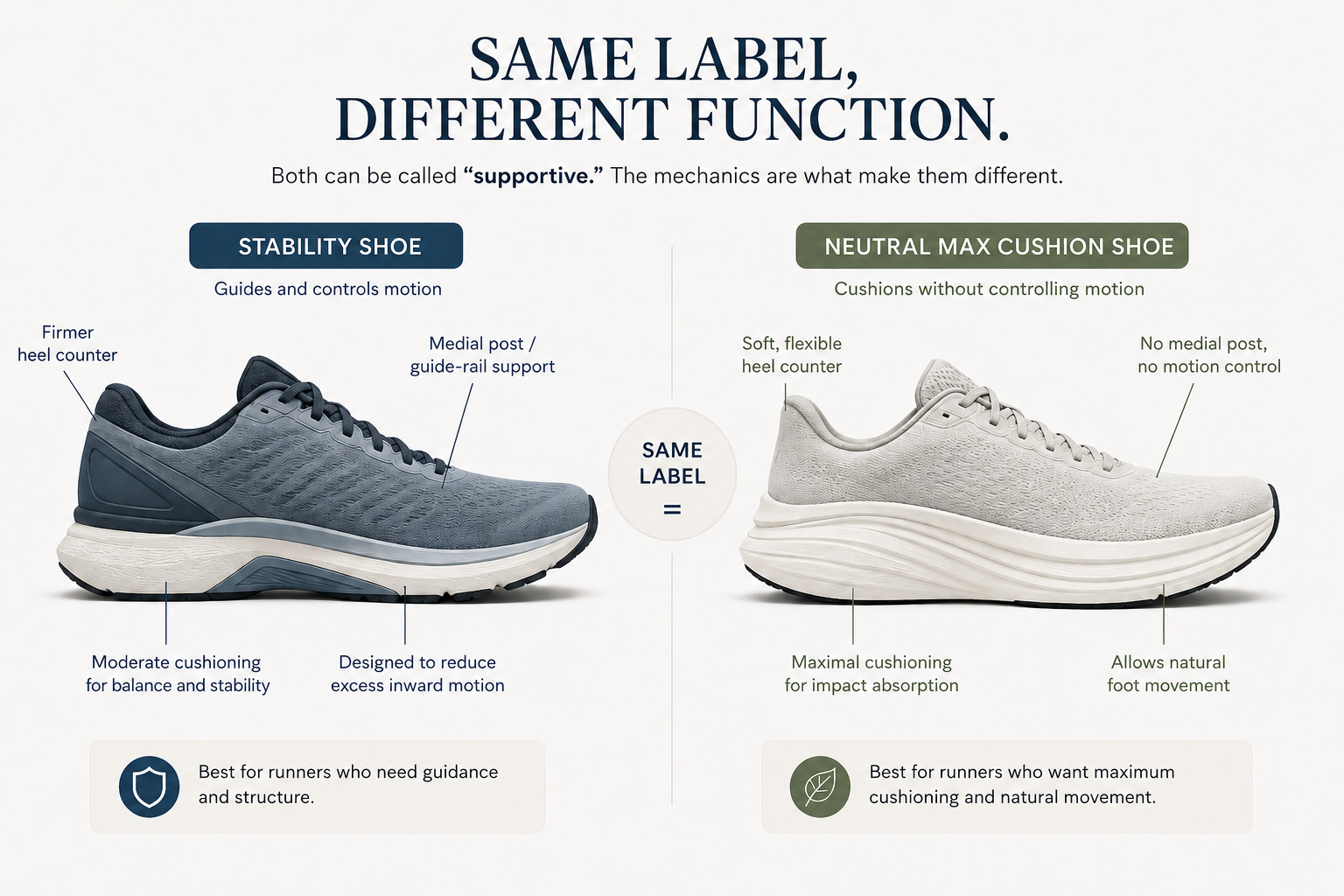
Same word. Opposite mechanical designs.
Both of these shoes carry the supportive label. One has a medial post and structured heel counter designed to control overpronation. The other has a neutral last and maximal cushioning designed to absorb impact. For a foot with flat arches and plantar fasciitis driven by overpronation, these two shoes produce opposite mechanical outcomes.
Why the same supportive shoe can help one foot and harm another
This is the part of the supportive shoe conversation that almost never gets addressed in consumer-facing content. Support is not a universal property. It is a relational one. A shoe provides support relative to what a specific foot needs in the context of a specific condition and a specific activity pattern. Outside of that context, the word is descriptively empty.
Consider two people with foot pain walking into the same store and picking up the same shoe from the stability category. The first person has flat feet, overpronation, and plantar fasciitis driven by arch collapse. The medial post in the shoe resists that inward collapse, reduces the elongation of the plantar fascia with each step, and directly addresses the mechanical cause of the pain. For this person, the shoe is genuinely supportive in a clinically meaningful sense.
The second person has a high-arched, supinating foot with plantar fasciitis driven by insufficient shock absorption and lateral load concentration. For this person, a medial post pushes the foot further into supination, increases lateral pressure, and worsens the load on the already-stressed plantar fascia. The same shoe, providing the same stability features, is actively counterproductive. The shoe is still correctly described as supportive. It is simply the wrong kind of support for this foot.
This is not an edge case. High-arched feet account for a meaningful proportion of the population. Supination-driven plantar fasciitis is a real and distinct presentation from pronation-driven plantar fasciitis. Yet the generic recommendation for plantar fasciitis is overwhelmingly to wear supportive shoes, without specifying which structural properties are relevant for which foot type. The result is that a portion of people who follow that recommendation correctly and purchase a stability shoe will find that it makes their condition worse. They will then conclude that supportive shoes do not help their plantar fasciitis. The correct conclusion is that the wrong type of support does not help their specific presentation of plantar fasciitis.
What supportive actually requires for common foot conditions
The right framework is not to ask whether a shoe is supportive. It is to ask what structural properties your specific condition requires, and then to verify whether a given shoe provides them. Here is how that maps across the most common conditions.
Plantar fasciitis with overpronation
The primary structural requirement is motion control. A medial post or guide rail system that resists inward arch collapse, a firm heel counter that stabilizes the rearfoot, and a midsole that maintains its geometry under asymmetric load. Cushioning is secondary. A maximally cushioned neutral shoe provides no meaningful support for this presentation regardless of how it is marketed. See the full explanation of softness versus stability for the biomechanical detail on why.
Plantar fasciitis with a high arch and supination
The primary structural requirement is shock absorption and lateral load distribution. A neutral shoe with responsive cushioning, a flexible midsole that accommodates the foot's natural supination pattern, and sufficient stack height to reduce impact concentration. A stability shoe with a medial post is contraindicated for this presentation. It will increase lateral pressure rather than reduce it.
Flat feet without active pain
The structural requirement depends on whether the flat foot is accompanied by symptoms. A flexible flat foot in a person without pain may not require any specific supportive feature beyond a shoe that maintains reasonable structural integrity and does not collapse completely under load. A rigid orthotic or aggressive medial post in an asymptomatic flat foot can introduce new problems by preventing the natural motion the foot has adapted to. Supportive in this context means structurally sound, not aggressively corrective.
Posterior tibial tendon dysfunction
The primary structural requirement is medial arch support combined with rearfoot stability. The posterior tibial tendon is responsible for supporting the arch during the stance phase of gait. A shoe that allows unrestricted arch collapse places continuous load on an already compromised tendon. Supportive for this condition means a stability shoe with a firm medial post, a rigid heel counter, and sufficient torsional resistance to prevent midfoot collapse under load.
Metatarsalgia and forefoot pain
The primary structural requirement is forefoot cushioning and pressure redistribution. A rocker sole geometry that reduces peak pressure at the metatarsal heads, combined with a wide enough toe box to allow forefoot splay under load. A medial post is largely irrelevant for isolated forefoot pain. Supportive here means protective of the forefoot specifically, not structurally corrective of rearfoot mechanics.
Diabetic neuropathy
The structural requirements are more comprehensive than for most other conditions. A wide toe box, extra depth for accommodation of deformity or custom orthotics, seamless interior construction to eliminate friction points, and a cushioned midsole that distributes pressure across the entire plantar surface. Supportive for diabetic neuropathy means protective of tissue integrity across the whole foot, not supportive in any single biomechanical sense. The MySoleMatch diabetic neuropathy guide covers the full clinical requirements for this condition in detail.
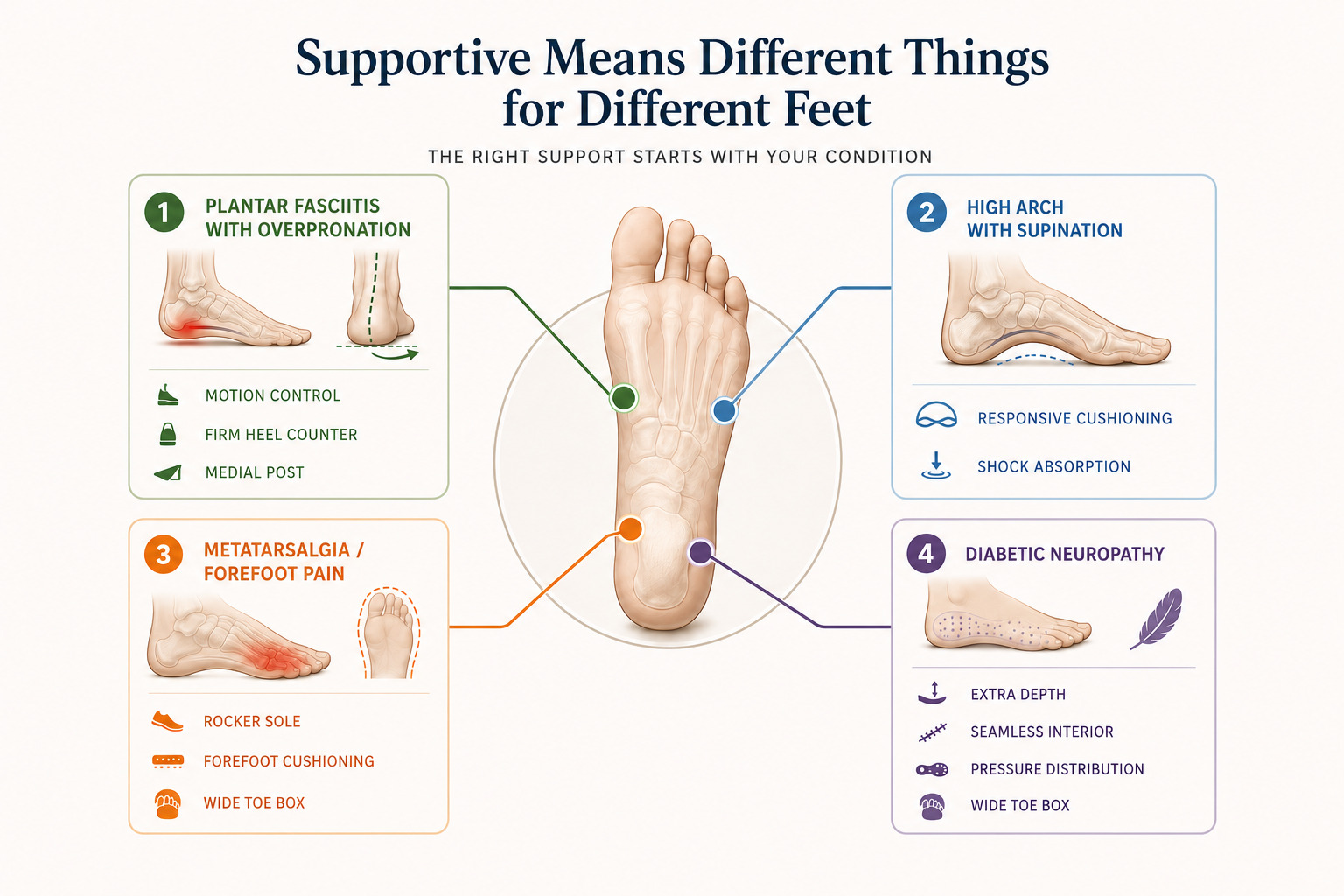
Supportive is always relative to the condition.
The structural features that constitute genuine support for flat feet and overpronation are different from those required for a high-arched supinating foot, forefoot pain, or diabetic neuropathy. The word supportive covers all of these. It describes none of them precisely enough to make a good footwear decision.
What to ask instead of whether a shoe is supportive
The more useful questions are structural and condition-specific. They take slightly longer to answer than a single label but they produce footwear decisions that are actually matched to the mechanical reality of the foot they are supposed to help.
Does my condition involve motion that needs to be controlled? If yes, the shoe needs a medial post or guide rail system, a firm heel counter, and torsional resistance. Cushioning is a secondary consideration. If no, motion control features are unnecessary and may be counterproductive.
Does my condition involve impact that needs to be absorbed? If yes, stack height, midsole responsiveness, and rocker geometry are relevant. Medial posts are secondary. If no, maximal cushioning is a comfort feature rather than a clinical one.
Does my condition involve forefoot compression? If yes, toe box width and depth are primary requirements. Rearfoot stability features do not address this problem. If the wide toe box article covers your condition, that is where the structural requirement lives.
Does my condition involve ankle instability? If yes, heel counter integrity, midsole base width, and fit lockdown are the relevant structural features. Collar height is a secondary consideration. The ankle support article covers exactly why collar height is often the wrong primary criterion.
Does my condition involve pressure sensitivity or tissue protection? If yes, interior construction, material softness, and seamless design matter as much as or more than structural stability features. This is particularly true for diabetic neuropathy, post-surgical feet, and rheumatoid arthritis affecting multiple foot joints.
Why condition-specific matching matters more than supportive labels
The research makes the scale of the problem clear. When between 63 and 72 percent of people are wearing shoes that do not fit their feet correctly, and when foot pain affects between 13 and 36 percent of the general population across multiple international cohorts according to PMC research, the gap between what the footwear industry provides and what people actually need is not a small one. It is a systemic one.
Generic supportive recommendations cannot close that gap because they do not carry enough specific information to guide good decisions for individual feet with individual conditions. A recommendation to wear supportive shoes is the footwear equivalent of recommending that someone with chest pain take medication. It is directionally correct and completely insufficient without knowing what kind of pain, what kind of medication, and what the underlying cause is.
The MySoleMatch approach is different in one specific way. It does not start with shoes and apply conditions to them. It starts with the condition and the foot type and maps to the structural features that address the specific mechanical cause. The word supportive does not appear in that process as a category. It appears, if at all, as a description of the output after the matching is done.
If you have a foot condition and you have been told to wear supportive shoes without being told which structural properties that means for your specific condition, the MySoleMatch quiz is the next step. Five questions. Condition-specific. The result is a structural profile that describes what your foot actually needs, not a category label that describes how a shoe feels in a store.
And if the condition is significant enough that the stakes of the wrong shoe are medical rather than just uncomfortable, the MySoleMatch podiatrist finder can help locate a specialist who can evaluate your gait, assess your foot structure, and give you a definition of supportive that is specific to your foot and nobody else's.