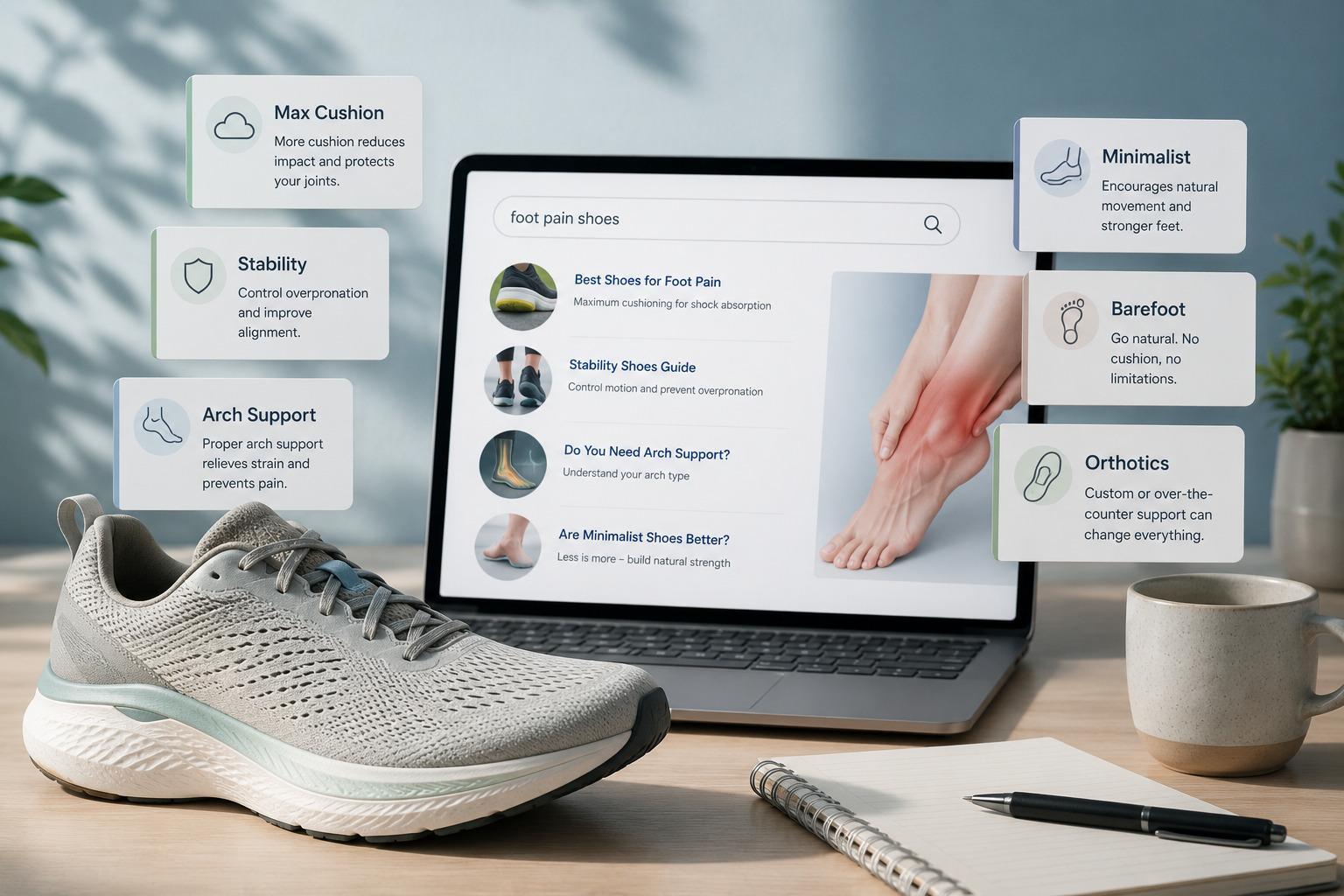
You search for the best shoe for plantar fasciitis and find twelve different answers. One recommends maximum cushion. Another says stability with a medial post. A third says minimalist shoes to strengthen the foot. A podiatry clinic says arch support is essential. A barefoot brand says arch support is the problem. A forum thread has forty replies and no consensus. You close the browser more confused than when you opened it.
This is not a failure of the internet. It is not because every source is uninformed or dishonest. The contradiction is structural. It is built into the way foot pain advice gets created, distributed, and consumed. Understanding why the advice conflicts is more useful than trying to find the one source that finally has the right answer. Because the right answer does not exist as a general statement. It only exists in the context of a specific condition, a specific foot structure, a specific gait pattern, and a specific set of activities.
That is what most online advice leaves out. And that omission is the entire reason the contradiction exists.
Foot pain is not one condition
The first structural reason online advice contradicts itself is that foot pain is treated as a single category when it is dozens of distinct conditions with different causes, different affected structures, and different mechanical requirements.
Plantar fasciitis driven by overpronation and flat arches requires motion control. Plantar fasciitis driven by a high arch and supination requires cushioning and flexibility. These are both called plantar fasciitis. They require structurally opposite shoes. An article that recommends stability shoes for plantar fasciitis is correct for one presentation and counterproductive for the other. Both articles can cite real patients who experienced real relief. Neither is wrong about its specific context. Both are incomplete as general advice.
The same dynamic plays out across every common foot condition. Heel pain from plantar fasciitis has different footwear requirements than heel pain from heel fat pad atrophy, which has different requirements than posterior heel pain from Achilles tendinopathy. Forefoot pain from metatarsalgia requires different structural features than forefoot pain from Morton's neuroma, which differs again from forefoot pain associated with bunions or rheumatoid arthritis. Arch pain from posterior tibial tendon dysfunction points toward a different shoe than arch pain from a rigid high arch.
When advice collapses all of these into "foot pain" and recommends a solution, it is making a category error. The solution is condition-specific. The advice is not. That gap is where the contradiction lives.
The disagreement is not just online noise. Experts genuinely disagree.
It would be comforting to believe that if you could just find the right professional, the contradiction would resolve. The research suggests otherwise. The disagreement exists inside the professional community as clearly as it does online.
A 2025 PubMed study examining footwear recommendations across professional groups found significant differences in how different disciplines understand what shoes can do. Among the findings: 82 percent of retailers believed footwear could reduce pronation, compared with 55 percent of podiatrists, 42 percent of physiotherapists, and 29 percent of coaches. That is not a small variance. It is a fundamental disagreement about whether a core function of supportive footwear actually works. And each of those professional groups is giving footwear recommendations to people with foot pain.
A PMC process evaluation study of podiatric treatment found that almost half of podiatrists used a non-functional approach that did not analyze the underlying cause of the problem, while the other half used a functional strategy that assessed root mechanics. The study concluded that fundamental differences in treatment plans and heterogeneous outcomes for the same conditions were a direct consequence. The contradiction does not begin on the internet. It begins in the clinical encounter.
A PubMed review examining the quality of foot and ankle clinical research found that 67 percent of studies in podiatric journals were Level IV evidence, the lowest tier of clinical evidence, with only 6 percent reaching Level I. A systematic review published on PMC found that among 166 publications providing foot health recommendations, 79 gave recommendations without indicating the strength or quality of the underlying evidence. Nearly half of published foot health guidance carries no evidence quality signal. When that guidance reaches the internet, it arrives without the context that would tell a reader how much weight to give it. All recommendations look equally authoritative in a search result.
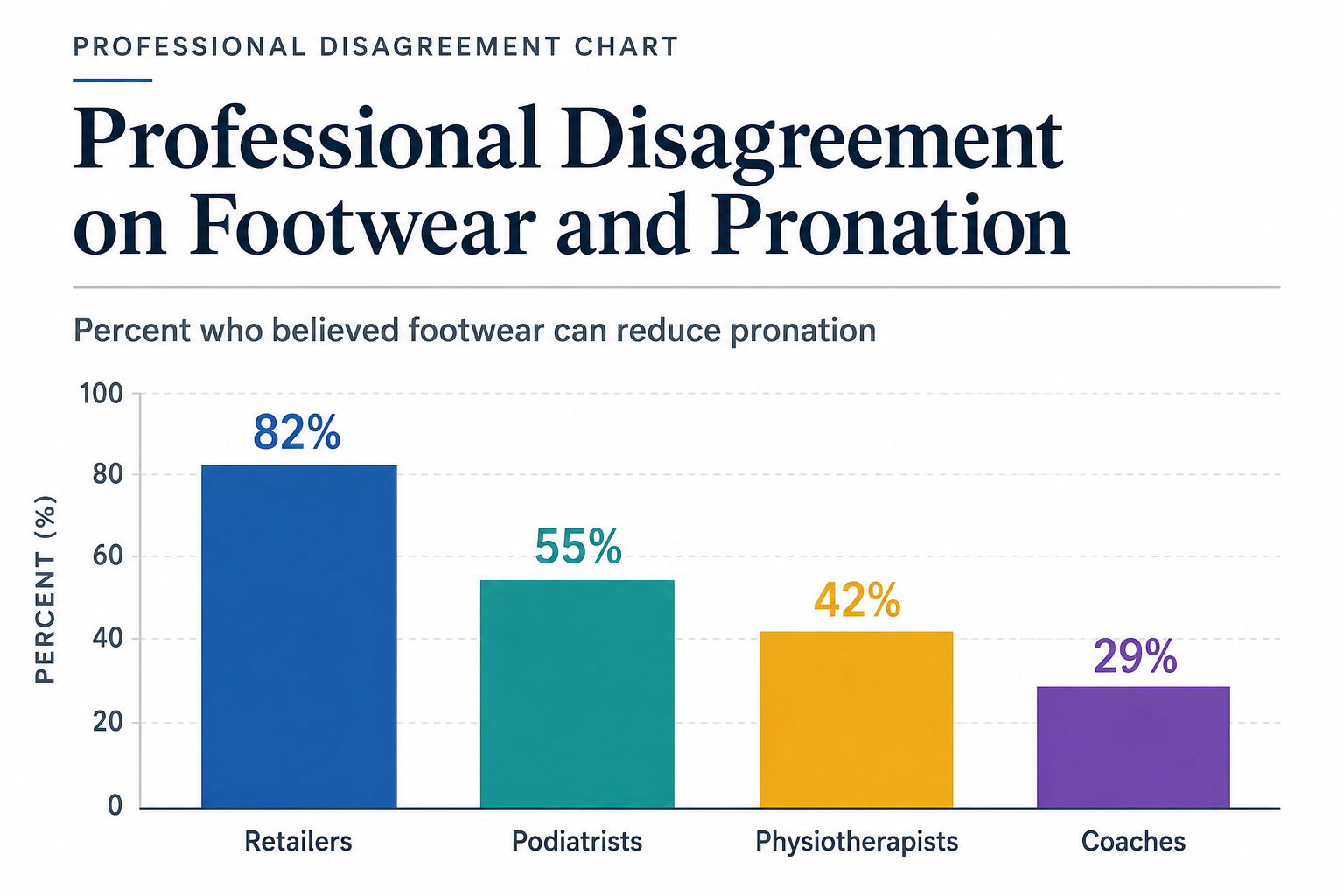
The contradiction is not just online. It starts with the professionals.
A 2025 PubMed study found that 82 percent of retailers believed footwear could reduce pronation, compared with 55 percent of podiatrists, 42 percent of physiotherapists, and 29 percent of coaches. These groups are all giving footwear advice to people with foot pain. They are not answering the same question.
Different sources are operating from different frameworks entirely
The deeper reason the advice contradicts itself is not that different sources have different facts. It is that they are using different theoretical frameworks for what shoes are supposed to accomplish.
A Frontiers review examining running injury paradigms identified four major frameworks through which footwear has been recommended over decades of research. The pronation control framework holds that controlling excessive inward roll of the foot reduces injury and pain. The impact force modification framework holds that reducing the shock of each footstrike is the primary protective mechanism. The habitual joint motion framework holds that shoes should accommodate the foot's natural movement pattern rather than correcting it. The comfort filter framework holds that the best shoe for any individual is simply the one that feels most comfortable, because comfort is a reliable proxy for biomechanical compatibility. The review concluded that evidence supporting any single one of these paradigms is generally limited.
This means that when a stability brand recommends motion control for plantar fasciitis, it is operating from the pronation control framework. When a cushioning brand recommends maximum stack height for the same condition, it is operating from the impact force modification framework. When a barefoot brand recommends minimalist footwear to allow natural movement, it is operating from the habitual joint motion framework. When a running store employee tells you to pick what feels best on your foot, they are applying the comfort filter.
None of these are simply wrong. Each has a body of research behind it. Each applies more reliably to some presentations than others. The problem is that a consumer searching for foot pain advice encounters all four frameworks simultaneously, often without any indication that they are frameworks at all rather than facts. The advice appears to contradict itself. It is actually answering four different versions of the same question.
Every source has a different incentive for the recommendation it makes
Online foot pain advice comes from a wide range of sources with structurally different reasons for the recommendations they make. Understanding those incentives does not mean dismissing the advice. It means reading it with appropriate context.
A podiatry clinic recommending arch support is drawing on clinical experience with the patients who present to their practice, which skews toward people with significant pain and established conditions. A running brand recommending its stability category is drawing on biomechanical research conducted primarily on runners, which may not transfer to someone who walks rather than runs. A barefoot shoe company recommending minimalist footwear is drawing on research supporting foot strengthening and natural movement, which is relevant for healthy feet in transition and significantly less relevant for an acutely inflamed plantar fascia that needs protection. An affiliate review site recommending the top-selling shoes in a category is drawing on popularity and commission structure, not clinical outcomes.
A wellness influencer recommending the shoes that resolved their personal foot pain is drawing on a sample size of one, with a specific condition, a specific foot structure, and a specific activity pattern that may share nothing with yours beyond the name of the condition. Their experience is real. Their recommendation is not generalizable. But online it looks identical to a clinical guideline.
None of this means the advice is useless. Podiatric clinical experience, biomechanical running research, foot strengthening science, and personal testimonials all contain real and useful information. The problem is that they are presented without the frame that would allow a reader to know which one applies to them. That frame is always the specific condition, the specific foot type, and the specific mechanical cause of the pain.
The shoe review ecosystem was built to answer the wrong question
The majority of shoe reviews evaluate comfort, durability, cushioning feel, ride quality, style, and value. These are legitimate criteria for people choosing shoes for general use. They are largely irrelevant for someone trying to determine whether a specific shoe will address the mechanical cause of a specific foot condition.
A shoe that scores highly on comfort may achieve that comfort through maximal softness that collapses under the asymmetric load of an overpronating foot, providing no resistance to the arch collapse driving the plantar fasciitis. A shoe that scores highly on cushioning feel may achieve that through a high-stack neutral foam that feels excellent on a carpeted showroom floor and fails to control the motion that is loading the posterior tibial tendon over a ten-hour workday.
The review is not wrong about the shoe. The shoe is comfortable. The review is wrong about what the reader actually needs to know. Comfort in the store is not a reliable proxy for mechanical appropriateness for a specific condition. As the softness versus stability article explains in detail, these are different properties that do different jobs. A review system built around comfort will consistently miss the distinction.
The MySoleMatch evaluation framework starts from the opposite end. It maps the structural requirements of the condition first and then identifies shoes whose construction matches those requirements. Comfort is a secondary check, not the primary filter. The question is not whether the shoe feels good. The question is whether the shoe addresses the mechanical cause of the condition it is being considered for.
Plantar fasciitis as the clearest illustration of all of this
No foot condition better illustrates why online advice contradicts itself than plantar fasciitis. It is the most commonly searched foot pain condition. It has more published advice than almost any other foot problem. And it produces more contradictory recommendations than almost anything else in the footwear space.
The American Academy of Family Physicians states directly in a peer-reviewed evidence review that no evidence strongly supports the effectiveness of any single treatment for plantar fasciitis, and that most patients improve without specific therapy or by using conservative measures. Clinical literature lists at least ten distinct conservative treatment approaches including rest, NSAIDs, stretching, shoe modifications, orthotics, corticosteroid injections, physical therapy, night splints, shock wave therapy, and ultrasound, with varying effectiveness across different patient presentations.
Cleveland Clinic recommends cushioning combined with heel and arch support. Barefoot footwear advocates recommend minimal structure and natural foot movement. A 2025 PMC review covering plantar fasciitis treatments from 2020 to 2025 categorized thirty distinct treatment approaches across four phases of management. They are not all wrong. They are not all talking about the same patient.
A person with acute plantar fasciitis, significant inflammation, and flat-arch overpronation needs protective, structured footwear with motion control as an immediate intervention. A person with chronic, low-grade plantar fasciitis and a history of wearing highly structured shoes may genuinely benefit from gradually transitioning toward less structured footwear that allows the foot's intrinsic muscles to strengthen over time. These are not contradictory treatment strategies. They are sequential or parallel strategies for different phases and presentations of the same diagnosis. Online they appear as contradictions because the phase, severity, foot type, and gait pattern that determine which applies have been removed from the advice.
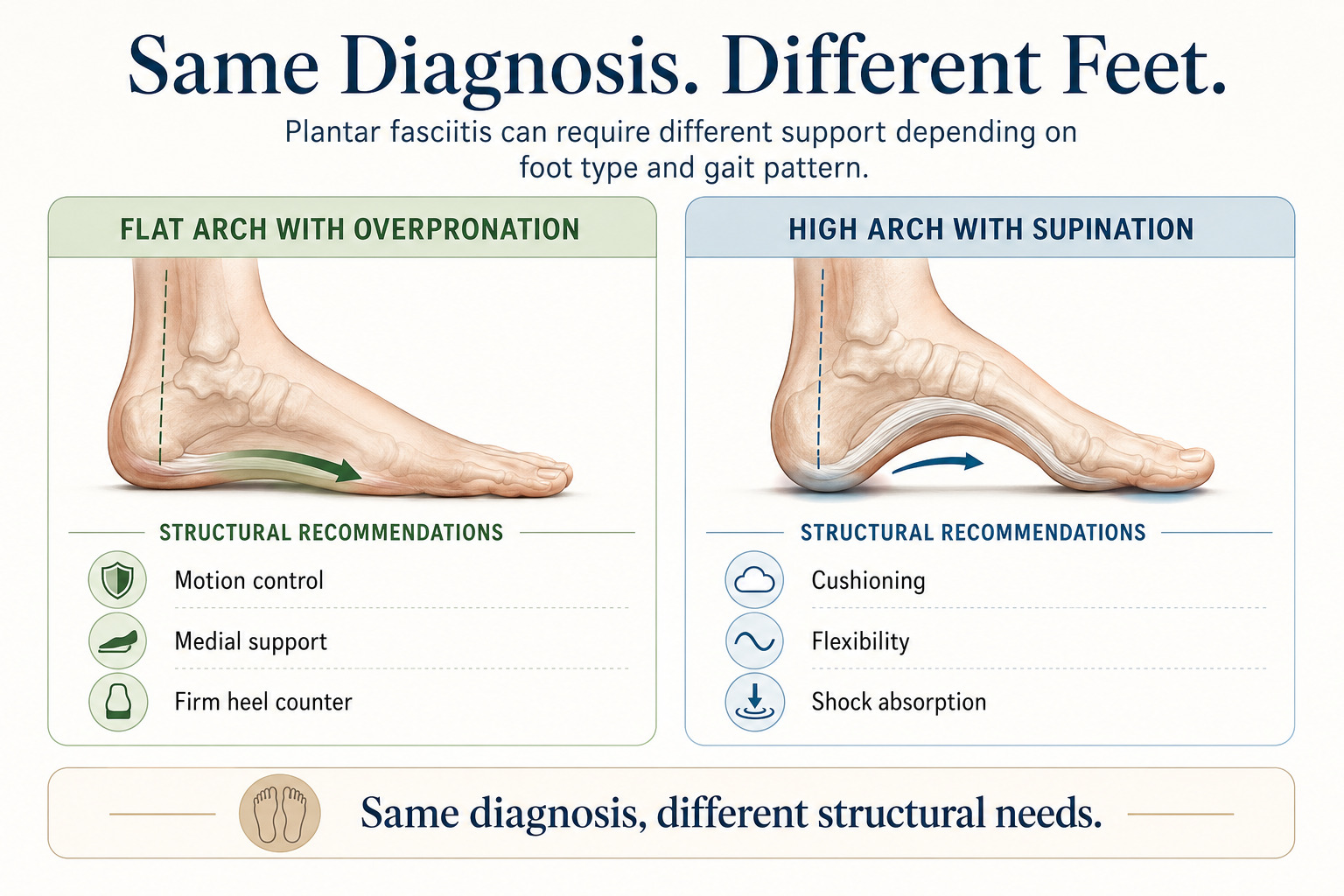
Same diagnosis. Different feet. Different answers.
Plantar fasciitis driven by overpronation and flat arches points toward motion control and medial support. The same diagnosis in a high-arched supinating foot points toward cushioning and flexibility. Online advice for plantar fasciitis rarely specifies which presentation it is addressing. That is where the contradiction comes from.
The better question is not what shoe is best for foot pain
Most online searches about foot pain are framed as product questions. What is the best shoe for plantar fasciitis? What shoe do podiatrists recommend for flat feet? What running shoe is best for people with overpronation? These are reasonable questions. They are also questions that cannot be answered accurately without knowing the specific condition, foot structure, gait pattern, activity type, and severity of the presentation.
The better question is not what shoe is best. The better question is what structural properties does my specific condition require from a shoe, and which available shoes provide those properties in a construction that fits my foot correctly. That question has a specific, answerable, non-contradictory answer for each individual. It just cannot be answered generically for a category.
This is why the word supportive fails as a guide. It answers the product question without answering the condition question. Two shoes both accurately called supportive can have opposite structural profiles and produce opposite mechanical effects on the same foot. The label is not wrong. It is simply not specific enough to be useful for anyone managing a real foot condition.
The same applies to wide toe box, stability, cushioned, orthopedic, and every other category label that appears in footwear marketing and online advice. Each describes a shoe feature or category. None describes whether that feature addresses the specific mechanical cause of a specific person's specific condition. That gap is where the frustration of searching for foot pain advice lives.
What condition-matched advice actually looks like
The internet is not going to stop producing contradictory foot pain advice. The structural reasons it exists, including the variety of conditions, the disagreement among professional disciplines, the competing theoretical frameworks, and the incentive structures of different recommendation sources, are not going away. The more useful response is to approach online advice with a framework for reading it that extracts its value without being misled by its generality.
When you encounter a recommendation, the questions worth asking are: what specific condition is this advice addressing, what foot type or gait pattern does it assume, what phase of the condition is it for, and what is the source's framework and incentive. A podiatric clinical recommendation for a patient with severe overpronation and acute plantar fasciitis is useful information if you share those specifics. It is potentially harmful guidance if you have a high arch and supination. The recommendation has not changed. Its applicability to you has.
MySoleMatch is built on a different starting point. Every condition page, every guide, and every quiz result begins with the condition and the foot type rather than the shoe. The structural requirements are mapped first. The shoes that meet those requirements are identified second. The result is not a popularity ranking or a comfort score. It is a condition-matched structural profile that describes what your foot actually needs from footwear, derived from the same clinical logic that a functional podiatric approach would apply.
If you have been searching for foot pain advice and finding contradictions, the MySoleMatch quiz is the alternative to another search. Five steps. Condition-specific. The output is a structural requirement profile for your condition and foot type, not a list of popular shoes that have good reviews. Those are different things, and for anyone managing real foot pain, the difference matters.
And if your condition is significant enough that a general framework is not sufficient, the MySoleMatch podiatrist finder can help locate a specialist who can evaluate your gait, assess your foot structure, and apply the functional approach that the research consistently shows produces better outcomes than non-functional, generic advice. Some foot conditions need a clinical evaluation. No quiz or article, including this one, is a substitute for that when it is warranted.
The one thing that resolves the contradiction
Every contradictory piece of foot pain advice online becomes less contradictory when you add the context it removed. The advice that says wear stability shoes is correct for overpronating flat feet with motion-driven plantar fasciitis. The advice that says wear cushioned neutral shoes is correct for high-arched supinating feet with impact-driven heel pain. The advice that says transition to minimalist shoes is correct for healthy feet in a gradual strengthening program with appropriate time and guidance. The advice that says see a podiatrist first is correct for anyone with severe, chronic, or medically complex foot conditions.
None of it contradicts the others when the condition, foot type, and context are restored. The contradiction is not in the advice. It is in the removal of context that makes the advice look general when it is specific.
Foot pain advice starts making sense when it starts with the foot rather than the shoe. That is the only reframe that consistently resolves the contradiction. And it is the principle that every article, every condition guide, and every quiz result on this platform is built around.